Respiration – Human Respiratory System: NEET MCQs with Answers
11 free questions on Respiration – Human Respiratory System for NEET (UG), starting with previous-year NEET and AIPMT questions. Try each one, then tap Show answer for the answer and a short explanation.
Syllabus covered: Human Respiratory System
Question 1
Previous-year questionThe correct path along which air is breathed in is [AIPMT 1994]
- trachea → lungs → larynx → pharynx → alveoli
- nose → larynx → pharynx → bronchus → alveoli → bronchioles
- nostrils → pharynx → larynx → trachea → bronchi → bronchioles → alveoli
- nose → mouth → lungs
Show answer
Answer: (C) nostrils → pharynx → larynx → trachea → bronchi → bronchioles → alveoli
Explanation: In the mammalian respiratory system, air enters through the nostrils and passes through the pharynx (the common passage for food and air) → larynx (voice box) → trachea (wind pipe) → bronchi (two, one for each lung) → bronchioles → alveoli, the small sacs where gaseous exchange occurs.
Question 2
Previous-year questionWhich one of the following organs of the human body is the most severely affected by a shortage of oxygen? [AIPMT 1999]
- Intestine
- Skin
- Kidney
- Brain
Show answer
Answer: (D) Brain
Explanation: Brain cells are highly specialised, cannot regenerate and cannot respire anaerobically. Even a brief interruption of oxygen supply therefore causes irreversible death of brain cells, making the brain the organ most vulnerable to hypoxia.
Question 3
Previous-year questionWhich of the following is NOT a function of the conducting part of the respiratory system? [NEET 2022]
- Inhaled air is humidified
- The temperature of inhaled air is brought to body temperature
- It provides a surface for the diffusion of O₂ and CO₂
- It clears inhaled air of foreign particles
Show answer
Answer: (C) It provides a surface for the diffusion of O₂ and CO₂
Explanation: The conducting part — nasopharynx, larynx, trachea, bronchi, bronchioles and terminal bronchioles — merely provides a passage for air and conditions it by warming, moistening and cleaning it. Providing a surface for the diffusion of O₂ and CO₂ is the job of the respiratory (exchange) portion, i.e. the alveoli.
Question 4
Previous-year questionAir is breathed through the following sequence of structures: [1995]
- nostrils — pharynx — larynx — trachea — bronchi — bronchioles — alveoli
- trachea — lungs — larynx — pharynx — alveoli
- nose — mouth — lungs
- nose — larynx — pharynx — bronchus — alveoli — bronchioles
Show answer
Answer: (A) nostrils — pharynx — larynx — trachea — bronchi — bronchioles — alveoli
Explanation: Air entering the external nostrils passes through the nasal chamber into the pharynx, then through the larynx into the trachea, which divides into the two primary bronchi. These branch repeatedly into bronchioles, ending in the terminal bronchioles and the alveoli, where exchange of gases takes place.
Question 5
Previous-year questionA diagrammatic view of the human respiratory system has labels A, B, C and D. Select the correct identification with its function/characteristic. [NEET, 2013]
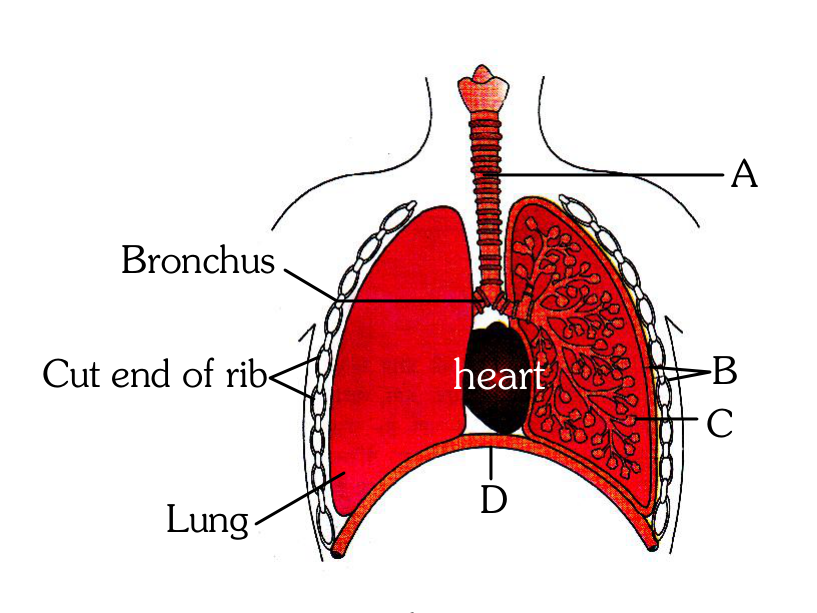
- D - Lower end of lungs - diaphragm pulls it down during inspiration.
- A - Trachea - long tube supported by complete cartilaginous rings for conducting inspired air.
- B - Pleural membrane - surrounds ribs on both sides to provide cushion against rubbing.
- C - Alveoli - thin walled vascular bag-like structures for exchange of gases.
Show answer
Answer: (D) C - Alveoli - thin walled vascular bag-like structures for exchange of gases.
Explanation: The alveoli are thin-walled, richly vascularised bag-like structures — the actual site of gas exchange. (Note: tracheal rings are incomplete, not complete.) Hence option D.
Question 6
Previous-year questionDuring swallowing of food, which structure prevents the entering of food into the glottis? [AIPMT (Pre.), 2012]
- Semilunar Valve
- Circular Muscular flap
- Cartilaginous flap
- Circular sphincter
Show answer
Answer: (C) Cartilaginous flap
Explanation: The epiglottis, a cartilaginous flap, folds over the glottis during swallowing to prevent food from entering the respiratory tract.
Question 7
Previous-year questionTwo friends are eating together. One suddenly starts coughing while swallowing food. This coughing would have been due to improper movement of [AIPMT (Pre.), 2011]
- Epiglottis
- Diaphragm
- Neck
- Tongue
Show answer
Answer: (A) Epiglottis
Explanation: During swallowing the epiglottis covers the glottis. If it fails to close properly, food enters the larynx and triggers a protective cough.
Doing well? Create a free account to take timed tests on this topic and see your weak areas.
Question 8
Previous-year questionBowman's glands are located in the [AIPMT, 2007]
- Olfactory epithelium of our nose
- Proximal end of uriniferous tubules
- Anterior pituitary
- Female reproductive system of cockroach
Show answer
Answer: (A) Olfactory epithelium of our nose
Explanation: Bowman's glands lie within the olfactory epithelium of the nose (do not confuse with Bowman's capsule of the nephron).
Question 9
Previous-year questionBowman's glands are found in [AIPMT, 2006]
- Olfactory epithelium
- External auditory canal
- Cortical nephrons only
- Juxtamedullary nephrons
Show answer
Answer: (A) Olfactory epithelium
Explanation: Bowman's (olfactory) glands are located in the olfactory epithelium of the nasal cavity, secreting mucus that dissolves odorant molecules.
Question 10
Which statement correctly distinguishes breathing from cellular respiration?
- Breathing occurs inside body cells, whereas cellular respiration occurs in the air passages
- Breathing directly releases ATP from air, whereas cellular respiration only consumes ATP
- Breathing needs a long series of oxidising enzymes, whereas cellular respiration proceeds without any enzymes
- Breathing is a physical exchange of air that yields no ATP, whereas cellular respiration is an enzyme-controlled oxidation of food that yields ATP in cells
Show answer
Answer: (D) Breathing is a physical exchange of air that yields no ATP, whereas cellular respiration is an enzyme-controlled oxidation of food that yields ATP in cells
Explanation: Breathing is the movement of atmospheric air into the lungs and of air rich in CO₂ out of them, driven by muscles, and it releases no energy. Cellular respiration takes place inside cells, where enzymes oxidise food molecules with the release of energy trapped as ATP. The two are linked, since breathing supplies the O₂ that cells use and removes the CO₂ they form.
Question 11
Moving inward from the chest wall towards the human lung, in which order are the following layers met?
- Thoracic lining, inner pleural membrane, pleural fluid, outer pleural membrane, lung surface
- Thoracic lining, outer pleural membrane, inner pleural membrane, pleural fluid, lung surface
- Thoracic lining, outer pleural membrane, pleural fluid, inner pleural membrane, lung surface
- Thoracic lining, pleural fluid, outer pleural membrane, inner pleural membrane, lung surface
Show answer
Answer: (C) Thoracic lining, outer pleural membrane, pleural fluid, inner pleural membrane, lung surface
Explanation: Each lung is covered by a double-layered pleura. The outer pleural membrane is in close contact with the thoracic lining, and the inner pleural membrane is in contact with the lung surface. Pleural fluid lies between the two membranes and reduces friction on the lung surface.
Want more Respiration – Human Respiratory System questions?
E-GYAN NIDHI has 127 questions on this topic and 63,000+ in total, all free: timed CBT tests, NEET marking and instant analysis.
Register free Free Sunday Mock TestMore topics in Human Physiology
- Respiration – Respiratory Volumes and Capacities MCQs
- Body Fluids and Circulation – Blood MCQs
- Excretion – Modes of Excretion MCQs
- Locomotion and Movement – Disorders of muscular and skeletal system-Myasthenia gravis MCQs
- Neural Control and Coordination – Central Neural System MCQs
- Endocrine System – Chemical Coordination and Integration MCQs
- Respiration – Mechanism of Breathing its regulation in humans MCQs
- Respiration – Exchange of Gases MCQs
- Respiration – Transport of Gases and Regulation of Respiration MCQs
- Respiration – Disorders of Respiratory System MCQs
- Body Fluids and Circulation – Circulatory Pathways MCQs
- Body Fluids and Circulation – Regulation of Cardiac Activity MCQs
- Body Fluids and Circulation – Disorders of Circulatory System MCQs
- Excretion – Human Excretory System MCQs
- Excretion – Urine Formation MCQs
- Excretion – Function of Tubules MCQs
- Excretion – Mechanism of Concentration of the Filtrate MCQs
- Excretion – Regulation of Kidney Function MCQs
- Excretion – Disorders of Excretory System MCQs
- Locomotion and Movement – Joints MCQs
- Locomotion and Movement – Skeletal System and its functions (To be dealt with the MCQs
- Locomotion and Movement – Skeletal Muscle and Its Contraction MCQs
- Endocrine System – Mechanism of Hormone Action (Elementary Idea) MCQs
- Endocrine System – Hypo-and hyperactivity and related disorders (Common MCQs
- Neural Control and Coordination – Neuron as Structural and Functional Unit of Neural System MCQs
- Neural Control and Coordination – Human Neural System MCQs