Excretion – Function of Tubules: NEET MCQs with Answers
15 free questions on Excretion – Function of Tubules for NEET (UG), starting with previous-year NEET and AIPMT questions. Try each one, then tap Show answer for the answer and a short explanation.
Syllabus covered: Function of Tubules
Question 1
Previous-year questionWhich of the diagrams given below correctly shows the transport across the proximal (P) and distal (D) tubules of the nephron? [NEET 2025]
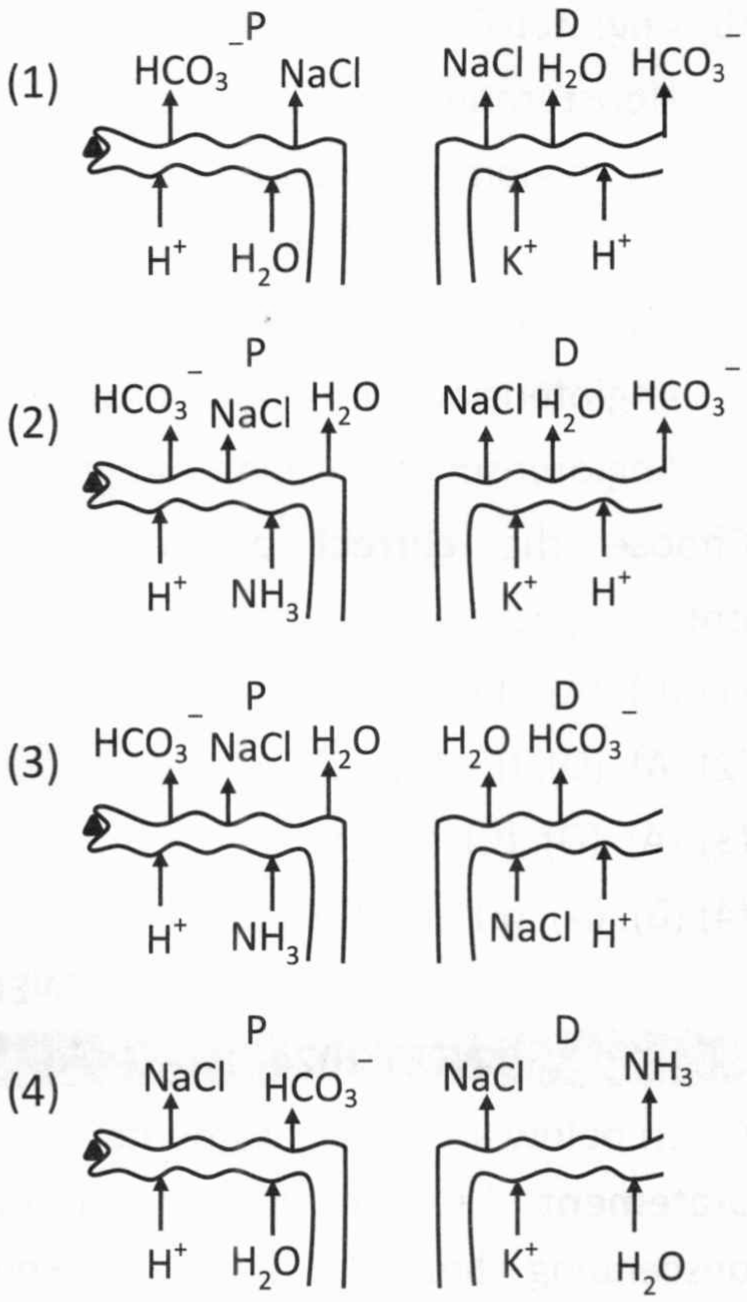
- Figure (1)
- Figure (2)
- Figure (3)
- Figure (4)
Show answer
Answer: (B) Figure (2)
Explanation: In the PCT, HCO₃⁻, NaCl and H₂O are reabsorbed, while H⁺ and NH₃ are secreted into the filtrate. In the DCT, conditional reabsorption of NaCl and H₂O takes place, HCO₃⁻ is reabsorbed, and K⁺ and H⁺ are secreted. The correct diagram shows exactly these movements. The wrong diagrams show H₂O moving into the filtrate in the PCT, NaCl moving into the filtrate in the DCT, or NH₃ reabsorbed and H₂O secreted in the DCT.
Question 2
Previous-year questionWhich region of the human nephron is impermeable to water? [NEET 2024 (Sawaimadhopur)]
- Distal convoluted tubule
- Ascending limb of loop of Henle
- Descending limb of loop of Henle
- Proximal convoluted tubule
Show answer
Answer: (B) Ascending limb of loop of Henle
Explanation: The ascending limb of Henle's loop is impermeable to water and only transports electrolytes, which dilutes the filtrate. The descending limb and PCT are permeable to water, and the DCT conditionally reabsorbs water.
Question 3
Previous-year questionAssertion: The ascending limb of the loop of Henle is impermeable to water and allows transport of electrolytes actively or passively. [NEET 2023 (Manipur)]
Reason: Dilution of the filtrate occurs because of the efflux of electrolytes into the medullary fluid.
Reason: Dilution of the filtrate occurs because of the efflux of electrolytes into the medullary fluid.
- Assertion is true but the Reason is false.
- Assertion is false but the Reason is true.
- Both Assertion and Reason are true and the Reason is a correct explanation of the Assertion.
- Both Assertion and Reason are true but the Reason is not a correct explanation of the Assertion.
Show answer
Answer: (C) Both Assertion and Reason are true and the Reason is a correct explanation of the Assertion.
Explanation: Both statements are true: the ascending limb of Henle's loop is impermeable to water but transports electrolytes actively or passively. Because electrolytes move out into the medullary fluid while water cannot follow, the filtrate becomes diluted as it ascends, so R correctly explains A.
Question 4
Previous-year questionIdentify the correct statement. [NEET 2017]
- The descending limb of loop of Henle is impermeable to water.
- The ascending limb of loop of Henle is permeable to water.
- The descending limb of loop of Henle is permeable to electrolytes.
- The ascending limb of loop of Henle is impermeable to water.
Show answer
Answer: (D) The ascending limb of loop of Henle is impermeable to water.
Explanation: According to NCERT, the ascending limb of Henle's loop is impermeable to water but allows transport of electrolytes actively or passively, so the filtrate becomes dilute as it moves up. The descending limb is the reverse – permeable to water and almost impermeable to electrolytes – so the other options are wrong.
Question 5
Previous-year questionIf Henle's loop were absent from the mammalian nephron, which of the following is to be expected? [AIPMT 2003]
- The urine will be more concentrated
- The urine will be more dilute
- There will be no urine formation
- There will be hardly any change in the quality and quantity of urine formed
Show answer
Answer: (B) The urine will be more dilute
Explanation: The main function of Henle's loop is to absorb water from the tubular lumen, which concentrates the urine. If the loop of Henle were absent, this concentrating mechanism would be lost and the urine would become more dilute.
Question 6
Previous-year questionThe maximum amount of electrolytes and water (70–80%) from the glomerular filtrate is reabsorbed in which part of the nephron? [AIPMT 2012]
- Ascending limb of loop of Henle
- Distal convoluted tubule
- Proximal convoluted tubule
- Descending limb of loop of Henle
Show answer
Answer: (C) Proximal convoluted tubule
Explanation: From Bowman's capsule the glomerular filtrate enters the proximal convoluted tubule, which is surrounded by a network of peritubular capillaries and is the seat of reabsorption. About 75% of the glomerular filtrate — including glucose, amino acids, vitamins, sodium, potassium, chlorides, phosphates, bicarbonates, most of the water and some urea — is reabsorbed in the PCT before the filtrate reaches the loop of Henle.
Question 7
Previous-year questionRemoval of the proximal convoluted tubule from the nephron will result in [AIPMT 2015]
- no change in quality and quantity of urine
- no urine formation
- more diluted urine
- more concentrated urine
Show answer
Answer: (C) more diluted urine
Explanation: If the proximal convoluted tubule were removed, the kidney would malfunction. In the absence of the reabsorption normally carried out there, far more water and solute would remain in the filtrate and the urine would be much more dilute.
Doing well? Create a free account to take timed tests on this topic and see your weak areas.
Question 8
Previous-year questionThe part of the nephron involved in the active reabsorption of sodium is the [NEET 2016, Phase II]
- distal convoluted tubule
- proximal convoluted tubule
- Bowman's capsule
- descending limb of Henle's loop
Show answer
Answer: (B) proximal convoluted tubule
Explanation: The proximal convoluted tubule is the site of active reabsorption of sodium. The majority — about 70% — of the filtered sodium is reabsorbed here, into the cytosol of the epithelial cells of the nephron.
Question 9
Previous-year questionWhich of the following statements is correct? [NEET 2017]
- The ascending limb of the loop of Henle is impermeable to water
- The descending limb of the loop of Henle is impermeable to water
- The ascending limb of the loop of Henle is permeable to water
- The descending limb of the loop of Henle is permeable to electrolytes
Show answer
Answer: (A) The ascending limb of the loop of Henle is impermeable to water
Explanation: The ascending limb of the loop of Henle is impermeable to water but permeable to K⁺, Cl⁻ and Na⁺ and partially permeable to urea. Because sodium, potassium, calcium, magnesium and chloride are reabsorbed here, the filtrate becomes hypotonic. The descending limb is the opposite — highly permeable to water but much less so to urea and ions.
Question 10
Previous-year questionMatch the following parts of a nephron with their function. Column I — 1. Descending limb of Henle's loop; 2. Proximal convoluted tubule; 3. Ascending limb of Henle's loop; 4. Distal convoluted tubule Column II — (i) Reabsorption of salts only; (ii) Reabsorption of water only; (iii) Conditional reabsorption of sodium ion and water; (iv) Reabsorption of ion, water and organic nutrients [NEET (Odisha) 2019]
- 1-(i), 2-(iii), 3-(ii), 4-(iv)
- 1-(ii), 2-(iv), 3-(i), 4-(iii)
- 1-(i), 2-(iv), 3-(ii), 4-(iii)
- 1-(iv), 2-(i), 3-(iii), 4-(ii)
Show answer
Answer: (B) 1-(ii), 2-(iv), 3-(i), 4-(iii)
Explanation: The descending limb of Henle's loop is permeable to water only (1-ii). The proximal convoluted tubule reabsorbs ions, water and organic nutrients (2-iv). The ascending limb reabsorbs salts only, being impermeable to water (3-i). The distal convoluted tubule carries out the conditional reabsorption of sodium ions and water (4-iii).
Question 11
Previous-year questionGiven below are two statements. Statement I: In the nephron, the descending limb of the loop of Henle is impermeable to water and permeable to electrolytes. Statement II: The proximal convoluted tubule is lined by simple columnar brush border epithelium and increases the surface area for reabsorption. In the light of the above statements, choose the correct answer from the options given below. [NEET 2024]
- Both statement I and statement II are true
- Both statement I and statement II are false
- Statement I is true, but statement II is false
- Statement I is false, but statement II is true
Show answer
Answer: (B) Both statement I and statement II are false
Explanation: Both statements are false. The descending limb of the loop of Henle is permeable to water but almost impermeable to electrolytes — exactly the reverse of what Statement I says. And the PCT is lined by simple cuboidal brush-border epithelium, not columnar, although it is true that this increases the surface area for reabsorption.
Question 12
Previous-year questionIf the kidneys failed to reabsorb water, the effect on the tissues would be that they [1994]
- absorb water from the blood plasma
- remain unaffected
- take more oxygen from the blood
- shrink and shrivel
Show answer
Answer: (D) shrink and shrivel
Explanation: If tubular reabsorption of water failed, huge volumes of dilute urine would be lost and the blood would become concentrated. Water would then be drawn osmotically out of the tissues, so the cells would shrink and the body would become severely dehydrated.
Question 13
Previous-year questionWhich statement regarding excretion by the human kidneys is correct? [2010]
- Nearly 99 per cent of the glomerular filtrate is reabsorbed by the renal tubules
- The descending limb of the loop of Henle is impermeable to water
- The ascending limb of the loop of Henle is impermeable to electrolytes
- The distal convoluted tubule is incapable of reabsorbing bicarbonate
Show answer
Answer: (A) Nearly 99 per cent of the glomerular filtrate is reabsorbed by the renal tubules
Explanation: About 180 litres of filtrate are formed daily but only about 1.5 litres of urine are released, so nearly 99 per cent is reabsorbed. The descending limb of Henle's loop is permeable to water but almost impermeable to electrolytes, while the ascending limb is the reverse, and the DCT can reabsorb bicarbonate.
Question 14
Previous-year questionUnder normal conditions, which one is completely reabsorbed in the renal tubule? [1991]
- Salts
- Urea
- Glucose
- Uric acid
Show answer
Answer: (C) Glucose
Explanation: Glucose is entirely reclaimed in the proximal tubule, so that normal urine contains none; its appearance signals either hyperglycaemia beyond the renal threshold or tubular damage. Salts are reabsorbed selectively according to need, while urea and uric acid are excreted.
Question 15
Previous-year questionGlucose is taken back from the glomerular filtrate through [1990]
- osmosis
- active transport
- diffusion
- passive transport
Show answer
Answer: (B) active transport
Explanation: Glucose is reabsorbed against its concentration gradient by a sodium-linked cotransporter in the proximal tubule, the energy coming indirectly from the sodium-potassium pump. Because the carriers are limited in number, glucose appears in the urine once the blood level exceeds the renal threshold.
Want more Excretion – Function of Tubules questions?
E-GYAN NIDHI has 108 questions on this topic and 63,000+ in total, all free: timed CBT tests, NEET marking and instant analysis.
Register free Free Sunday Mock TestMore topics in Human Physiology
- Respiration – Respiratory Volumes and Capacities MCQs
- Body Fluids and Circulation – Blood MCQs
- Excretion – Modes of Excretion MCQs
- Locomotion and Movement – Disorders of muscular and skeletal system-Myasthenia gravis MCQs
- Neural Control and Coordination – Central Neural System MCQs
- Endocrine System – Chemical Coordination and Integration MCQs
- Respiration – Human Respiratory System MCQs
- Respiration – Mechanism of Breathing its regulation in humans MCQs
- Respiration – Exchange of Gases MCQs
- Respiration – Transport of Gases and Regulation of Respiration MCQs
- Respiration – Disorders of Respiratory System MCQs
- Body Fluids and Circulation – Circulatory Pathways MCQs
- Body Fluids and Circulation – Regulation of Cardiac Activity MCQs
- Body Fluids and Circulation – Disorders of Circulatory System MCQs
- Excretion – Human Excretory System MCQs
- Excretion – Urine Formation MCQs
- Excretion – Mechanism of Concentration of the Filtrate MCQs
- Excretion – Regulation of Kidney Function MCQs
- Excretion – Disorders of Excretory System MCQs
- Locomotion and Movement – Joints MCQs
- Locomotion and Movement – Skeletal System and its functions (To be dealt with the MCQs
- Locomotion and Movement – Skeletal Muscle and Its Contraction MCQs
- Endocrine System – Mechanism of Hormone Action (Elementary Idea) MCQs
- Endocrine System – Hypo-and hyperactivity and related disorders (Common MCQs
- Neural Control and Coordination – Neuron as Structural and Functional Unit of Neural System MCQs
- Neural Control and Coordination – Human Neural System MCQs