Excretion – Human Excretory System: NEET MCQs with Answers
15 free questions on Excretion – Human Excretory System for NEET (UG), starting with previous-year NEET and AIPMT questions. Try each one, then tap Show answer for the answer and a short explanation.
Syllabus covered: Human Excretory System: structure and fuction
Question 1
Previous-year questionThe structure shown in the figure given below is: [NEET 2021 (Paper-2)]
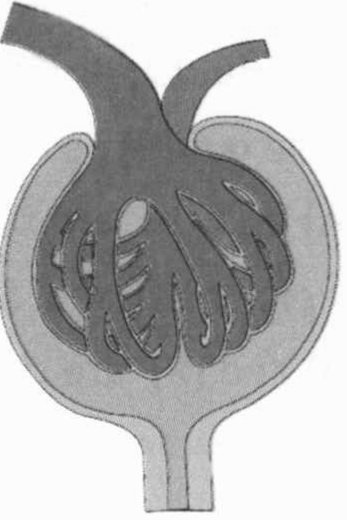
- Glomerulus
- Bowman's capsule
- Malpighian body
- Renal capsule
Show answer
Answer: (C) Malpighian body
Explanation: The figure shows a tuft of glomerular capillaries enclosed by the double-walled cup-shaped Bowman's capsule. Together, the glomerulus and Bowman's capsule form the Malpighian body (renal corpuscle). Glomerulus or Bowman's capsule alone is only one part, and 'renal capsule' is the fibrous covering of the whole kidney.
Question 2
Previous-year questionReabsorption of useful substances from the glomerular filtrate occurs in the [AIPMT 1989]
- collecting tube
- loop of Henle
- proximal convoluted tubule
- distal convoluted tubule
Show answer
Answer: (C) proximal convoluted tubule
Explanation: The proximal convoluted tubule, lined by brush-border cuboidal epithelium, is the main site of reabsorption: nearly all essential nutrients such as glucose and amino acids and about 70-80 percent of electrolytes and water are reabsorbed here.
Question 3
Previous-year questionThe brush border is characteristic of the [AIPMT 1990]
- neck of the nephron
- collecting tube
- proximal convoluted tubule
- All of the above
Show answer
Answer: (C) proximal convoluted tubule
Explanation: The proximal convoluted tubule is present in the cortex, is about 12–24 mm long and is lined by brush-bordered cuboidal epithelium with numerous microvilli that greatly increase the surface area for reabsorption. These cells also have numerous mitochondria to power active transport.
Question 4
Previous-year questionThe proximal and distal convoluted tubules are parts of the [AIPMT 1990]
- seminiferous tubules
- nephron
- oviduct
- vas deferens
Show answer
Answer: (B) nephron
Explanation: The nephron is the structural and functional unit of the kidney and is also called the renal or uriniferous tubule. It is formed of two parts — Bowman's capsule, and the nephric tubule, which comprises the proximal convoluted tubule, loop of Henle and distal convoluted tubule.
Question 5
Previous-year questionUnder normal conditions, which one is completely reabsorbed in the renal tubule? [AIPMT 1991]
- Urea
- Uric acid
- Salts
- Glucose
Show answer
Answer: (D) Glucose
Explanation: Glucose is a high-threshold substance, meaning that it is totally or almost totally reabsorbed from the nephric filtrate into the blood capillaries. The renal threshold for glucose is about 180 mg/100 mL of nephric filtrate; above this level, sugar begins to appear in the urine.
Question 6
Previous-year questionWhich part does NOT belong to the uriniferous tubule? [AIPMT 1994]
- Glomerulus
- Henle's loop
- Distal convoluted tubule
- Collecting tubule
Show answer
Answer: (A) Glomerulus
Explanation: The glomerulus does not belong to the uriniferous tubule. Each nephron is divided into the nephric or uriniferous tubule and the glomerulus; the latter is a tuft of about 50 capillaries whose walls have numerous minute pores, making the glomerular membrane 100–500 times as permeable as a usual capillary. Henle's loop, the DCT and the collecting tubule are all parts of the uriniferous tubule.
Question 7
Previous-year questionThe basic functional unit of the human kidney is the [AIPMT 1997]
- nephron
- pyramid
- nephridia
- Henle's loop
Show answer
Answer: (A) nephron
Explanation: Each human kidney consists of about one million structural and functional units called nephrons. Each nephron has two main parts — the Malpighian body (glomerulus and Bowman's capsule) and the renal tubule. Nephridia, by contrast, are the excretory tubules of flatworms and annelids.
Doing well? Create a free account to take timed tests on this topic and see your weak areas.
Question 8
Previous-year questionThe principal nitrogenous excretory compound in humans is synthesised [AIPMT 2010]
- in kidneys, but eliminated mostly through the liver
- in kidneys as well as eliminated by kidneys
- in the liver and also eliminated by the same through bile
- in the liver, but eliminated mostly through the kidneys
Show answer
Answer: (D) in the liver, but eliminated mostly through the kidneys
Explanation: In humans the principal nitrogenous excretory compound is urea. It is synthesised in the liver by the ornithine cycle and is then transported by the blood to the kidneys, through which it is eliminated.
Question 9
Previous-year questionWhich one of the following is not a part of the renal pyramid? [AIPMT 2011]
- Peritubular capillaries
- Convoluted tubules
- Collecting ducts
- Loop of Henle
Show answer
Answer: (B) Convoluted tubules
Explanation: The convoluted tubules are not part of the renal pyramid; they lie in the cortex of the kidney. The medulla is divided into a number of conical areas called medullary or renal pyramids, and the peritubular capillaries, loop of Henle and collecting ducts all lie within the medulla.
Question 10
Previous-year questionWhich one of the following correctly explains the function of a specific part of a human nephron? [AIPMT 2011]
- Henle's loop — Most reabsorption of the major substances from the glomerular filtrate
- Distal convoluted tubule — Reabsorption of ions into the surrounding blood capillaries
- Afferent arteriole — Carries the blood away from the glomerulus towards the renal vein
- Podocytes — Create minute spaces (slit pores) for the filtration of blood into the Bowman's capsule
Show answer
Answer: (D) Podocytes — Create minute spaces (slit pores) for the filtration of blood into the Bowman's capsule
Explanation: Podocytes, or visceral epithelial cells, are the cells of Bowman's capsule that wrap around the glomerular capillaries and create minute slit pores through which blood is filtered. The others need correction: afferent arterioles bring blood to the glomerulus; reabsorption in Henle's loop is minimal; and in the DCT the reabsorption of Na⁺ and water is conditional.
Question 11
Previous-year questionAssertion (A): Nephrons are of two types — cortical and juxtamedullary — based on their relative position in cortex and medulla. Reason (R): Juxtamedullary nephrons have a short loop of Henle whereas cortical nephrons have a longer loop of Henle. In the light of the above statements, choose the correct answer from the options given below. [NEET 2023]
- Both A and R are true and R is the correct explanation of A.
- Both A and R are true, but R is not the correct explanation of A.
- A is true, but R is false.
- A is false, but R is true.
Show answer
Answer: (C) A is true, but R is false.
Explanation: The Assertion is correct, but the Reason reverses the facts. Juxtamedullary nephrons have a long loop of Henle extending deep into the renal medulla, whereas cortical nephrons have a shorter loop that only reaches the outer section of the medulla.
Question 12
Previous-year questionChoose the correct statement given below regarding the juxta medullary nephron. [NEET 2024]
- Juxta medullary nephrons are located in the columns of Bertini.
- The renal corpuscle of the juxta medullary nephron lies in the outer portion of the renal medulla.
- The loop of Henle of the juxta medullary nephron runs deep into the medulla.
- Juxta medullary nephrons outnumber the cortical nephrons.
Show answer
Answer: (C) The loop of Henle of the juxta medullary nephron runs deep into the medulla.
Explanation: Juxtamedullary nephrons have a long loop of Henle that extends deep into the renal medulla — the key feature enabling the counter-current mechanism. They are not present in the columns of Bertini, their renal corpuscle lies in the inner cortical region, and they are fewer in number than cortical nephrons.
Question 13
Previous-year questionA person is undergoing prolonged fasting. The urine will be found to contain abnormal quantities of [2004]
- glucose
- fats
- ketones
- amino acids
Show answer
Answer: (C) ketones
Explanation: With carbohydrate exhausted, the body turns to stored fat, and the liver oxidises fatty acids faster than the resulting acetyl CoA can be handled by the Krebs cycle. The excess is converted into ketone bodies, which accumulate in the blood and spill over into the urine.
Question 14
Previous-year questionWhich of the following is NOT a part of the renal cortex? [2011]
- Collecting ducts
- Peritubular capillaries
- Convoluted tubules
- Bowman's capsules
Show answer
Answer: (A) Collecting ducts
Explanation: The collecting ducts run through the renal medulla, converging on the papillae of the pyramids from which urine drains into the pelvis. Bowman's capsules, both convoluted tubules and the peritubular capillary network surrounding them all lie in the cortex.
Question 15
Previous-year questionThe part NOT belonging to the uriniferous tubule is the [1994]
- distal convoluted tubule
- glomerulus
- connecting tubule
- loop of Henle
Show answer
Answer: (B) glomerulus
Explanation: The glomerulus is a tuft of blood capillaries, so it belongs to the vascular system rather than to the tubule itself. The uriniferous tubule comprises Bowman's capsule and the tubular segments that follow it, with the glomerulus merely lying within the cup of the capsule.
Want more Excretion – Human Excretory System questions?
E-GYAN NIDHI has 180 questions on this topic and 63,000+ in total, all free: timed CBT tests, NEET marking and instant analysis.
Register free Free Sunday Mock TestMore topics in Human Physiology
- Respiration – Respiratory Volumes and Capacities MCQs
- Body Fluids and Circulation – Blood MCQs
- Excretion – Modes of Excretion MCQs
- Locomotion and Movement – Disorders of muscular and skeletal system-Myasthenia gravis MCQs
- Neural Control and Coordination – Central Neural System MCQs
- Endocrine System – Chemical Coordination and Integration MCQs
- Respiration – Human Respiratory System MCQs
- Respiration – Mechanism of Breathing its regulation in humans MCQs
- Respiration – Exchange of Gases MCQs
- Respiration – Transport of Gases and Regulation of Respiration MCQs
- Respiration – Disorders of Respiratory System MCQs
- Body Fluids and Circulation – Circulatory Pathways MCQs
- Body Fluids and Circulation – Regulation of Cardiac Activity MCQs
- Body Fluids and Circulation – Disorders of Circulatory System MCQs
- Excretion – Urine Formation MCQs
- Excretion – Function of Tubules MCQs
- Excretion – Mechanism of Concentration of the Filtrate MCQs
- Excretion – Regulation of Kidney Function MCQs
- Excretion – Disorders of Excretory System MCQs
- Locomotion and Movement – Joints MCQs
- Locomotion and Movement – Skeletal System and its functions (To be dealt with the MCQs
- Locomotion and Movement – Skeletal Muscle and Its Contraction MCQs
- Endocrine System – Mechanism of Hormone Action (Elementary Idea) MCQs
- Endocrine System – Hypo-and hyperactivity and related disorders (Common MCQs
- Neural Control and Coordination – Neuron as Structural and Functional Unit of Neural System MCQs
- Neural Control and Coordination – Human Neural System MCQs