Body Fluids and Circulation – Blood: NEET MCQs with Answers
15 free questions on Body Fluids and Circulation – Blood for NEET (UG), starting with previous-year NEET and AIPMT questions. Try each one, then tap Show answer for the answer and a short explanation.
Syllabus covered: Blood: Composition of blood, blood groups, coagulation of blood
Question 1
Previous-year questionThe figure shows a human blood cell. Identify it and give its characteristics. [NEET 2013]
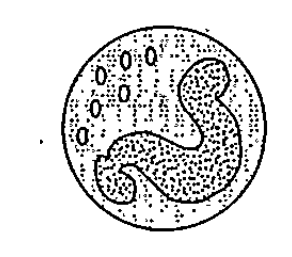
- Basophil — Secretes serotonin, inflammatory response
- B-lymphocyte — Forms about 20% of blood cells, involved in immune response
- Neutrophil — Most abundant blood cells, phagocytic
- Monocyte — Lifespan of 3 days, produces antibodies
Show answer
Answer: (A) Basophil — Secretes serotonin, inflammatory response
Explanation: The cell shown is a basophil, a granulocyte with a lobed, S-shaped nucleus and coarse granules that take a basic stain. Basophils are the least numerous leucocytes. They secrete histamine, serotonin and heparin and are involved in inflammatory reactions.
Question 2
Previous-year questionFrom which of the following blood types can a person with blood group A Rh⁻ safely receive a transfusion? [Re-NEET 2024]
A. B Rh⁻
B. AB Rh⁻
C. O Rh⁻
D. A Rh⁻
E. A Rh⁺
A. B Rh⁻
B. AB Rh⁻
C. O Rh⁻
D. A Rh⁻
E. A Rh⁺
- D and E only
- D only
- A and B only
- C and D only
Show answer
Answer: (D) C and D only
Explanation: An A Rh⁻ person has anti-B antibodies and can form anti-Rh antibodies, so the donor must lack the B antigen and the Rh antigen. Hence O Rh⁻ (C) and A Rh⁻ (D) are suitable; B Rh⁻ and AB Rh⁻ carry the B antigen, and A Rh⁺ carries the Rh antigen.
Question 3
Previous-year questionWhich of the following statements about basophils are correct? [NEET 2023]
A. Basophils are the most abundant cells among the total WBCs
B. Basophils secrete histamine, serotonin and heparin
C. Basophils are involved in the inflammatory response
D. Basophils have a kidney-shaped nucleus
E. Basophils are agranulocytes
A. Basophils are the most abundant cells among the total WBCs
B. Basophils secrete histamine, serotonin and heparin
C. Basophils are involved in the inflammatory response
D. Basophils have a kidney-shaped nucleus
E. Basophils are agranulocytes
- C and E only
- B and C only
- A and B only
- D and E only
Show answer
Answer: (B) B and C only
Explanation: Basophils secrete histamine, serotonin, heparin etc. (B) and are involved in inflammatory reactions (C). They are the least abundant WBCs (0.5–1%), not the most abundant (neutrophils are); they are granulocytes, and the kidney-shaped nucleus is a feature of monocytes, not basophils.
Question 4
Previous-year questionArrange the following formed elements of human blood in decreasing order of their abundance. [Re-NEET 2022]
(a) Platelets
(b) Neutrophils
(c) Erythrocytes
(d) Eosinophils
(e) Monocytes
(a) Platelets
(b) Neutrophils
(c) Erythrocytes
(d) Eosinophils
(e) Monocytes
- (c), (a), (b), (e), (d)
- (c), (b), (a), (e), (d)
- (d), (e), (b), (a), (c)
- (a), (c), (b), (d), (e)
Show answer
Answer: (A) (c), (a), (b), (e), (d)
Explanation: Erythrocytes are most abundant (5–5.5 million/mm³), followed by platelets (1.5–3.5 lakh/mm³). Among leucocytes (6000–8000/mm³), neutrophils form 60–65%, monocytes 6–8% and eosinophils 2–3%. Hence the order is erythrocytes > platelets > neutrophils > monocytes > eosinophils.
Question 5
Previous-year questionUnder which of the following conditions does erythroblastosis foetalis occur? [NEET (COVID-19) 2020]
- Mother Rh⁺ and foetus Rh⁻
- Mother Rh⁻ and foetus Rh⁺
- Both mother and foetus Rh⁻
- Both mother and foetus Rh⁺
Show answer
Answer: (B) Mother Rh⁻ and foetus Rh⁺
Explanation: When an Rh⁻ mother carries an Rh⁺ foetus, she becomes sensitised (usually at the first delivery) and forms anti-Rh antibodies. In later pregnancies these antibodies cross the placenta and destroy foetal RBCs, causing erythroblastosis foetalis. No such reaction occurs if the mother is Rh⁺ or if both are of the same Rh type.
Question 6
Previous-year questionIn what way does serum differ from blood? [NEET-II 2016]
- It lacks clotting factors
- It lacks antibodies
- It lacks globulins
- It lacks albumins
Show answer
Answer: (A) It lacks clotting factors
Explanation: Serum is plasma without the clotting factors (e.g. fibrinogen), which are used up when blood clots. Serum still contains albumins and globulins, including antibodies (immunoglobulins).
Question 7
Previous-year questionThe breakdown product of haemoglobin is [AIPMT 1988]
- bilirubin
- iron
- biliverdin
- calcium
Show answer
Answer: (A) bilirubin
Explanation: Haemoglobin from destroyed erythrocytes splits into haem and globin. The iron of the haem is salvaged and stored as haemosiderin for reuse, while the rest of the haem group is degraded to the yellow pigment bilirubin, which is released into the blood, taken up by liver cells and secreted into the intestine, where it is metabolised to urobilinogen.
Doing well? Create a free account to take timed tests on this topic and see your weak areas.
Question 8
Previous-year questionWhich one engulfs pathogens rapidly? [AIPMT 1989]
- Acidophils
- Monocytes
- Basophils
- Neutrophils
Show answer
Answer: (D) Neutrophils
Explanation: Neutrophils are granulocytes whose cytoplasm is filled with fine granules — actually lysosomes and Golgi bodies. They are the chief phagocytic cells of the body and engulf microbes rapidly, which is why they are called the soldiers of the body.
Question 9
Previous-year questionA person with blood group A requires blood. The blood group which can be given is [AIPMT 1989]
- A and B
- A and AB
- A and O
- A, B, AB and O
Show answer
Answer: (C) A and O
Explanation: Blood group A has the A-antigen and the anti-b antibody, while blood group O has no antigens at all and can therefore be given safely. Groups B and AB carry the B antigen, which would be agglutinated by the recipient's anti-b antibody.
Question 10
Previous-year questionRemoval of calcium from freshly collected blood would [AIPMT 1989]
- cause delayed clotting
- prevent clotting
- cause immediate clotting
- prevent destruction of haemoglobin
Show answer
Answer: (B) prevent clotting
Explanation: Blood clotting begins when prothrombin, in the presence of Ca²⁺, is converted to thrombin, which in turn converts dissolved fibrinogen into fine thread-like fibrin. Since calcium is indispensable to this cascade, its removal prevents clotting altogether.
Question 11
Previous-year questionCells formed in the bone marrow include [AIPMT 1993]
- RBC
- RBC and leucocytes
- leucocytes
- lymphocytes
Show answer
Answer: (B) RBC and leucocytes
Explanation: In the developing foetus the haemopoietic tissues are the liver and spleen, but after birth the RBCs are produced mainly in the bone marrow of the long bones. Leucocyte formation (leucopoiesis) also occurs in the bone marrow, as well as in Peyer's patches, lymph nodes, thymus and spleen.
Question 12
Previous-year questionVitamin-K is required for [AIPMT 1993]
- formation of thromboplastin
- conversion of fibrinogen to fibrin
- conversion of prothrombin to thrombin
- synthesis of prothrombin
Show answer
Answer: (D) synthesis of prothrombin
Explanation: Vitamin K (phylloquinone) is required for the synthesis of prothrombin, which is in turn necessary for blood clotting. It is synthesised naturally by bacteria in the colon and is commonly called the anti-haemorrhagic vitamin; its deficiency leads to bleeding, i.e. failure of coagulation.
Question 13
Previous-year questionThe haemorrhagic disease of the new born is caused due to the deficiency of [AIPMT 1995]
- vitamin-A
- vitamin-B₁
- vitamin-B₁₂
- vitamin-K
Show answer
Answer: (D) vitamin-K
Explanation: Haemorrhagic disease of the newborn results from a deficiency of vitamin K. It is characterised by delayed blood clotting and consequent haemorrhage (blood loss).
Question 14
Previous-year questionAntigens are present [AIPMT 1995]
- inside the nucleus
- on the cell surface
- inside the cytoplasm
- on the nuclear membrane
Show answer
Answer: (B) on the cell surface
Explanation: Antigens are foreign particles present on the surface of a cell. When introduced into the blood, they initiate a specific immune response directed against themselves.
Question 15
Previous-year questionWhich one of the following vertebrate organs receives oxygenated blood only? [AIPMT 1996]
- Gill
- Lung
- Liver
- Spleen
Show answer
Answer: (D) Spleen
Explanation: Only the spleen and the brain always receive purely oxygenated blood. Gills and lungs are the blood-purifying organs and therefore receive deoxygenated blood, while the liver is part of the hepatic portal system and receives food-laden blood from the alimentary canal.
Want more Body Fluids and Circulation – Blood questions?
E-GYAN NIDHI has 378 questions on this topic and 63,000+ in total, all free: timed CBT tests, NEET marking and instant analysis.
Register free Free Sunday Mock TestMore topics in Human Physiology
- Respiration – Respiratory Volumes and Capacities MCQs
- Excretion – Modes of Excretion MCQs
- Locomotion and Movement – Disorders of muscular and skeletal system-Myasthenia gravis MCQs
- Neural Control and Coordination – Central Neural System MCQs
- Endocrine System – Chemical Coordination and Integration MCQs
- Respiration – Human Respiratory System MCQs
- Respiration – Mechanism of Breathing its regulation in humans MCQs
- Respiration – Exchange of Gases MCQs
- Respiration – Transport of Gases and Regulation of Respiration MCQs
- Respiration – Disorders of Respiratory System MCQs
- Body Fluids and Circulation – Circulatory Pathways MCQs
- Body Fluids and Circulation – Regulation of Cardiac Activity MCQs
- Body Fluids and Circulation – Disorders of Circulatory System MCQs
- Excretion – Human Excretory System MCQs
- Excretion – Urine Formation MCQs
- Excretion – Function of Tubules MCQs
- Excretion – Mechanism of Concentration of the Filtrate MCQs
- Excretion – Regulation of Kidney Function MCQs
- Excretion – Disorders of Excretory System MCQs
- Locomotion and Movement – Joints MCQs
- Locomotion and Movement – Skeletal System and its functions (To be dealt with the MCQs
- Locomotion and Movement – Skeletal Muscle and Its Contraction MCQs
- Endocrine System – Mechanism of Hormone Action (Elementary Idea) MCQs
- Endocrine System – Hypo-and hyperactivity and related disorders (Common MCQs
- Neural Control and Coordination – Neuron as Structural and Functional Unit of Neural System MCQs
- Neural Control and Coordination – Human Neural System MCQs