Plant Families – Malvaceae: NEET MCQs with Answers
15 free questions on Plant Families – Malvaceae for NEET (UG), starting with previous-year NEET and AIPMT questions. Try each one, then tap Show answer for the answer and a short explanation.
Syllabus covered: Malvaceae, Cruciferae, Leguminosae, Compositae, Graminae
Question 1
Previous-year questionThe floral diagram given below represents which family? [Re-NEET 2022]
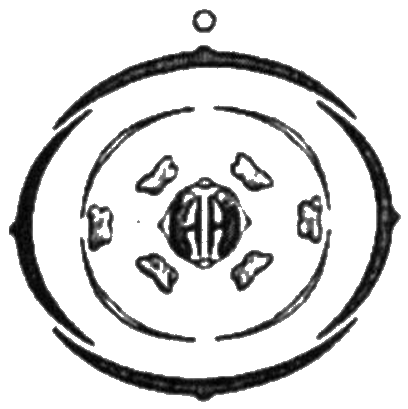
- Fabaceae
- Brassicaceae
- Solanaceae
- Liliaceae
Show answer
Answer: (B) Brassicaceae
Explanation: The diagram shows four sepals, four petals arranged in a cross, six stamens in a tetradynamous arrangement (two outer short and four inner long) and a bicarpellary ovary divided by a false septum (replum) with parietal placentation. These features are characteristic of Brassicaceae (Cruciferae), e.g. mustard.
Question 2
Previous-year questionThe technical term for the androecium in the flower of China rose (Hibiscus rosa-sinensis) is [2011]
- polyandrous
- monadelphous
- polyadelphous
- diadelphous
Show answer
Answer: (B) monadelphous
Explanation: In China rose the numerous stamens have their filaments united into a single tube surrounding the style, which is the monadelphous condition and a defining feature of Malvaceae. Diadelphous stamens, united into two bundles, occur in pea, and polyadelphous stamens, in several bundles, in Citrus.
Question 3
Previous-year questionThe family delimited by the head type of inflorescence is [1991]
- Solanaceae
- Fabaceae
- Liliaceae
- Asteraceae
Show answer
Answer: (D) Asteraceae
Explanation: Asteraceae is distinguished by the capitulum or head, in which numerous small sessile florets are crowded on a flattened receptacle surrounded by an involucre of bracts, the whole resembling a single flower. Ray florets occupy the margin and disc florets the centre, as in the sunflower and marigold.
Question 4
Previous-year questionWhich of the following is correctly matched? [1998]
- Brassicaceae — wheat
- Cucurbitaceae — orange
- Leguminosae — sunflower
- Malvaceae — cotton
Show answer
Answer: (D) Malvaceae — cotton
Explanation: Cotton, Gossypium, is a member of Malvaceae, which is recognised by its epicalyx, monadelphous stamens and twisted aestivation. Wheat belongs to Poaceae, orange to Rutaceae and sunflower to Asteraceae, so the first three pairings are wrong.
Question 5
Previous-year questionEpipetalous stamens with free filaments and fused anthers occur in [1994]
- Liliaceae
- Asteraceae
- Poaceae
- Solanaceae
Show answer
Answer: (B) Asteraceae
Explanation: In Asteraceae the five stamens are attached to the corolla tube, so they are epipetalous, and their anthers are united into a tube while the filaments remain free, so they are syngenesious. Solanaceae also has epipetalous stamens, but there the anthers are free.
Question 6
Previous-year questionPulses are obtained from the family [1994]
- Poaceae
- Fabaceae
- Solanaceae
- Asteraceae
Show answer
Answer: (B) Fabaceae
Explanation: Fabaceae supplies the pulses — gram, pea, arhar, moong and lentil — whose seeds are exceptionally rich in protein because the root nodules of these plants fix atmospheric nitrogen in symbiosis with Rhizobium. Poaceae yields the cereals, which are chiefly carbohydrate sources.
Question 7
Previous-year questionThe syngenesious condition is found in [1990]
- Solanaceae
- Asteraceae
- Fabaceae
- Lamiaceae
Show answer
Answer: (B) Asteraceae
Explanation: Syngenesious stamens have free filaments but anthers united into a tube around the style, and this arrangement is characteristic of Asteraceae. As the style elongates through the anther tube it sweeps out the pollen, an arrangement that promotes cross-pollination.
Doing well? Create a free account to take timed tests on this topic and see your weak areas.
Question 8
Previous-year questionRadial symmetry is found in the flowers of [NEET-II 2016]
- Trifolium
- Pisum
- Cassia
- Brassica
Show answer
Answer: (D) Brassica
Explanation: Brassica has actinomorphic (radially symmetrical) flowers; the others are zygomorphic.
Question 9
Previous-year questionA tricarpellary, syncarpous gynoecium is found in flowers of [NEET-I 2016]
- Liliaceae
- Solanaceae
- Fabaceae
- Poaceae
Show answer
Answer: (A) Liliaceae
Explanation: Liliaceae has a tricarpellary, syncarpous gynoecium.
Question 10
Previous-year questionThe standard petal of a papilionaceous corolla is also called the [NEET-I 2016]
- Carina
- Pappus
- Vexillum
- Corona
Show answer
Answer: (C) Vexillum
Explanation: The standard (largest posterior) petal is the vexillum.
Question 11
Previous-year questionThe keel is a characteristic feature of the flower of [AIPMT 2015]
- Tulip
- Indigofera
- Aloe
- Tomato
Show answer
Answer: (B) Indigofera
Explanation: Indigofera (Fabaceae) has a keel.
Question 12
Previous-year question⊕ ⚥ K(5) C(5) A5 G(2) is the floral formula of [AIPMT 2015]
- Allium
- Sesbania
- Petunia
- Brassica
Show answer
Answer: (C) Petunia
Explanation: This is the Solanaceae formula — petunia.
Question 13
Previous-year questionWhich statement is correct? [AIPMT 2014]
- The seed in grasses is not endospermic
- Mango is a parthenocarpic fruit
- A proteinaceous aleurone layer is present in maize grain
- A sterile pistil is called a staminode
Show answer
Answer: (C) A proteinaceous aleurone layer is present in maize grain
Explanation: Maize grain has a proteinaceous aleurone layer. (Grass seeds ARE endospermic; mango is not parthenocarpic; a sterile stamen — not pistil — is a staminode.)
Question 14
Previous-year questionIn China rose the flowers are [AIPMT 2013]
- Actinomorphic, hypogynous, twisted aestivation
- Actinomorphic, epigynous, valvate aestivation
- Zygomorphic, hypogynous, imbricate aestivation
- Zygomorphic, epigynous, twisted aestivation
Show answer
Answer: (A) Actinomorphic, hypogynous, twisted aestivation
Explanation: China rose flowers are actinomorphic and hypogynous with twisted aestivation.
Question 15
Previous-year questionVexillary aestivation is characteristic of the family [AIPMT Pre 2012]
- Fabaceae
- Asteraceae
- Solanaceae
- Brassicaceae
Show answer
Answer: (A) Fabaceae
Explanation: Vexillary (papilionaceous) aestivation is characteristic of Fabaceae.
Want more Plant Families – Malvaceae questions?
E-GYAN NIDHI has 424 questions on this topic and 63,000+ in total, all free: timed CBT tests, NEET marking and instant analysis.
Register free Free Sunday Mock TestMore topics in Structural Organization in Animals and Plants
- Morphology of Flowering Plants – The Root MCQs
- Morphology of Flowering Plants – The Stem MCQs
- Morphology of Flowering Plants – The Leaf MCQs
- Morphology of Flowering Plants – The Flower MCQs
- Morphology of Flowering Plants – The Fruit MCQs
- Morphology of Flowering Plants – The Seed MCQs
- Morphology of Flowering Plants – Semi-Technical Description of a Typical Flowering Plant MCQs
- Anatomy of Flowering Plants – The Tissues MCQs
- Anatomy of Flowering Plants – The Tissue System MCQs
- Anatomy of Flowering Plants – Anatomy of Dicotyledonous and Monocotyledonous Plants MCQs