Morphology of Flowering Plants – The Root: NEET MCQs with Answers
15 free questions on Morphology of Flowering Plants – The Root for NEET (UG), starting with previous-year NEET and AIPMT questions. Try each one, then tap Show answer for the answer and a short explanation.
Syllabus covered: The Root
Question 1
Previous-year questionIn Rhizophora, the roots that grow vertically upward (negatively geotropic) are known as: [NEET 2024 (Sawaimadhopur)]
- Prop roots
- Stilt roots
- Storage roots
- Pneumatophores
Show answer
Answer: (D) Pneumatophores
Explanation: In plants growing in swampy areas such as Rhizophora, many roots come out of the ground and grow vertically upwards; these pneumatophores help to get oxygen for respiration. Prop roots (banyan) and stilt roots (maize, sugarcane) are supporting roots, and storage roots store food.
Question 2
Previous-year questionThe root system shown in the figure given below belongs to: [Re-NEET 2021]
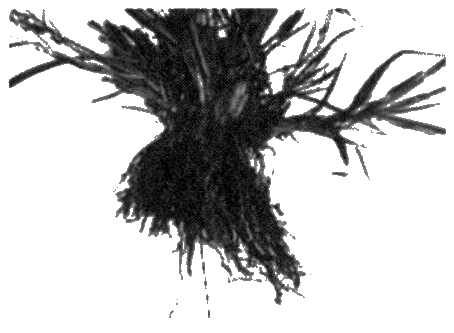
- Triticum
- Mango
- Banyan
- Brassica
Show answer
Answer: (A) Triticum
Explanation: The figure shows a fibrous root system, in which the short-lived primary root is replaced by a large number of roots arising from the base of the stem; this is characteristic of monocots such as wheat (Triticum). Mango and Brassica are dicots with a tap root system, and banyan is known for its prop roots.
Question 3
Previous-year questionSweet potato is a modified [NEET 2018]
- stem
- adventitious root
- rhizome
- tap root
Show answer
Answer: (B) adventitious root
Explanation: In sweet potato, adventitious roots become swollen with stored food to form tuberous roots. They bear no nodes, internodes or buds, which distinguishes them from the modified stem of potato.
Question 4
Previous-year questionPneumatophores occur in [NEET 2018]
- halophytes
- free-floating hydrophytes
- submerged hydrophytes
- carnivorous plants
Show answer
Answer: (A) halophytes
Explanation: Pneumatophores are the breathing roots of halophytic mangrove plants growing in waterlogged saline soil, where the soil oxygen is insufficient for the submerged root system.
Question 5
Previous-year questionPlants which produce characteristic pneumatophores and show vivipary belong to [NEET 2017]
- halophytes
- psammophytes
- hydrophytes
- mesophytes
Show answer
Answer: (A) halophytes
Explanation: Mangroves such as Rhizophora are halophytes of saline marshy soils. They produce negatively geotropic pneumatophores for gaseous exchange and show vivipary, in which the seed germinates while still attached to the parent plant.
Question 6
Previous-year questionVivipary is a characteristic feature of [AIPMT 1990]
- Mesophytes
- Xerophytes
- Hygrophytes
- Halophytes
Show answer
Answer: (D) Halophytes
Explanation: Vivipary is a special mode of seed germination shown by halophytes (mangroves) such as Rhizophora, in which the seed germinates inside the fruit while it is still attached to the parent plant. The embryo derives nourishment from the parent, and the seedling later drops and fixes itself in the soft mud.
Question 7
Previous-year questionButtress roots occur in [AIPMT 1995]
- Sorghum
- Banyan
- Terminalia
- Pandanus
Show answer
Answer: (C) Terminalia
Explanation: Buttress roots are irregular, broad, plank-like woody outgrowths that arise from the basal part of the trunk of tall trees and radiate into the soil, e.g. Terminalia, Ficus religiosa and Bombax. They provide mechanical support against toppling. Banyan bears prop roots, Pandanus bears stilt roots and Sorghum bears stilt roots at the lower nodes.
Doing well? Create a free account to take timed tests on this topic and see your weak areas.
Question 8
Previous-year questionClinging roots are borne by [AIPMT 1999]
- Trapa
- Orchid
- Screw pine
- Podostemon
Show answer
Answer: (B) Orchid
Explanation: Epiphytic orchids produce clinging (climbing) adventitious roots from the nodes or leaf axils of the stem, which fix the plant firmly to the supporting tree trunk. Screw pine (Pandanus) bears stilt roots, while Trapa and Podostemon are aquatic plants with other root modifications.
Question 9
Previous-year questionPneumatophores are a characteristic feature of plants growing in [AIPMT 2000]
- Saline soils
- Sandy soils
- Marshy places and salt lakes
- Dry land regions
Show answer
Answer: (C) Marshy places and salt lakes
Explanation: Pneumatophores develop in plants of marshy, water-logged and saline habitats such as tidal swamps and salt lakes, where the soil is deficient in oxygen. These negatively geotropic roots come above the mud and take up oxygen through lenticels.
Question 10
Previous-year questionThe roots of which of the following plants contain an oxygen-binding pigment? [AIPMT 2001]
- Carrot
- Soyabean
- Mustard
- Radish
Show answer
Answer: (B) Soyabean
Explanation: The root nodules of leguminous plants such as soyabean contain leghaemoglobin, a red, iron-containing oxygen-binding protein present in the cytoplasm of the infected nodule cells. It maintains a very low free-oxygen concentration so that the oxygen-sensitive enzyme nitrogenase can function, while still supplying oxygen to the respiring bacteroids.
Question 11
Previous-year questionSweet potato is homologous to [AIPMT 2011]
- Potato
- Colocasia
- Ginger
- Turnip
Show answer
Answer: (D) Turnip
Explanation: Homologous organs have the same fundamental origin and structure although they may differ in function. Both sweet potato and turnip are modified roots that have become fleshy for food storage, hence they are homologous. Potato, Colocasia and ginger are all modified underground stems and are therefore analogous to sweet potato, not homologous.
Question 12
Previous-year questionIn which of the following plants do the roots play an insignificant role in water absorption? [AIPMT 2015]
- Sunflower
- Pistia
- Pea
- Wheat
Show answer
Answer: (B) Pistia
Explanation: Pistia is a free-floating hydrophyte. Its entire submerged surface is thin-walled and permeable, so water and dissolved minerals are absorbed over the whole body surface; the roots serve mainly for balancing the plant. In terrestrial plants such as sunflower, pea and wheat, roots are the principal absorbing organs.
Question 13
Previous-year questionPlants that develop characteristic pneumatophores and also exhibit vivipary are classified as [NEET 2017]
- Mesophytes
- Halophytes
- Psammophytes
- Hydrophytes
Show answer
Answer: (B) Halophytes
Explanation: Both features are adaptations to saline marshy habitats. Halophytes such as Rhizophora produce negatively geotropic breathing roots (pneumatophores) for respiration and show vivipary, in which the seed germinates while still attached to the parent plant, so that the seedling is not lost in the tidal water.
Question 14
Previous-year questionSweet potato is an example of a modified [NEET 2018]
- Stem
- Adventitious root
- Tap root
- Rhizome
Show answer
Answer: (B) Adventitious root
Explanation: Sweet potato (Ipomoea batatas) is a swollen tuberous adventitious root that stores food. It arises from the nodes of the trailing stem and has no definite shape. Potato, in contrast, is a stem tuber and carrot is a modified tap root.
Question 15
Previous-year questionPneumatophores are met with in [NEET 2018]
- Carnivorous plants
- Free-floating hydrophytes
- Halophytes
- Submerged hydrophytes
Show answer
Answer: (C) Halophytes
Explanation: Halophytes such as mangroves (Rhizophora) grow in saline, water-logged swampy soil where oxygen availability is very poor. Some of their roots grow vertically upward out of the soil (negatively geotropic) and bear lenticels through which gaseous exchange occurs; such breathing roots are called pneumatophores.
Want more Morphology of Flowering Plants – The Root questions?
E-GYAN NIDHI has 168 questions on this topic and 63,000+ in total, all free: timed CBT tests, NEET marking and instant analysis.
Register free Free Sunday Mock TestMore topics in Structural Organization in Animals and Plants
- Plant Families – Malvaceae MCQs
- Morphology of Flowering Plants – The Stem MCQs
- Morphology of Flowering Plants – The Leaf MCQs
- Morphology of Flowering Plants – The Flower MCQs
- Morphology of Flowering Plants – The Fruit MCQs
- Morphology of Flowering Plants – The Seed MCQs
- Morphology of Flowering Plants – Semi-Technical Description of a Typical Flowering Plant MCQs
- Anatomy of Flowering Plants – The Tissues MCQs
- Anatomy of Flowering Plants – The Tissue System MCQs
- Anatomy of Flowering Plants – Anatomy of Dicotyledonous and Monocotyledonous Plants MCQs