Anatomy of Flowering Plants – The Tissues: NEET MCQs with Answers
15 free questions on Anatomy of Flowering Plants – The Tissues for NEET (UG), starting with previous-year NEET and AIPMT questions. Try each one, then tap Show answer for the answer and a short explanation.
Syllabus covered: The Tissues
Question 1
Previous-year questionRead the two statements given below and choose the correct answer from the options. [NEET 2024 (Sawaimadhopur)]
Statement I: In collenchyma, the cell walls are thickened at the corners due to the deposition of cellulose, hemicellulose and pectin.
Statement II: Sclerenchyma consists of lignified cell walls and possesses pits.
Statement I: In collenchyma, the cell walls are thickened at the corners due to the deposition of cellulose, hemicellulose and pectin.
Statement II: Sclerenchyma consists of lignified cell walls and possesses pits.
- Both Statement I and Statement II are false
- Statement I is true but Statement II is false
- Statement I is false but Statement II is true
- Both Statement I and Statement II are true
Show answer
Answer: (D) Both Statement I and Statement II are true
Explanation: Collenchyma cells are thickened at the corners due to deposition of cellulose, hemicellulose and pectin, so Statement I is true. Sclerenchyma cells have thick, lignified walls with few or numerous pits, so Statement II is also true.
Question 2
Previous-year questionRead the statements given below and identify the correct set of statements. [NEET 2024 (Sawaimadhopur)]
A. Companion cells help in maintaining the pressure gradient in the sieve tubes.
B. Gymnosperms lack vessels in their xylem.
C. The xylem vessels are devoid of cytoplasm.
D. Xylem fibres may be septate or aseptate.
E. A mature sieve element in phloem possesses cytoplasm, vacuole and nucleus.
A. Companion cells help in maintaining the pressure gradient in the sieve tubes.
B. Gymnosperms lack vessels in their xylem.
C. The xylem vessels are devoid of cytoplasm.
D. Xylem fibres may be septate or aseptate.
E. A mature sieve element in phloem possesses cytoplasm, vacuole and nucleus.
- A, B, D, E only
- A, B, C, D only
- C, D, E only
- B, C, D, E only
Show answer
Answer: (B) A, B, C, D only
Explanation: Companion cells help maintain the pressure gradient in sieve tubes, gymnosperms lack vessels, mature xylem vessels have no cytoplasm, and xylem fibres may be septate or aseptate, so A–D are correct. E is wrong because a mature sieve element has peripheral cytoplasm and a large vacuole but lacks a nucleus.
Question 3
Previous-year questionWith reference to plant anatomy, what does the figure given below represent? [NEET 2024 (Sawaimadhopur)]
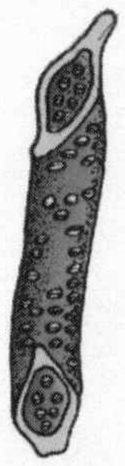
- Xylem fibre
- Xylem parenchyma
- Vessel
- Tracheid
Show answer
Answer: (C) Vessel
Explanation: The figure represents a vessel element. Vessels are long cylindrical tube-like xylem elements made of many cells (vessel members) with lignified, pitted walls and no protoplasm; the figure shows a broad member with a pitted wall and perforated oblique ends where it joins the next member. A tracheid is a single elongated cell with tapering ends and no perforated end walls. Xylem fibres are narrow with obliterated lumens, and xylem parenchyma cells are living, thin-walled cells.
Question 4
Previous-year questionXylem translocates [NEET 2019]
- water only
- water and mineral salts only
- water, mineral salts and some organic nitrogen only
- water, mineral salts, some organic nitrogen and hormones
Show answer
Answer: (D) water, mineral salts, some organic nitrogen and hormones
Explanation: Besides water and minerals, xylem sap carries organic nitrogen compounds (such as amino acids and ureides) and hormones like cytokinins from the root to the aerial parts.
Question 5
Previous-year questionTransmission tissue is a characteristic feature of a [AIPMT 2015]
- solid style
- dry stigma
- wet stigma
- hollow style
Show answer
Answer: (A) solid style
Explanation: In a solid style the central core of specialised cells, the transmission tissue, provides the nutritive path along which the pollen tube grows towards the ovary.
Question 6
Previous-year questionTracheids differ from the other tracheary elements in [AIPMT 2014]
- having Casparian strips
- being imperforate
- lacking a nucleus
- being lignified
Show answer
Answer: (B) being imperforate
Explanation: Tracheids lack perforations; water passes from one tracheid to the next through pit membranes. Vessels, the other tracheary element, possess perforation plates.
Question 7
Previous-year questionWhich one of the following yields fibres? [AIPMT 1988]
- Coconut
- Oak
- Teak
- Sisso
Show answer
Answer: (A) Coconut
Explanation: Commercial coir fibres are obtained from Cocos nucifera (coconut). They are surface fibres that occur in the fibrous mesocarp of the coconut fruit. Oak, teak and sisso are valued as timber-yielding trees rather than as fibre sources.
Doing well? Create a free account to take timed tests on this topic and see your weak areas.
Question 8
Previous-year questionThe tunica-corpus theory is connected with the [AIPMT 1988]
- Root apex
- Root cap
- Shoot apex
- Secondary growth
Show answer
Answer: (C) Shoot apex
Explanation: The tunica-corpus theory was proposed by Schmidt in 1924 to explain the organisation of the shoot apical meristem. The tunica is the outer zone whose cells divide anticlinally and give rise to the protoderm and hence the epidermis, while the corpus is the inner zone that forms the procambium and ground meristem.
Question 9
Previous-year questionWhich meristem helps in increasing the girth of the plant? [AIPMT 1988]
- Lateral meristem
- Intercalary meristem
- Primary meristem
- Apical meristem
Show answer
Answer: (A) Lateral meristem
Explanation: Lateral meristems, namely the vascular cambium and the cork cambium (phellogen), are situated along the sides of the stem and root. They add secondary tissues on both sides by dividing in the radial direction and thus bring about an increase in the girth of the organ.
Question 10
Previous-year questionDeath of the protoplasm is a prerequisite for a vital function like [AIPMT 1989]
- Transport of sap
- Transport of food
- Absorption of water
- Gaseous exchange
Show answer
Answer: (A) Transport of sap
Explanation: The tracheary elements of the xylem become lignified and lose their protoplasm as they mature. Only after this death of the protoplast do they form continuous hollow tubes offering minimum resistance, and it is in this dead condition that they conduct water and mineral sap.
Question 11
Previous-year questionSieve tubes are suited for the translocation of food because they possess [AIPMT 1989]
- Bordered pits
- No end walls
- Broader lumen and perforated cross walls
- No protoplasm
Show answer
Answer: (C) Broader lumen and perforated cross walls
Explanation: Sieve tubes are elongated tubular channels formed by the end-to-end union of numerous cells. They have a broad lumen and thin walls, and the transverse septa between successive cells bear numerous perforations forming sieve plates, so that the organic solutes can pass readily from one element to the next.
Question 12
Previous-year questionThe organisation of the stem apex into corpus and tunica is determined mainly by the [AIPMT 1989]
- Planes of cell division
- Regions of meristematic activity
- Rate of cell growth
- Rate of shoot tip growth
Show answer
Answer: (A) Planes of cell division
Explanation: According to the tunica-corpus theory the distinction between the two zones rests on the planes of cell division. Cells of the tunica, the outer zone, divide only anticlinally, that is, in a plane perpendicular to the surface, whereas cells of the corpus, the inner mass, divide in various planes.
Question 13
Previous-year questionCollenchyma occurs in the stem and petioles of [AIPMT 1990]
- Xerophytes
- Monocots
- Dicot herbs
- Hydrophytes
Show answer
Answer: (C) Dicot herbs
Explanation: Collenchyma is a simple permanent living tissue composed of elongated cells with thickened pectocellulosic walls. It provides both mechanical strength and elasticity and thus permits continued growth, and it occurs typically in the hypodermis of the stem and petiole of dicot herbs and in climbing stems.
Question 14
Previous-year questionAn organised and differentiated cellular structure having cytoplasm but no nucleus is [AIPMT 1991]
- Vessels
- Xylem parenchyma
- Sieve tubes
- Tracheids
Show answer
Answer: (C) Sieve tubes
Explanation: Sieve tubes are the food-conducting elements of the phloem. They possess a nucleus in the young stage but it disappears at maturity, leaving an organised and differentiated cell that retains a network of cytoplasmic strands. Vessels and tracheids are completely dead and devoid of protoplasm.
Question 15
Previous-year questionAngular collenchyma occurs in [AIPMT 1991]
- Cucurbita
- Tagetes
- Althaea
- Salvia
Show answer
Answer: (A) Cucurbita
Explanation: Depending on the site of wall thickening, collenchyma is of three types. Angular collenchyma, in which thickening occurs at the angles or corners of the cells, is found in Cucurbita and marigold; lamellar collenchyma has thickening on the tangential walls, as in sunflower; and lacunate collenchyma has thickening on the walls bordering the intercellular spaces, as in Salvia.
Want more Anatomy of Flowering Plants – The Tissues questions?
E-GYAN NIDHI has 559 questions on this topic and 63,000+ in total, all free: timed CBT tests, NEET marking and instant analysis.
Register free Free Sunday Mock TestMore topics in Structural Organization in Animals and Plants
- Plant Families – Malvaceae MCQs
- Morphology of Flowering Plants – The Root MCQs
- Morphology of Flowering Plants – The Stem MCQs
- Morphology of Flowering Plants – The Leaf MCQs
- Morphology of Flowering Plants – The Flower MCQs
- Morphology of Flowering Plants – The Fruit MCQs
- Morphology of Flowering Plants – The Seed MCQs
- Morphology of Flowering Plants – Semi-Technical Description of a Typical Flowering Plant MCQs
- Anatomy of Flowering Plants – The Tissue System MCQs
- Anatomy of Flowering Plants – Anatomy of Dicotyledonous and Monocotyledonous Plants MCQs