Human Reproductive Health – Population Stabilisation and Birth Control: NEET MCQs with Answers
15 free questions on Human Reproductive Health – Population Stabilisation and Birth Control for NEET (UG), starting with previous-year NEET and AIPMT questions. Try each one, then tap Show answer for the answer and a short explanation.
Syllabus covered: Population Stabilisation and Birth Control: Birth control-Need and Methods,
Question 1
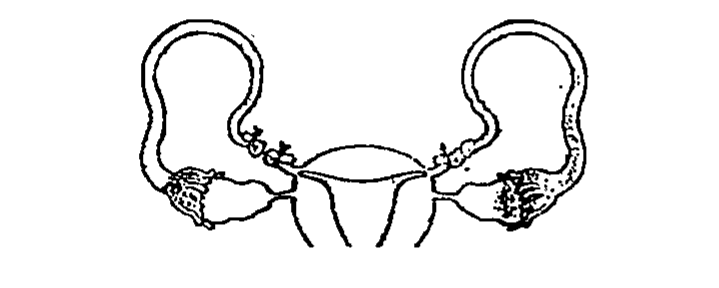
Previous-year questionWhat is the figure given below showing in particular? [AIPMT 2012]
- Ovarian cancer
- Uterine cancer
- Tubectomy
- Vasectomy
Show answer
Answer: (C) Tubectomy
Explanation: The figure shows the two Fallopian tubes of the female cut and ligated. This process of cutting and tying both oviducts is called tubectomy; it is a very reliable method of birth control with a failure rate of less than 1%.
Question 2
Previous-year questionSelect the option that lists only hormone-releasing intra-uterine devices. [NEET 2019]
- Vaults, LNG-20
- Multiload 375, Progestasert
- Progestasert, LNG-20
- Lippes loop, Multiload 375
Show answer
Answer: (C) Progestasert, LNG-20
Explanation: Progestasert and LNG-20 are the two hormone-releasing IUDs. Lippes loop is non-medicated, Multiload 375 is copper releasing, and vaults are barrier devices.
Question 3
Previous-year questionWhich of the following sets of contraceptive methods all involve a role of hormone? [NEET 2019]
- Lactational amenorrhoea, pills, emergency contraceptives
- Barrier method, lactational amenorrhoea, pills
- CuT, pills, emergency contraceptives
- Pills, emergency contraceptives, barrier methods
Show answer
Answer: (A) Lactational amenorrhoea, pills, emergency contraceptives
Explanation: Lactational amenorrhoea works through prolactin-mediated suppression of gonadotropins, oral pills contain progestogen/oestrogen, and emergency contraceptives are also progestogen or progestogen–oestrogen preparations. Barrier methods and CuT act mechanically or through copper ions, without hormones.
Question 4
Previous-year questionThe contraceptive 'SAHELI' [NEET 2018]
- Blocks oestrogen receptors in the uterus, thereby preventing eggs from getting implanted
- Increases the concentration of oestrogen and prevents ovulation in females
- Is a post-coital contraceptive
- Is an IUD
Show answer
Answer: (A) Blocks oestrogen receptors in the uterus, thereby preventing eggs from getting implanted
Explanation: Saheli is a non-steroidal, once-a-week oral pill developed by CDRI, Lucknow. Its active compound (centchroman) blocks oestrogen receptors in the uterus so that the endometrium does not become receptive, and the embryo cannot get implanted.
Question 5
Previous-year questionThe function of copper ions in copper-releasing IUDs is that [NEET 2017]
- They inhibit gametogenesis
- They make the uterus unsuitable for implantation
- They inhibit ovulation
- They suppress sperm motility and the fertilising capacity of sperms
Show answer
Answer: (D) They suppress sperm motility and the fertilising capacity of sperms
Explanation: Copper ions released from CuT, Cu7 or Multiload 375 suppress the motility and the fertilising capacity of sperms. Making the uterus unsuitable for implantation is chiefly the action of hormone-releasing IUDs.
Question 6
Previous-year questionWhich of the following approaches does not give the correct defined action of the contraceptive? [NEET 2016]
- Barrier methods – prevent fertilisation
- Intrauterine devices – increase phagocytosis of sperms, suppress sperm motility and fertilising capacity of sperms
- Hormonal contraceptives – prevent/retard entry of sperms, prevent ovulation and fertilisation
- Vasectomy – prevents spermatogenesis
Show answer
Answer: (D) Vasectomy – prevents spermatogenesis
Explanation: Vasectomy only cuts and ties the vas deferens, blocking the transport of sperms; spermatogenesis continues normally in the testes. Barrier methods prevent fertilisation, IUDs increase phagocytosis and suppress sperm motility, and hormonal pills prevent ovulation and retard sperm entry, so those descriptions are correct.
Question 7
Previous-year questionHysterectomy refers to the surgical removal of the [AIPMT 2015]
- Prostate gland
- Vas deferens
- Mammary glands
- Uterus
Show answer
Answer: (D) Uterus
Explanation: Hysterectomy is the surgical removal of the uterus. It is carried out for medical reasons such as tumours and, although it makes pregnancy impossible, it is not classified as a contraceptive method.
Doing well? Create a free account to take timed tests on this topic and see your weak areas.
Question 8
Previous-year questionTubectomy is a sterilisation method in which [AIPMT 2014]
- A small part of the fallopian tube is removed or tied up
- The ovaries are removed surgically
- A small part of the vas deferens is removed or tied up
- The uterus is removed surgically
Show answer
Answer: (A) A small part of the fallopian tube is removed or tied up
Explanation: In tubectomy a small portion of each fallopian tube is cut and tied, blocking the passage of the ovum so that it cannot meet the sperms. Removal of the vas deferens is vasectomy, while removal of the ovaries or uterus is not a contraceptive procedure.
Question 9
Previous-year questionWhich of the following is a hormone-releasing intrauterine device? [AIPMT 2014]
- Multiload 375
- LNG-20
- Cervical cap
- Vault
Show answer
Answer: (B) LNG-20
Explanation: LNG-20 (along with Progestasert) is a hormone-releasing IUD. Multiload 375 is copper releasing, whereas cervical caps and vaults are barrier devices and not IUDs at all.
Question 10
Previous-year questionHuman population growth in India [AIPMT 1996]
- tends to follow a sigmoid curve as in case of many other animal species
- tends to reach zero population growth as in case of some animal species
- can be reduced by permitting natural calamities and enforcing birth control measures
- can be regulated by following the National programme of family planning
Show answer
Answer: (D) can be regulated by following the National programme of family planning
Explanation: Although India is very densely populated, human population growth can be regulated by following the National Family Planning (Family Welfare) Programme, which promotes contraception, reproductive and child health care and public awareness.
Question 11
Previous-year questionThe most important component of the oral contraceptive pills is [AIPMT 1998]
- thyroxine
- luteinizing hormone
- progesterone
- growth hormone
Show answer
Answer: (C) progesterone
Explanation: The commonest oral contraceptive is the 'combined pill', which contains a synthetic progestin (acting like progesterone) together with oestrogen. Progesterone is the most important component, as it is chiefly responsible for preventing ovulation.
Question 12
Previous-year questionTablets to prevent contraception contain [AIPMT 1999]
- progesterone
- FSH
- LH
- Both (b) and (c)
Show answer
Answer: (A) progesterone
Explanation: Contraceptive tablets for women contain the female sex hormones oestrogen and progestogen (progesterone). These inhibit FSH secretion and thereby prevent follicular development and ovulation; some pills contain progestogen alone and act mainly by thickening the cervical mucus.
Question 13
Previous-year questionProgesterone, which is the most important component of oral contraceptive pill, prevents pregnancy by [AIPMT 2000]
- preventing the formation of egg
- preventing the cleavage of the fertilised egg
- creating unfavourable chemical environment for the sperms to survive in the female reproductive tract
- blocking ovulation
Show answer
Answer: (D) blocking ovulation
Explanation: Progestogen, along with oestrogen, disturbs the normal menstrual cycle and inhibits the pituitary from secreting FSH and LH. Without the LH surge ovulation is blocked, and hence no egg is available for fertilisation.
Question 14
Previous-year questionIn a population, unrestricted reproductive capacity is called [AIPMT 2002]
- biotic potential
- fertility
- carrying capacity
- birth rate
Show answer
Answer: (A) biotic potential
Explanation: Biotic potential is the innate capacity of a population to increase in numbers under ideal conditions of unlimited resources and no hindrances. It represents the maximum possible rate of increase of the population.
Question 15
Previous-year questionGiven below are four methods (A-D) and their modes of action (i-iv) in achieving contraception. Select their correct matching from the four option that follow. [AIPMT 2008] Method: A. The pill, B. Condom, C. Vasectomy, D. Copper-T Mode of Action: (i) Prevents sperms reaching cervix, (ii) Prevents implantation, (iii) Prevents ovulation, (iv) Semen contains no sperms
- A-(iii), B-(iv), C-(i), D-(ii)
- A-(ii), B-(iii), C-(i), D-(iv)
- A-(iii), B-(i), C-(iv), D-(ii)
- A-(iv), B-(i), C-(ii), D-(iii)
Show answer
Answer: (C) A-(iii), B-(i), C-(iv), D-(ii)
Explanation: Contraceptive pills are hormonal and primarily prevent ovulation (A–iii). A condom is a barrier that collects semen and prevents sperms from reaching the cervix (B–i). After vasectomy the semen contains no sperms (C–iv), and Copper-T largely prevents fertilisation and implantation (D–ii).
Want more Human Reproductive Health – Population Stabilisation and Birth Control questions?
E-GYAN NIDHI has 292 questions on this topic and 63,000+ in total, all free: timed CBT tests, NEET marking and instant analysis.
Register free Free Sunday Mock TestMore topics in Reproduction
- Human Reproduction – Male Reproductive System MCQs
- Human Reproduction – Female Reproductive System MCQs
- Human Reproduction – Gametogenesis-spermatogenesis & oogenesis MCQs
- Human Reproduction – Menstrual Cycle MCQs
- Human Reproduction – Fertilisation and Implantation MCQs
- Human Reproduction – Pregnancy and Embryonic Development MCQs
- Human Reproduction – Parturition and Lactation MCQs
- Human Reproductive Health – Amniocentesis MCQs
- Human Reproductive Health – Sexually Transmitted Infections (STIs) MCQs
- Human Reproductive Health – Infertility MCQs