Human Reproduction – Gametogenesis-spermatogenesis & oogenesis: NEET MCQs with Answers
15 free questions on Human Reproduction – Gametogenesis-spermatogenesis & oogenesis for NEET (UG), starting with previous-year NEET and AIPMT questions. Try each one, then tap Show answer for the answer and a short explanation.
Syllabus covered: Gametogenesis-spermatogenesis & oogenesis
Question 1
Previous-year questionThe figure shows a section of human ovary. Select the option which gives the correct identification of either A or B with function/characteristic. [Karnataka NEET 2013]
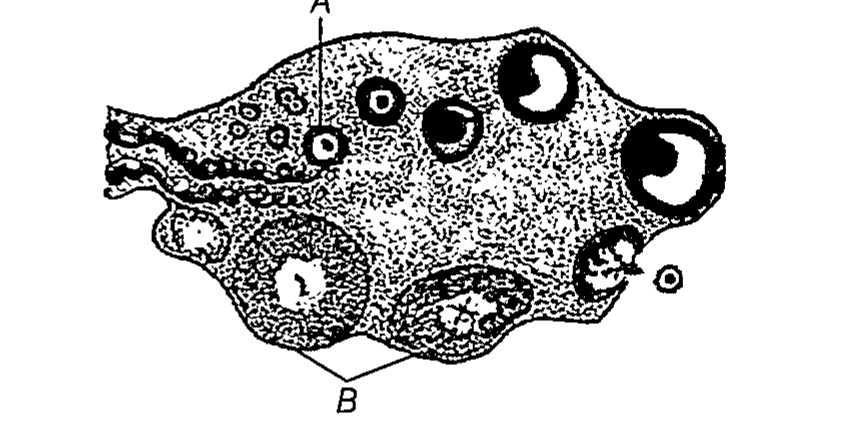
- B–Corpus luteum — Secretes progesterone
- A–Tertiary follicle — Forms Graafian follicle
- B–Corpus luteum — Secretes estrogen
- A–Primary oocyte — It is in the prophase I of the meiotic division
Show answer
Answer: (A) B–Corpus luteum — Secretes progesterone
Explanation: B in the figure is the corpus luteum, the temporary endocrine structure formed from the ruptured Graafian follicle after ovulation. It secretes large amounts of progesterone, which is essential for maintaining the endometrium until the placenta takes over; in the absence of fertilisation it degenerates in about 14 days into the corpus albicans.
Question 2
Previous-year questionThe difference between spermiogenesis and spermiation is that [NEET 2018]
- in spermiogenesis spermatids are formed, while in spermiation spermatozoa are formed
- in spermiogenesis spermatozoa are formed, while in spermiation spermatids are formed
- in spermiogenesis spermatozoa are formed, while in spermiation spermatozoa are released from the Sertoli cells into the cavity of the seminiferous tubules
- in spermiogenesis spermatozoa from the Sertoli cells are released into the cavity of the seminiferous tubules, while in spermiation spermatozoa are formed
Show answer
Answer: (C) in spermiogenesis spermatozoa are formed, while in spermiation spermatozoa are released from the Sertoli cells into the cavity of the seminiferous tubules
Explanation: Spermiogenesis is the transformation of spermatids into spermatozoa; spermiation is the subsequent release of these spermatozoa from the Sertoli cells into the tubular lumen.
Question 3
Previous-year questionIn human females, meiosis-II is not completed until [AIPMT 2015]
- fertilization
- uterine implantation
- birth
- puberty
Show answer
Answer: (A) fertilization
Explanation: The secondary oocyte is arrested at metaphase II and completes the division only when a sperm penetrates it, releasing the second polar body.
Question 4
Previous-year questionWhich of the following cells during gametogenesis is normally diploid? [AIPMT 2015]
- Spermatid
- Spermatogonia
- Secondary polar body
- Primary polar body
Show answer
Answer: (B) Spermatogonia
Explanation: Spermatogonia are the diploid germinal stem cells of the seminiferous tubules; spermatids and the polar bodies are all haploid products of meiosis.
Question 5
Previous-year questionHuman eggs are [AIPMT 1997, 1989]
- alecithal
- microlecithal
- mesolecithal
- macrolecithal
Show answer
Answer: (A) alecithal
Explanation: Human ova are almost free of yolk and are therefore described as alecithal. In such eggs cleavage is holoblastic, i.e. the cleavage furrow passes completely through the egg.
Question 6
Previous-year questionMiddle piece of mammalian sperm possesses [AIPMT 1999, 1991]
- mitochondria and centriole
- mitochondria only
- centriole only
- nucleus and mitochondria
Show answer
Answer: (B) mitochondria only
Explanation: The middle piece of the human sperm contains numerous mitochondria coiled spirally around the axial filament (mitochondrial spiral). These provide the ATP required for the movement of the sperm; the centrioles lie in the neck region.
Question 7
Previous-year questionSertoli cells are regulated by the pituitary hormone known as [AIPMT 2006]
- LH
- FSH
- GH
- prolactin
Show answer
Answer: (B) FSH
Explanation: Sertoli cells of the germinal epithelium of the seminiferous tubules nourish the developing sperms and are under the control of Follicle Stimulating Hormone (FSH) released by the anterior pituitary. LH acts instead on the Leydig cells.
Doing well? Create a free account to take timed tests on this topic and see your weak areas.
Question 8
Previous-year questionAt the end of first meiotic division, male germ cell differentiates into [AIPMT 2008, 1994]
- secondary spermatocyte
- primary spermatocyte
- spermatogonium
- spermatid
Show answer
Answer: (A) secondary spermatocyte
Explanation: The diploid primary spermatocyte completes the first meiotic (reduction) division to form two haploid cells called secondary spermatocytes. These subsequently undergo meiosis II to produce four spermatids.
Question 9
Previous-year questionWhich one of the following statements about human sperm is correct? [AIPMT 2010]
- Acrosome has a conical pointed structure used for piercing and penetrating the egg, resulting in fertilisation
- The sperm lysins in the acrosome dissolve the egg envelope facilitating fertilisation
- Acrosome serves as a sensory structure leading the sperm towards the ovum
- Acrosome serves no particular function
Show answer
Answer: (B) The sperm lysins in the acrosome dissolve the egg envelope facilitating fertilisation
Explanation: Penetration of the egg by the sperm is a chemical and not a mechanical process. The acrosome undergoes the acrosomal reaction and releases sperm lysins — hyaluronidase, corona penetrating enzyme and acrosin — which dissolve the egg envelopes locally and make a path for the sperm.
Question 10
Previous-year questionWhich one of the following statements is false in respect of viability of mammalian sperm? [AIPMT 2012]
- Sperm is viable for only up to 24 hrs
- Survival of sperm depends on the pH of the medium and is more active in alkaline medium
- Viability of sperm is determined by its motility
- Sperms must be concentrated in a thick suspension
Show answer
Answer: (A) Sperm is viable for only up to 24 hrs
Explanation: Human sperms remain viable in the female reproductive tract for about 24 to 48 hours, not merely up to 24 hours; it is the ovum that is viable for only about 24 hours. The other statements about pH, motility and concentration are correct.
Question 11
Previous-year questionWhat is the correct sequence of sperm formation? [NEET 2013]
- Spermatid, Spermatocyte, Spermatogonia, Spermatozoa
- Spermatogonia, Spermatocyte, Spermatozoa, Spermatid
- Spermatogonia, Spermatozoa, Spermatocyte, Spermatid
- Spermatogonia, Spermatocyte, Spermatid, Spermatozoa
Show answer
Answer: (D) Spermatogonia, Spermatocyte, Spermatid, Spermatozoa
Explanation: Spermatogonia lining the seminiferous tubule multiply mitotically and some enlarge into primary spermatocytes. These undergo meiosis I to give secondary spermatocytes and meiosis II to give haploid spermatids, which are then transformed into spermatozoa by spermiogenesis.
Question 12
Previous-year questionWhich of the following layers in an antral follicle is acellular? [AIPMT 2015]
- Granulosa
- Theca interna
- Stroma
- Zona pellucida
Show answer
Answer: (D) Zona pellucida
Explanation: During maturation of the follicle a glycoprotein polymer capsule, the zona pellucida, is laid down around the oocyte, separating it from the surrounding granulosa cells. It is acellular and remains with the oocyte even after ovulation.
Question 13
Previous-year questionThe difference between spermiogenesis and spermiation is [NEET 2018]
- In spermiogenesis, spermatozoa from Sertoli cells are released into the cavity of seminiferous tubules, while in spermiation spermatozoa are formed
- In spermiogenesis, spermatozoa are formed, while in spermiation spermatids are formed
- In spermiogenesis, spermatids are formed, while in spermiation spermatozoa are formed
- In spermiogenesis, spermatozoa are formed, while in spermiation spermatozoa are released from Sertoli cells into the cavity of seminiferous tubules
Show answer
Answer: (D) In spermiogenesis, spermatozoa are formed, while in spermiation spermatozoa are released from Sertoli cells into the cavity of seminiferous tubules
Explanation: Spermiogenesis is the differentiation phase in which each haploid spermatid is transformed into a spermatozoon. Spermiation is the subsequent release of these spermatozoa from the Sertoli cells into the lumen of the seminiferous tubules.
Question 14
Previous-year questionSelect the correct option of haploid cells from the following groups. [NEET (Oct.) 2020]
- Primary oocyte, secondary oocyte, spermatid
- Secondary spermatocyte, first polar body, ovum
- Spermatogonia, primary spermatocyte, spermatid
- Primary spermatocyte, secondary spermatocyte, second polar body
Show answer
Answer: (B) Secondary spermatocyte, first polar body, ovum
Explanation: Secondary spermatocyte, first polar body and ovum are all formed after the first meiotic division and are therefore haploid. Spermatogonia, primary spermatocytes and primary oocytes are diploid.
Question 15
Previous-year questionAt which stage of life, the oogenesis process is initiated? [NEET 2022]
- Embryonic development stage
- Birth
- Adult
- Puberty
Show answer
Answer: (A) Embryonic development stage
Explanation: Oogenesis begins during the embryonic development stage, when a couple of million gamete mother cells (oogonia) are formed within each foetal ovary. These enter prophase I of meiosis and remain arrested until puberty.
Want more Human Reproduction – Gametogenesis-spermatogenesis & oogenesis questions?
E-GYAN NIDHI has 142 questions on this topic and 63,000+ in total, all free: timed CBT tests, NEET marking and instant analysis.
Register free Free Sunday Mock TestMore topics in Reproduction
- Human Reproduction – Male Reproductive System MCQs
- Human Reproduction – Female Reproductive System MCQs
- Human Reproduction – Menstrual Cycle MCQs
- Human Reproduction – Fertilisation and Implantation MCQs
- Human Reproduction – Pregnancy and Embryonic Development MCQs
- Human Reproduction – Parturition and Lactation MCQs
- Human Reproductive Health – Population Stabilisation and Birth Control MCQs
- Human Reproductive Health – Amniocentesis MCQs
- Human Reproductive Health – Sexually Transmitted Infections (STIs) MCQs
- Human Reproductive Health – Infertility MCQs