Human Reproduction – Fertilisation and Implantation: NEET MCQs with Answers
15 free questions on Human Reproduction – Fertilisation and Implantation for NEET (UG), starting with previous-year NEET and AIPMT questions. Try each one, then tap Show answer for the answer and a short explanation.
Syllabus covered: Fertilisation and Implantation: Fertilization, embryo development up to blastocyst formation, implantation
Question 1
Previous-year questionIdentify the human developmental stage shown as well as the related right place of its occurrence in a normal pregnant woman and select the right option for the two, together. [AIPMT 2012]
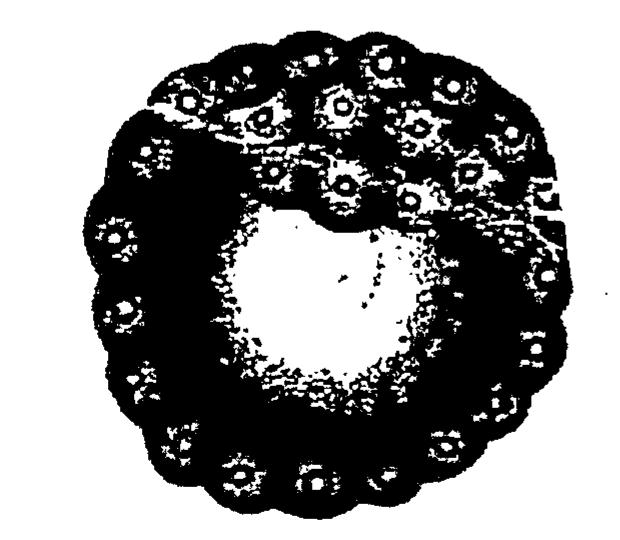
- Late morula — Middle part of Fallopian tube
- Blastula — End part of Fallopian tube
- Blastocyst — Uterine wall
- 8-celled morula — Starting point of Fallopian tube
Show answer
Answer: (C) Blastocyst — Uterine wall
Explanation: The figure, showing an outer layer of cells enclosing a fluid-filled cavity, is a blastocyst. Implantation of the embryo into the endometrium takes place at the blastocyst stage, so its right place of occurrence is the uterine wall.
Question 2
Previous-year questionThe meiotic division of the secondary oocyte is completed [NEET 2020]
- at the time of copulation
- after zygote formation
- at the time of fusion of a sperm with an ovum
- prior to ovulation
Show answer
Answer: (C) at the time of fusion of a sperm with an ovum
Explanation: The secondary oocyte remains arrested at metaphase II; only the entry of the sperm at fertilisation triggers completion of the second meiotic division.
Question 3
Previous-year questionThe extrusion of the second polar body from the egg nucleus occurs [NEET 2019]
- after the entry of the sperm but before fertilisation
- after fertilisation
- before the entry of the sperm into the ovum
- simultaneously with the first cleavage
Show answer
Answer: (A) after the entry of the sperm but before fertilisation
Explanation: Entry of the sperm activates the secondary oocyte to complete meiosis II, and the second polar body is extruded before the two pronuclei actually fuse.
Question 4
Previous-year questionCapacitation occurs in the [NEET 2017]
- epididymis
- vas deferens
- female reproductive tract
- rete testis
Show answer
Answer: (C) female reproductive tract
Explanation: Sperms become fully capable of fertilising only after spending some hours in the female reproductive tract, where membrane changes known as capacitation take place.
Question 5
Previous-year questionFertilization in humans is practically feasible only if [NEET 2016]
- the sperms are transported into the vagina just after the release of the ovum in the fallopian tube
- the ovum and sperms are transported simultaneously to the ampullary-isthmic junction of the fallopian tube
- the ovum and sperms are transported simultaneously to the ampullary-isthmic junction of the cervix
- the sperms are transported into the cervix within 48 hrs of the release of the ovum in the uterus
Show answer
Answer: (B) the ovum and sperms are transported simultaneously to the ampullary-isthmic junction of the fallopian tube
Explanation: Because of the short viability of the gametes, fertilisation can occur only if the ovum and the sperms arrive together at the ampullary-isthmic junction of the oviduct.
Question 6
Previous-year questionBlastopore is [AIPMT 2000, 1992]
- opening of Neural tube
- opening of gastrocoel
- future anterior end of embryo
- found in blastula
Show answer
Answer: (B) opening of gastrocoel
Explanation: During gastrulation the migration and rearrangement of cells forms a new cavity, the archenteron or gastrocoel. The blastopore is the external opening of this gastrocoel.
Question 7
Previous-year questionCleavage in mammalian egg is [AIPMT 2000]
- equal holoblastic
- unequal holoblastic
- superficial meroblastic
- discoidal meroblastic
Show answer
Answer: (B) unequal holoblastic
Explanation: The mammalian egg is alecithal, so the cleavage furrow passes completely through it (holoblastic). The first cleavage occurs about 30 hours after fertilisation and produces two blastomeres, one slightly larger than the other, so it is unequal holoblastic.
Doing well? Create a free account to take timed tests on this topic and see your weak areas.
Question 8
Previous-year questionWhat is true for cleavage? [AIPMT 2002]
- Size of embryo increases
- Size of cells decreases
- Size of cells increases
- Size of embryo decreases
Show answer
Answer: (B) Size of cells decreases
Explanation: Cleavage is a succession of rapid mitotic divisions in which the cells pass through S and M phases but virtually skip G₁ and G₂. As a result the cytoplasm of the zygote is divided into progressively smaller blastomeres while the overall size of the embryo remains unchanged.
Question 9
Previous-year questionGray crescent is the area [AIPMT 2005]
- at the point of entry of sperm into ovum
- just opposite to the site of entry of sperm into ovum
- at the animal pole
- at the vegetal pole
Show answer
Answer: (B) just opposite to the site of entry of sperm into ovum
Explanation: The grey crescent is a crescent-shaped, greyish region of cytoplasm that appears just opposite to the point of sperm entry after fertilisation. It marks the future dorsal side of the embryo.
Question 10
Previous-year questionA change in the amount of yolk and its distribution in the egg will affect. [AIPMT 2009, 1995, 1993]
- Formation of zygote
- Pattern of cleavage
- Number of blastomeres produced
- Fertilisation
Show answer
Answer: (B) Pattern of cleavage
Explanation: The pattern of cleavage is governed by the quantity and distribution of yolk. Holoblastic cleavage occurs in microlecithal, mesolecithal and telolecithal eggs, whereas meroblastic cleavage occurs in the heavily telolecithal eggs of reptiles, birds and monotremes.
Question 11
Previous-year questionWhich one of the following statements about morula in humans is correct? [AIPMT 2010]
- It has almost equal quantity of cytoplasm as an uncleaved zygote, but much more DNA
- It has far less cytoplasm as well as less DNA than in an uncleaved zygote
- It has more or less equal quantity of cytoplasm and DNA
- It has more cytoplasm and more DNA than an uncleaved zygote
Show answer
Answer: (A) It has almost equal quantity of cytoplasm as an uncleaved zygote, but much more DNA
Explanation: Cleavage consists of rapid mitotic divisions without any growth of the daughter blastomeres. Consequently the total amount of cytoplasm remains almost the same as in the uncleaved zygote, while the DNA content increases many-fold with every nuclear division.
Question 12
Previous-year questionIn human female, the blastocyst [AIPMT 2010]
- forms placenta even before implantation
- gets unplanted into uterus 3 days after ovulation
- gets nutrition from uterine endometria secretion only after implantation
- gets implanted in endometrium, by the trophoblast cells
Show answer
Answer: (D) gets implanted in endometrium, by the trophoblast cells
Explanation: Before implantation the blastomeres of the blastocyst are arranged into an outer trophoblast layer and an inner cell mass. The trophoblast layer attaches the blastocyst to the endometrium, while the inner cell mass differentiates into the embryo.
Question 13
Previous-year questionThe second maturation division of the mammalian ovum occurs [AIPMT 2010]
- shortly after ovulation before the ovum makes entry into the Fallopian tube
- until after the ovum has been penetrated by a sperm
- until the nucleus of the sperm has fused with that of the ovum
- in the Graafian follicle following the maturation division
Show answer
Answer: (B) until after the ovum has been penetrated by a sperm
Explanation: During oogenesis the secondary oocyte begins meiosis II but is arrested at metaphase. The ovum is shed at this stage and the division resumes only after the ovum has been penetrated by a sperm in the Fallopian tube.
Question 14
Previous-year questionWhat happens during fertilisation in human after many sperms reach close to the ovum? [AIPMT 2011]
- Secretions of acrosome helps one sperm enter cytoplasm of ovum through zona pellucida
- All sperms except the one nearest to the ovum lose their tails
- Cells of corona radiata trap all the sperms except one
- Only two sperms nearest the ovum 'rate' zona pellucida
Show answer
Answer: (A) Secretions of acrosome helps one sperm enter cytoplasm of ovum through zona pellucida
Explanation: The acrosomal secretions (sperm lysins) dissolve the zona pellucida locally and enable one sperm to enter the cytoplasm of the ovum. Contact of that sperm with the zona pellucida induces changes in the membrane that block the entry of any further sperms.
Question 15
Previous-year questionCapacitation refers to changes in the [AIPMT 2015]
- ovum before fertilisation
- ovum after fertilisation
- sperm after fertilisation
- sperm before fertilisation
Show answer
Answer: (D) sperm before fertilisation
Explanation: Capacitation refers to the changes that occur in the sperms in the female reproductive tract before fertilisation. During this period the cholesterol vesicles covering the acrosome are removed and the acrosomal membrane becomes more permeable.
Want more Human Reproduction – Fertilisation and Implantation questions?
E-GYAN NIDHI has 115 questions on this topic and 63,000+ in total, all free: timed CBT tests, NEET marking and instant analysis.
Register free Free Sunday Mock TestMore topics in Reproduction
- Human Reproduction – Male Reproductive System MCQs
- Human Reproduction – Female Reproductive System MCQs
- Human Reproduction – Gametogenesis-spermatogenesis & oogenesis MCQs
- Human Reproduction – Menstrual Cycle MCQs
- Human Reproduction – Pregnancy and Embryonic Development MCQs
- Human Reproduction – Parturition and Lactation MCQs
- Human Reproductive Health – Population Stabilisation and Birth Control MCQs
- Human Reproductive Health – Amniocentesis MCQs
- Human Reproductive Health – Sexually Transmitted Infections (STIs) MCQs
- Human Reproductive Health – Infertility MCQs