Thermal Properties of Matter – Specific Heat Capacity: NEET MCQs with Answers
15 free questions on Thermal Properties of Matter – Specific Heat Capacity for NEET (UG), starting with previous-year NEET and AIPMT questions. Try each one, then tap Show answer for the answer and a short explanation.
Syllabus covered: Specific Heat Capacity, Change of State and Calorimetry: specific heat capacity, calorimetry; change of state, latent heat.
Question 1
Previous-year questionLiquid oxygen at 50 K is heated to 300 K at a constant pressure of 1 atm. The rate of heating is constant. Which one of the graphs in the figure represents the variation of temperature with time? [AIPMT 2012]
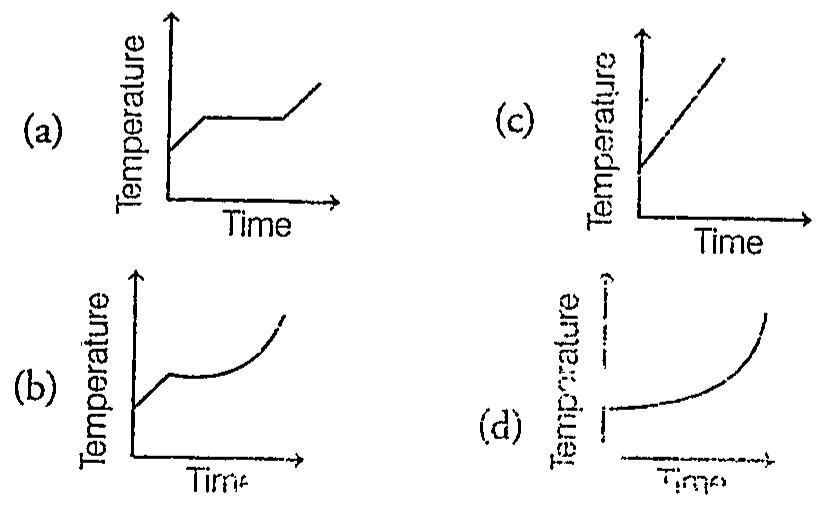
- Graph (a)
- Graph (b)
- Graph (c)
- Graph (d)
Show answer
Answer: (A) Graph (a)
Explanation: With a constant rate of heating, the temperature of a single phase rises steadily along a straight line. When the liquid reaches its boiling point, however, the supplied heat goes entirely into the latent heat of vaporisation, so the temperature stays fixed while the phase change proceeds — the graph must show a horizontal plateau there. Once all the oxygen has become gas, the temperature climbs again. The correct shape is therefore rise → flat plateau → rise, which is graph (a).
Question 2
Previous-year questionThe quantities of heat required to raise the temperature of two solid copper spheres of radii r₁ and r₂ (r₁ = 1.5r₂) through 1 K are in the ratio [NEET 2020]
- 9/4
- 3/2
- 5/3
- 27/8
Show answer
Answer: (D) 27/8
Explanation: The heat needed is proportional to the mass and hence to r³, so the ratio is (1.5)³ = 27/8.
Question 3
Previous-year questionA piece of ice falls from a height h so that it melts completely. Only one-quarter of the heat produced is absorbed by the ice and all the energy of the ice gets converted into heat during its fall. The value of h is [latent heat of ice = 3.4 × 10⁵ J/kg and g = 10 N/kg] [NEET 2016]
- 34 km
- 544 km
- 136 km
- 68 km
Show answer
Answer: (C) 136 km
Explanation: mgh/4 = mL gives h = 4L/g = 136 km.
Question 4
Previous-year questionSteam at 100°C is passed into 20 g of water at 10°C. When the water acquires a temperature of 80°C, the mass of water present will be [take specific heat of water = 1 cal g⁻¹ °C⁻¹ and latent heat of steam = 540 cal g⁻¹] [AIPMT 2014]
- 24 g
- 31.5 g
- 42.5 g
- 22.5 g
Show answer
Answer: (D) 22.5 g
Explanation: If m gram of steam condenses, m(540) + m(20) = 20(70), so m ≈ 2.5 g. The total water present is then 20 + 2.5 = 22.5 g.
Question 5
Previous-year question10 g of ice cubes at 0°C are released in a tumbler (water equivalent 55 g) at 40°C. Assuming that negligible heat is taken from the surroundings, the temperature of water in the tumbler becomes nearly (L = 80 cal/g) [AIPMT 1988]
- 31°C
- 22°C
- 19°C
- 15°C
Show answer
Answer: (B) 22°C
Explanation: Let θ be the final temperature. Heat gained by the ice (melting, then warming) equals heat lost by the tumbler and its water: mL + msθ = 55 × (40 − θ) (10 × 80) + (10 × 1 × θ) = 55(40 − θ) 800 + 10θ = 2200 − 55θ 65θ = 1400 θ = 21.5 ≈ 22°C.
Question 6
Previous-year questionTwo containers A and B are partly filled with water and closed. The volume of A is twice that of B and it contains half the amount of water in B. If both are at the same temperature, the water vapour in the containers will have pressure in the ratio of [AIPMT 1988]
- 1 : 2
- 1 : 1
- 2 : 1
- 4 : 1
Show answer
Answer: (B) 1 : 1
Explanation: In a closed container with liquid present, the vapour reaches saturation, and the saturated vapour pressure of a substance depends only on its temperature. It is independent of the volume of the container and of how much liquid is present, provided some liquid remains. Since both containers are at the same temperature, the ratio is 1 : 1.
Question 7
Previous-year questionThe thermal capacity of 40 g of aluminium (s = 0.2 cal/g-K) is [AIPMT 1990]
- 168 J/°C
- 672 J/°C
- 840 J/°C
- 33.6 J/°C
Show answer
Answer: (D) 33.6 J/°C
Explanation: Thermal capacity is the heat needed to raise the whole body's temperature by 1 degree: C = ms = 40 × 0.2 = 8 cal/°C. Converting to joules using 1 cal = 4.2 J : C = 8 × 4.2 = 33.6 J/°C.
Doing well? Create a free account to take timed tests on this topic and see your weak areas.
Question 8
Previous-year questionIf 1 g of steam is mixed with 1 g of ice, then the resultant temperature of the mixture is [AIPMT 1999]
- 270°C
- 230°C
- 100°C
- 50°C
Show answer
Answer: (C) 100°C
Explanation: Heat needed to take 1 g of ice at 0°C all the way to water at 100°C: Q = mL_fusion + msΔθ = (1 × 80) + (1 × 1 × 100) = 180 cal. Heat available if 1 g of steam fully condensed at 100°C: Q′ = mL_vaporisation = 1 × 536 = 536 cal. Since 536 cal is far more than the 180 cal needed, only part of the steam condenses and the mixture settles at the condensation temperature, 100°C.
Question 9
Previous-year questionAn electric kettle takes a current of 4 A at 220 V. How much time will it take to boil 1 kg of water from a temperature of 20°C? (The temperature of boiling water is 100°C) [AIPMT 2008]
- 6.3 min
- 8.4 min
- 12.6 min
- 4.2 min
Show answer
Answer: (A) 6.3 min
Explanation: Heat required, Q = msΔT = 1 × 4200 × (100 − 20) = 3.36 × 10⁵ J. Power supplied, P = VI = 220 × 4 = 880 W. So t = Q/P = 3.36 × 10⁵/880 ≈ 382 s ≈ 6.3 min.
Question 10
Previous-year questionSteam at 100°C is passed into 20 g of water at 10°C. When the water acquires a temperature of 80°C, the mass of water present will be [Take the specific heat of water = 1 cal g⁻¹ °C⁻¹ and the latent heat of steam = 540 cal g⁻¹] [AIPMT 2014]
- 24 g
- 31.5 g
- 42.5 g
- 22.5 g
Show answer
Answer: (D) 22.5 g
Explanation: Let m′ be the mass of steam that condenses. Heat lost by the steam (condensing, then cooling from 100°C to 80°C) equals heat gained by the water: m′L + m′s(100 − 80) = 20 × s × (80 − 10) m′(540 + 20) = 20 × 70 = 1400 m′ = 1400/560 = 2.5 g Total mass of water present = 20 + 2.5 = 22.5 g. Note the question asks for the total water, not just the condensed steam.
Question 11
Previous-year questionTwo identical bodies are made of a material for which the heat capacity increases with temperature. One of these is at 100°C, while the other one is at 0°C. If the two bodies are brought into contact, then assuming no heat loss, the final common temperature is [NEET 2016]
- 50°C
- more than 50°C
- less than 50°C but greater than 0°C
- 0°C
Show answer
Answer: (B) more than 50°C
Explanation: Because heat capacity rises with temperature, the hotter body has the larger heat capacity over its range. Giving up a certain amount of heat therefore lowers its temperature by less than the same amount of heat raises the temperature of the colder body. The balance point is consequently pulled towards the hotter body, so the final common temperature is more than 50°C. (If the heat capacity were constant, the answer would be exactly 50°C.)
Question 12
Previous-year questionA piece of ice falls from a height h so that it melts completely. Only one-quarter of the heat produced is absorbed by the ice, and all the energy of the ice gets converted into heat during its fall. The value of h is [Latent heat of ice is 3.4 × 10⁵ J/kg and g = 10 N/kg] [NEET 2016]
- 544 km
- 136 km
- 68 km
- 34 km
Show answer
Answer: (B) 136 km
Explanation: The energy released in the fall is mgh, but only a quarter of it is absorbed by the ice, and that quarter must supply the latent heat: mgh/4 = mL h = 4L/g = (4 × 3.4 × 10⁵)/10 = 1.36 × 10⁵ m = 136 km.
Question 13
Previous-year questionThe quantities of heat required to raise the temperature of two solid copper spheres of radii r₁ and r₂ (with r₁ = 1.5r₂) through 1 K are in the ratio [NEET (Sep.) 2020]
- 9/4
- 3/2
- 5/3
- 27/8
Show answer
Answer: (D) 27/8
Explanation: Q = mcΔT and m = ρV = ρ(4/3)πr³, so for the same material and the same temperature rise, Q ∝ r³. Q₁/Q₂ = (r₁/r₂)³ = (1.5)³ = 27/8. The common trap is to use the ratio of surface areas or radii — the heat needed scales with mass, hence with volume.
Question 14
Previous-year questionA piece of ice falls from a height h so that it melts completely. Only one-quarter of the heat produced is absorbed by the ice and all the energy of the ice gets converted into heat during its fall. The value of h is (L_ice = 3.4×10⁵ J/kg, g = 10 N/kg): [AIPMT 2016]
- 34 km
- 544 km
- 136 km
- 68 km
Show answer
Answer: (C) 136 km
Explanation: Only one-quarter of the heat produced is absorbed by the ice: (1/4)mgh = mL. The mass cancels, giving h = 4L/g = 4×3.4×10⁵/10 = 1.36×10⁵ m = 136 km. Previous Years’ Questions — JEE Main / AIEEE
Question 15
Previous-year questionSteam at 100°C is passed into 20 g of water at 10°C. When the water acquires a temperature of 80°C, the mass of water present will be (s_water = 1 cal/g°C, L_steam = 540 cal/g): [AIPMT 2014]
- 24 g
- 31.5 g
- 42.5 g
- 22.5 g
Show answer
Answer: (D) 22.5 g
Explanation: Let m grams of steam condense. Heat released = 540m (condensation) + m×1×(100−80) = 560m cal. Heat gained by the water = 20×1×(80−10) = 1400 cal. So 560m = 1400 ⇒ m = 2.5 g. Total mass of water = 20 + 2.5 = 22.5 g.
Want more Thermal Properties of Matter – Specific Heat Capacity questions?
E-GYAN NIDHI has 162 questions on this topic and 63,000+ in total, all free: timed CBT tests, NEET marking and instant analysis.
Register free Free Sunday Mock TestMore topics in PROPERTIES OF SOLIDS AND LIQUIDS
- Mechanical Properties of Solid – Elastic Behaviour of Material MCQs
- Mechanical Properties of Fluids – Fluid's Flow MCQs
- Mechanical Properties of Fluids – Surface Tension and Capillarity MCQs
- Mechanical Properties of Fluids – Pressure MCQs
- Thermal Properties of Matter – Thermometry and Thermal Expansion MCQs
- Thermal Properties of Matter – Heat Transfer MCQs