Mechanical Properties of Solid – Elastic Behaviour of Material: NEET MCQs with Answers
15 free questions on Mechanical Properties of Solid – Elastic Behaviour of Material for NEET (UG), starting with previous-year NEET and AIPMT questions. Try each one, then tap Show answer for the answer and a short explanation.
Syllabus covered: Elastic Behaviour of Material, Hooke's Law and Elastic Moduli: Elastic behaviour, Stress-strain relationship, Hooke's Law. Young's modulus, bulk modulus, modulus of rigidity, Effect of gravity on fluid pressure,
Question 1
Previous-year questionThe ratios of the diameters, the lengths and the Young's moduli of the steel and copper wires shown in the figure are p, q and s respectively. The corresponding ratio of the increase in their lengths would be [NEET 2013]
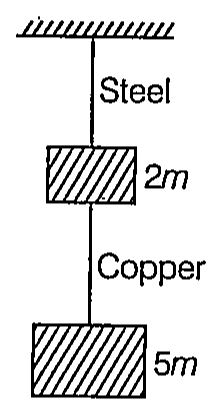
- 5q/(7sp²)
- 7q/(5sp²)
- 2q/(5sp)
- 7q/(5sp)
Show answer
Answer: (B) 7q/(5sp²)
Explanation: The steel wire carries both blocks, so F_s = (2m + 5m)g = 7mg, while the copper wire carries only the lower block, F_c = 5mg. For a wire of diameter D, ΔL = 4FL/(πD²Y). ΔL_s/ΔL_c = (F_s/F_c)(L_s/L_c)(D_c/D_s)²(Y_c/Y_s) = (7mg/5mg) × q × (1/p)² × (1/s) = 7q/(5sp²).
Question 2
Previous-year questionA wire of length L and area of cross-section A is hanging from a fixed support. The length of the wire changes to L₁ when a mass M is suspended from its free end. The expression for Young's modulus is [NEET 2020]
- Mg(L₁ – L)/AL
- MgL/AL₁
- MgL/A(L₁ – L)
- MgL₁/AL
Show answer
Answer: (C) MgL/A(L₁ – L)
Explanation: The extension is (L₁ – L), so Y = (Mg/A)/[(L₁ – L)/L] = MgL/[A(L₁ – L)].
Question 3
Previous-year questionThe bulk modulus of a spherical object is B. If it is subjected to a uniform pressure p, the fractional decrease in its radius is [NEET 2017]
- B/3p
- 3p/B
- p/3B
- p/B
Show answer
Answer: (C) p/3B
Explanation: ΔV/V = p/B and ΔV/V = 3Δr/r for a sphere, so Δr/r = p/3B.
Question 4
Previous-year questionThe Young's modulus of steel is twice that of brass. Two wires of the same length and of the same area of cross-section, one of steel and another of brass, are suspended from the same roof. If we want the lower ends of the wires to be at the same level, then the weights added to the steel and brass wires must be in the ratio of [AIPMT 2015]
- 2 : 1
- 4 : 1
- 1 : 1
- 1 : 2
Show answer
Answer: (A) 2 : 1
Explanation: Equal extensions with equal L and A require W ∝ Y, so the steel wire must carry twice the load: 2 : 1.
Question 5
Previous-year questionCopper of fixed volume V is drawn into a wire of length ℓ. When this wire is subjected to a constant force F, the extension produced is Δℓ. Which of the following graphs is a straight line? [AIPMT 2014]
- Δℓ versus 1/ℓ
- Δℓ versus ℓ²
- Δℓ versus 1/ℓ²
- Δℓ versus ℓ
Show answer
Answer: (B) Δℓ versus ℓ²
Explanation: With A = V/ℓ, Δℓ = Fℓ/(AY) = Fℓ²/(VY). So Δℓ is proportional to ℓ² and that graph is the straight line.
Question 6
Previous-year questionTwo wires A and B are made of the same material. Their lengths are in the ratio 1 : 2 and their diameters are in the ratio 2 : 1. If they are pulled by the same force, the increase in their lengths will be in the ratio [AIPMT 1988]
- 2 : 1
- 1 : 4
- 1 : 8
- 8 : 1
Show answer
Answer: (C) 1 : 8
Explanation: ΔL = 4FL/(πD²Y), so for the same force and material ΔL ∝ L/D². ΔL_A/ΔL_B = (L_A/L_B) × (D_B/D_A)² = (1/2) × (1/2)² = (1/2)(1/4) = 1/8. Hence the ratio is 1 : 8.
Question 7
Previous-year questionThe following four wires are made of the same material. Which of these will have the largest extension when the same tension is applied? [NEET 2013]
- Length = 50 cm, diameter = 0.5 mm
- Length = 100 cm, diameter = 1 mm
- Length = 200 cm, diameter = 2 mm
- Length = 300 cm, diameter = 3 mm
Show answer
Answer: (A) Length = 50 cm, diameter = 0.5 mm
Explanation: From Y = FL/(AΔL) with A = πd²/4, ΔL = 4FL/(πd²Y), so for the same tension and material ΔL ∝ L/d². With L in cm and d in mm, L/d² is 200 for the 50 cm, 0.5 mm wire, against 100, 50 and 33.3 for the 100 cm, 200 cm and 300 cm wires, so the 50 cm, 0.5 mm wire stretches the most.
Doing well? Create a free account to take timed tests on this topic and see your weak areas.
Question 8
Previous-year questionThe approximate depth of an ocean is 2700 m. The compressibility of water is 45.4 × 10⁻¹¹ Pa⁻¹ and the density of water is 10³ kg/m³. What fractional compression of water will be obtained at the bottom of the ocean? [AIPMT 2015 (Cancelled)]
- 1.2 × 10⁻²
- 1.4 × 10⁻²
- 0.8 × 10⁻²
- 1.0 × 10⁻²
Show answer
Answer: (A) 1.2 × 10⁻²
Explanation: Excess pressure at the bottom, Δp = ρgd = 10³ × 10 × 2700 = 2.7 × 10⁷ Pa. Compressibility K is the reciprocal of the bulk modulus, so ΔV/V = K × Δp = 45.4 × 10⁻¹¹ × 2.7 × 10⁷ = 1.226 × 10⁻² ≈ 1.2 × 10⁻².
Question 9
Previous-year questionThe Young's modulus of steel is twice that of brass. Two wires of the same length and of the same area of cross-section, one of steel and another of brass, are suspended from the same roof. If the lower ends of the wires are to be at the same level, the weights added to the steel and brass wires must be in the ratio of [AIPMT 2015]
- 4 : 1
- 1 : 1
- 1 : 2
- 2 : 1
Show answer
Answer: (D) 2 : 1
Explanation: For each wire, ΔL = WL/(YA). The wires have the same original length and cross-section, and the lower ends are level, so the elongations must be equal: W_s L/(Y_s A) = W_b L/(Y_b A) ⟹ W_s/W_b = Y_s/Y_b = 2/1. Hence the required ratio is 2 : 1 — the stiffer steel wire needs the greater load to stretch by the same amount.
Question 10
Previous-year questionThe bulk modulus of a spherical object is B. If it is subjected to a uniform pressure p, the fractional decrease in its radius is [NEET 2017]
- p/B
- B/3p
- 3p/B
- p/3B
Show answer
Answer: (D) p/3B
Explanation: By definition B = p/(ΔV/V), so the fractional decrease in volume is ΔV/V = p/B. For a sphere, V = (4/3)πR³, so a small change gives ΔV/V = 3ΔR/R. Therefore 3ΔR/R = p/B ⟹ ΔR/R = p/3B.
Question 11
Previous-year questionTwo wires are made of the same material and have the same volume. The first wire has cross-sectional area A and the second has cross-sectional area 3A. If the length of the first wire is increased by Δl on applying a force F, how much force is needed to stretch the second wire by the same amount? [NEET 2018]
- 4F
- 6F
- 9F
- F
Show answer
Answer: (C) 9F
Explanation: Since the volume V = Al is fixed, the length of each wire is l = V/A. Y = Fl/(AΔl) = F(V/A)/(AΔl) = FV/(A²Δl). The wires are of the same material (same Y), the same volume V, and are stretched by the same Δl, so F ∝ A². F₂/F₁ = (3A/A)² = 9 ⟹ F₂ = 9F.
Question 12
Previous-year questionA wire of length L and area of cross-section A hangs from a fixed support. When a mass M is suspended from its free end, the length of the wire changes to L₁. The expression for Young's modulus is [NEET (Sep.) 2020]
- Mg(L₁ − L)/(AL)
- MgL/(AL₁)
- MgL/[A(L₁ − L)]
- MgL₁/(AL)
Show answer
Answer: (C) MgL/[A(L₁ − L)]
Explanation: The stretching force is F = Mg and the increase in length is ΔL = L₁ − L. Y = normal stress / longitudinal strain = (Mg/A) / [(L₁ − L)/L] = MgL/[A(L₁ − L)].
Question 13
Previous-year questionGiven below are two statements. One is labelled as Assertion (A) and the other is labelled as Reason (R). Assertion (A): The stretching of a spring is determined by the shear modulus of the material of the spring. Reason (R): A coil spring of copper has more tensile strength than a steel spring of the same dimensions. In the light of the above statements, choose the most appropriate answer from the options given below. [NEET 2022]
- Both A and R are true but R is not the correct explanation of A
- A is true but R is false
- A is false but R is true
- Both A and R are true and R is the correct explanation of A
Show answer
Answer: (B) A is true but R is false
Explanation: When a coil spring is stretched, the length and volume of its wire barely change; the wire is twisted, which is a shearing deformation, so the shear modulus governs the stretching. The Reason is false because steel has greater tensile strength than copper, so a copper spring is weaker than a steel one of the same dimensions.
Question 14
Previous-year questionA wire is suspended from the ceiling (a rigid support) and stretched by a weight w attached at its free end. The longitudinal stress at any point of cross-sectional area A of the wire is [NEET 2023]
- w/A
- w/2A
- zero
- 2w/A
Show answer
Answer: (A) w/A
Explanation: Longitudinal stress is defined as the restoring force per unit area of cross-section. At any section of the wire, the portion below it is in equilibrium under the applied weight w, so the tension there is w. Stress = force/area = w/A. (Neglecting the weight of the wire itself, this stress is the same at every point along its length.)
Question 15
Previous-year questionThe elastic limit of steel is 8 × 10⁸ N m⁻² and its Young's modulus is 2 × 10¹¹ N m⁻². The maximum elongation of a steel wire of length 1 m is [NEET 2024]
- 4 mm
- 0.4 mm
- 40 mm
- 8 mm
Show answer
Answer: (A) 4 mm
Explanation: Young's modulus relates stress and strain as Y = (F/A)/(Δl/l). The largest stress the wire can bear is the elastic limit, so F/A = E = 8 × 10⁸ N m⁻². Δl = (E/Y) × l = (8 × 10⁸ / 2 × 10¹¹) × 1 = 4 × 10⁻³ m = 4 mm.
Want more Mechanical Properties of Solid – Elastic Behaviour of Material questions?
E-GYAN NIDHI has 286 questions on this topic and 63,000+ in total, all free: timed CBT tests, NEET marking and instant analysis.
Register free Free Sunday Mock TestMore topics in PROPERTIES OF SOLIDS AND LIQUIDS
- Mechanical Properties of Fluids – Fluid's Flow MCQs
- Mechanical Properties of Fluids – Surface Tension and Capillarity MCQs
- Mechanical Properties of Fluids – Pressure MCQs
- Thermal Properties of Matter – Thermometry and Thermal Expansion MCQs
- Thermal Properties of Matter – Specific Heat Capacity MCQs
- Thermal Properties of Matter – Heat Transfer MCQs