Thermal Properties of Matter – Heat Transfer: NEET MCQs with Answers
15 free questions on Thermal Properties of Matter – Heat Transfer for NEET (UG), starting with previous-year NEET and AIPMT questions. Try each one, then tap Show answer for the answer and a short explanation.
Syllabus covered: Heat Transfer: Heat transfer- conduction, convection, and radiation.
Question 1
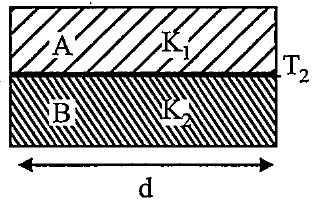
Previous-year questionTwo rods A and B of different materials are welded together as shown in the figure. Their thermal conductivities are K₁ and K₂. The thermal conductivity of the composite rod will be [NEET 2017]
- 3(K₁ + K₂)/2
- K₁ + K₂
- 2(K₁ + K₂)
- (K₁ + K₂)/2
Show answer
Answer: (D) (K₁ + K₂)/2
Explanation: The two slabs of equal area lie side by side across the same temperature difference — a parallel combination — so K = (K₁ + K₂)/2.
Question 2
Previous-year questionA black body of surface area 20 cm² is heated to 227 °C and suspended in a room at 27 °C. The initial rate of heat loss from the body is (emissivity = 0.5, Stefan's constant σ = 6 × 10⁻⁸ W/m² K⁴) [NEET 2021 (Paper-2)]
- 1.6 W
- 3.2 W
- 4.8 W
- 6.4 W
Show answer
Answer: (B) 3.2 W
Explanation: Net rate of heat loss = eσA(T⁴ – T₀⁴) = 0.5 × 6 × 10⁻⁸ × 20 × 10⁻⁴ × (500⁴ – 300⁴) ≈ 3.2 W, taking the stated emissivity of 0.5.
Question 3
Previous-year questionAn object in a large room at 25 °C takes 12 minutes to cool from 80 °C to 70 °C. The time taken to cool from 70 °C to 60 °C would be nearly [NEET 2019 (Odisha)]
- 10 min
- 12 min
- 20 min
- 15 min
Show answer
Answer: (D) 15 min
Explanation: 10/12 = k(75 – 25) = 50k and 10/t = k(65 – 25) = 40k. Dividing: t/12 = 50/40 ⇒ t = 15 min.
Question 4
Previous-year questionAssertion: Houses made of concrete roofs overlaid with foam keep the room hotter during summer. Reason: The layer of foam insulation prohibits heat transfer, as it contains air pockets. [Re-NEET 2024]
- Both Assertion and Reason are true and the Reason is a correct explanation of the Assertion.
- Assertion is false but Reason is true.
- Both Assertion and Reason are true but the Reason is not a correct explanation of the Assertion.
- Both Assertion and Reason are false.
Show answer
Answer: (B) Assertion is false but Reason is true.
Explanation: Foam contains trapped air pockets, making it a very poor conductor, so it blocks heat flow (Reason true). Because it blocks the inward flow of heat, it keeps the room cooler, not hotter, in summer (Assertion false).
Question 5
Previous-year questionTwo rods, one of copper and the other of steel, of the same length and cross-sectional area are joined end to end. The thermal conductivities of copper and steel are 385 J s⁻¹ K⁻¹ m⁻¹ and 50 J s⁻¹ K⁻¹ m⁻¹. The free ends of copper and steel are held at 100 °C and 0 °C. The temperature at the junction is nearly [Re-NEET 2022]
- 12 °C
- 50 °C
- 73 °C
- 88.5 °C
Show answer
Answer: (D) 88.5 °C
Explanation: Equal heat current: 385(100 – θ) = 50(θ – 0) ⇒ 38500 = 435θ ⇒ θ ≈ 88.5 °C.
Question 6
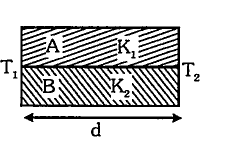
Previous-year questionTwo rods A and B of different materials are welded together side by side as shown. Their thermal conductivities are K₁ and K₂. The thermal conductivity of the composite rod will be [NEET 2017]
- 3(K₁ + K₂)/2
- K₁ + K₂
- 2(K₁ + K₂)
- (K₁ + K₂)/2
Show answer
Answer: (D) (K₁ + K₂)/2
Explanation: The rods are in parallel (same ΔT, same length d, equal areas A). K_eq(2A)ΔT/d = K₁AΔT/d + K₂AΔT/d ⇒ K_eq = (K₁ + K₂)/2.
Question 7
Previous-year questionA certain quantity of water cools from 70°C to 60°C in the first 5 minutes and to 54°C in the next 5 minutes. The temperature of the surroundings is [AIPMT 2014]
- 45°C
- 20°C
- 42°C
- 10°C
Show answer
Answer: (A) 45°C
Explanation: Using (70 – 60)/5 = k(65 – θ₀) and (60 – 54)/5 = k(57 – θ₀) and dividing, 10(57 – θ₀) = 6(65 – θ₀), which gives θ₀ = 45°C.
Doing well? Create a free account to take timed tests on this topic and see your weak areas.
Question 8
Previous-year questionA black body is at a temperature of 5760 K. The energy of radiation emitted by the body at wavelength 250 nm is U₁, at wavelength 500 nm is U₂ and that at 1000 nm is U₃. Wien's constant b = 2.88 × 10⁶ nm K. Which of the following is correct? [NEET 2016]
- U₁ = 0
- U₃ = 0
- U₁ > U₂
- U₂ > U₁
Show answer
Answer: (D) U₂ > U₁
Explanation: λ_m = 2.88 × 10⁶/5760 = 500 nm, so the emission peaks at 500 nm and U₂ exceeds the value at either 250 nm or 1000 nm.
Question 9
Previous-year questionThe power radiated by a black body is P and it radiates maximum energy at wavelength λ₀. If the temperature of the black body is now changed so that it radiates maximum energy at wavelength (3/4)λ₀, the power radiated by it becomes nP. The value of n is [NEET 2018]
- 3/4
- 4/3
- 81/256
- 256/81
Show answer
Answer: (D) 256/81
Explanation: Wien's law gives T′ = (4/3)T, and since P ∝ T⁴ the power becomes (4/3)⁴ = 256/81 times as large.
Question 10
Previous-year questionA spherical black body with a radius of 12 cm radiates 450 watt power at 500 K. If the radius were halved and the temperature doubled, the power radiated in watt would be [NEET 2017]
- 450
- 1000
- 1800
- 225
Show answer
Answer: (C) 1800
Explanation: P ∝ r²T⁴. Halving r divides the power by 4 and doubling T multiplies it by 16, so the net factor is 4 and P = 1800 W.
Question 11
Previous-year questionIf the temperature of the Sun is doubled, the rate of energy received on the earth will be increased by a factor of [AIPMT 1993]
- 2
- 4
- 8
- 16
Show answer
Answer: (D) 16
Explanation: By the Stefan-Boltzmann law, E ∝ T⁴. If T becomes 2T, then E becomes (2)⁴ = 16 times its original value.
Question 12
Previous-year questionA black body is at a temperature of 500 K. It emits energy at a rate which is proportional to [AIPMT 1997]
- (500)⁴
- (500)³
- (500)²
- 500
Show answer
Answer: (A) (500)⁴
Explanation: Stefan's law states that the energy radiated per unit area per unit time is E = σT⁴. Since the body is already at 500 K on the absolute scale, the rate is proportional to (500)⁴.
Question 13
Previous-year questionThe radiant energy from the Sun, incident normally at the surface of the earth, is 20 kcal/m² min. What would have been the radiant energy incident normally on the earth if the Sun had a temperature twice the present one? [AIPMT 1998]
- 160 kcal/m² min
- 40 kcal/m² min
- 320 kcal/m² min
- 80 kcal/m² min
Show answer
Answer: (C) 320 kcal/m² min
Explanation: By Stefan's law E ∝ T⁴, so doubling the temperature multiplies the radiant energy by 2⁴ = 16. E₂ = 20 × 16 = 320 kcal/m² min.
Question 14
Previous-year questionWhich one of the following processes depends on gravity? [AIPMT 2000]
- Conduction
- Convection
- Radiation
- None of these
Show answer
Answer: (B) Convection
Explanation: In convection the warmer, lighter portions of the fluid move upward while the cooler, heavier portions sink to take their place. That movement depends on weight, and therefore on gravity. Conduction transmits heat through a body without any bulk movement of its particles, and radiation travels even through a vacuum — neither depends on gravity.
Question 15
Previous-year questionThe presence of a gravitational field is required for heat transfer by [AIPMT 2000]
- conduction
- stirring of liquids
- natural convection
- radiation
Show answer
Answer: (C) natural convection
Explanation: Natural convection works because the heated fluid becomes less dense and rises while cooler, denser fluid sinks — a circulation driven entirely by buoyancy, which requires gravity. Conduction passes energy between neighbouring particles and radiation travels as electromagnetic waves; neither needs gravity. Stirring is forced convection, driven mechanically rather than by gravity.
Want more Thermal Properties of Matter – Heat Transfer questions?
E-GYAN NIDHI has 346 questions on this topic and 63,000+ in total, all free: timed CBT tests, NEET marking and instant analysis.
Register free Free Sunday Mock TestMore topics in PROPERTIES OF SOLIDS AND LIQUIDS
- Mechanical Properties of Solid – Elastic Behaviour of Material MCQs
- Mechanical Properties of Fluids – Fluid's Flow MCQs
- Mechanical Properties of Fluids – Surface Tension and Capillarity MCQs
- Mechanical Properties of Fluids – Pressure MCQs
- Thermal Properties of Matter – Thermometry and Thermal Expansion MCQs
- Thermal Properties of Matter – Specific Heat Capacity MCQs