Mechanical Properties of Fluids – Fluid's Flow: NEET MCQs with Answers
15 free questions on Mechanical Properties of Fluids – Fluid's Flow for NEET (UG), starting with previous-year NEET and AIPMT questions. Try each one, then tap Show answer for the answer and a short explanation.
Syllabus covered: Fluid's Flow, Viscosity and Bernoulli's Principle: Viscosity. Stokes' law. terminal velocity, streamline, and turbulent flow. critical velocity. Bernoulli's principle and its applications.
Question 1
Previous-year questionA body is falling freely in a resistive medium. Its motion is described by dv/dt = 4 − 2v, where v (in m s⁻¹) is its velocity at any instant. The initial acceleration and the terminal velocity are respectively: [NEET 2024]
- 2 m s⁻², 4 m s⁻¹
- 6 m s⁻², 2 m s⁻¹
- 2 m s⁻², 6 m s⁻¹
- 4 m s⁻², 2 m s⁻¹
Show answer
Answer: (D) 4 m s⁻², 2 m s⁻¹
Explanation: Initially v = 0, so a = dv/dt = 4 m s⁻². At terminal velocity dv/dt = 0 ⇒ 4 − 2v = 0 ⇒ v = 2 m s⁻¹.
Question 2
Previous-year questionThe viscous drag acting on a metal sphere of diameter 1 mm, falling through a fluid of viscosity 0.8 Pa·s with a velocity of 2 m s⁻¹, is: [NEET 2023]
- 15 × 10⁻³ N
- 30 × 10⁻³ N
- 1.5 × 10⁻³ N
- 20 × 10⁻³ N
Show answer
Answer: (A) 15 × 10⁻³ N
Explanation: r = 0.5 mm = 5 × 10⁻⁴ m. F = 6πηrv = 6 × 3.14 × 0.8 × 5 × 10⁻⁴ × 2 ≈ 15 × 10⁻³ N.
Question 3
Previous-year questionThe terminal velocity of a copper ball of radius 5 mm falling through a tank of oil at room temperature is 10 cm s⁻¹. If the viscosity of the oil is 0.9 kg m⁻¹ s⁻¹, the viscous drag force is: [NEET 2022]
- 8.48 × 10⁻³ N
- 8.48 × 10⁻⁵ N
- 4.23 × 10⁻³ N
- 4.23 × 10⁻⁶ N
Show answer
Answer: (A) 8.48 × 10⁻³ N
Explanation: F = 6πηrv = 6 × 3.14 × 0.9 × 5 × 10⁻³ × 0.1. F = 8.48 × 10⁻³ N.
Question 4
Previous-year questionThe correct statement about the variation of viscosity of a fluid with increase in temperature is: [NEET 2022]
- viscosity of both liquids and gases increases
- viscosity of liquids increases
- viscosity of liquids decreases
- viscosity of gases decreases
Show answer
Answer: (C) viscosity of liquids decreases
Explanation: In liquids, viscosity is due to cohesive forces, which weaken on heating, so η decreases. In gases, viscosity arises from molecular transfer between layers, which increases with temperature.
Question 5
Previous-year questionAn open rectangular vessel full of petrol takes 20√2 minutes to empty through an orifice in its bottom. The time it takes to empty when half filled with petrol is: (neglect evaporation) [NEET 2021]
- 10 min
- 15 min
- 20 min
- 25 min
Show answer
Answer: (C) 20 min
Explanation: Time to empty a tank through a small orifice t = (A/a)√(2H/g) ∝ √H. t′ = 20√2 × √(1/2) = 20 min.
Question 6
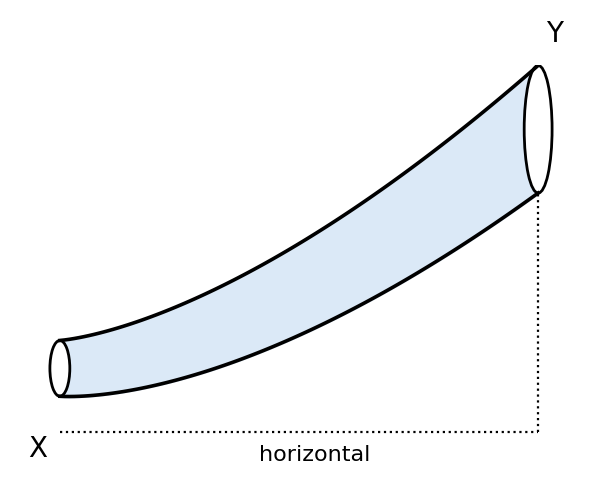
Previous-year questionAn ideal fluid flows in a non-uniform tube XY (as shown) from end X to end Y. If K₁ and K₂ are the kinetic energies per unit volume of the fluid at X and Y respectively, the correct option is: [Re-NEET 2024]
- K₁ = K₂
- 2K₁ = K₂
- K₁ > K₂
- K₁ < K₂
Show answer
Answer: (C) K₁ > K₂
Explanation: By continuity Av = constant, so the fluid moves faster where the tube is narrower. Kinetic energy per unit volume ½ρv² is therefore larger at the narrower end X than at the wider end Y: K₁ > K₂.
Question 7
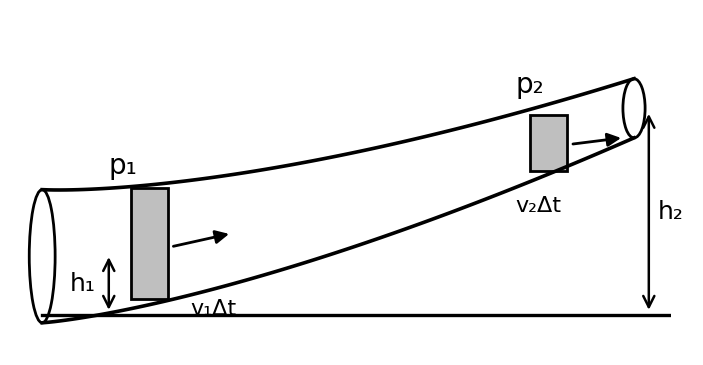
Previous-year questionA fluid of density ρ is flowing in a pipe of varying cross-sectional area as shown. Bernoulli's equation for the motion becomes: [NEET 2022]
- p + ½ρv² = constant
- ½ρv² + ρgh = constant
- p + ρgh = constant
- p + ½ρv² + ρgh = constant
Show answer
Answer: (D) p + ½ρv² + ρgh = constant
Explanation: The pipe changes both in cross-section (so v changes) and in height (so h changes). Hence the full form p + ½ρv² + ρgh = constant is needed.
Doing well? Create a free account to take timed tests on this topic and see your weak areas.
Question 8
Previous-year questionA small hole of area of cross-section 2 mm² is present near the bottom of a fully filled open tank of height 2 m. Taking g = 10 m/s², the rate of flow of water through the open hole would be nearly [NEET 2019]
- 12.6 × 10⁻⁶ m³/s
- 8.9 × 10⁻⁶ m³/s
- 2.23 × 10⁻⁶ m³/s
- 6.4 × 10⁻⁶ m³/s
Show answer
Answer: (A) 12.6 × 10⁻⁶ m³/s
Explanation: v = √(2gh) = √40 ≈ 6.32 m/s, so Q = Av = 2 × 10⁻⁶ × 6.32 ≈ 12.6 × 10⁻⁶ m³/s.
Question 9
Previous-year questionA small sphere of radius r falls from rest in a viscous liquid. As a result, heat is produced due to the viscous force. The rate of production of heat when the sphere attains its terminal velocity is proportional to [NEET 2018]
- r³
- r²
- r⁴
- r⁵
Show answer
Answer: (D) r⁵
Explanation: The rate of heat production is F v_t = (6πηrv_t)v_t ∝ r × (r²)² = r⁵, since v_t ∝ r².
Question 10
Previous-year questionThe terminal velocity v_r of a small steel ball of radius r falling under gravity through a column of a viscous liquid depends on the mass of the ball m, the acceleration due to gravity g, the coefficient of viscosity η and the radius r. Which of the following relations is dimensionally correct? [AIPMT 1992]
- v_r ∝ mgr/η
- v_r ∝ mgηr
- v_r ∝ mg/(rη)
- v_r ∝ ηmg/r
Show answer
Answer: (C) v_r ∝ mg/(rη)
Explanation: At terminal velocity, Stokes' law gives the balance mg = 6πηr v_r, so v_r = mg/(6πηr) ⟹ v_r ∝ mg/(rη). A dimensional check confirms this: [mg/(rη)] = (M L T⁻²)/(L × M L⁻¹ T⁻¹) = L T⁻¹, which is indeed a velocity.
Question 11
Previous-year questionA fluid is in streamline flow across a horizontal pipe of variable cross-sectional area. For this, which of the following statements is correct? [NEET 2013]
- The velocity is minimum at the narrowest part of the pipe and the pressure is minimum at the widest part of the pipe
- The velocity is maximum at the narrowest part of the pipe and the pressure is maximum at the widest part of the pipe
- Velocity and pressure are both maximum at the narrowest part of the pipe
- Velocity and pressure are both maximum at the widest part of the pipe
Show answer
Answer: (B) The velocity is maximum at the narrowest part of the pipe and the pressure is maximum at the widest part of the pipe
Explanation: By the equation of continuity, Av = constant, so the speed is greatest where the cross-section is smallest — the velocity is maximum at the narrowest part. By Bernoulli's theorem for a horizontal pipe, p + ½ρv² = constant, so the pressure is greatest where the speed is least — that is at the widest part. Hence velocity is maximum at the narrowest section while pressure is maximum at the widest section.
Question 12
Previous-year questionThe cylindrical tube of a spray pump has radius R, one end of which has n fine holes each of radius r. If the speed of the liquid in the tube is v, the speed of ejection of the liquid through the holes is [AIPMT 2015]
- vR²/(n²r²)
- vR²/(nr²)
- vR²/(n³r²)
- v²R/(nr)
Show answer
Answer: (B) vR²/(nr²)
Explanation: By the equation of continuity, the volume flow rate in the tube equals the total flow rate through all the holes: Av = A′v′ πR²v = n(πr²)v′ v′ = R²v/(nr²). Since the holes are fine and numerous, the emerging jet is much faster than the flow inside the tube.
Question 13
Previous-year questionA wind with a speed of 40 m/s blows parallel to the roof of a house. The area of the roof is 250 m². Assuming that the pressure inside the house is atmospheric pressure, the force exerted by the wind on the roof and its direction will be (ρ_air = 1.2 kg/m³) [AIPMT 2015]
- 4.8 × 10⁵ N, downwards
- 4.8 × 10⁵ N, upwards
- 2.4 × 10⁵ N, upwards
- 2.4 × 10⁵ N, downwards
Show answer
Answer: (C) 2.4 × 10⁵ N, upwards
Explanation: By Bernoulli's theorem, applied to the still air inside and the moving air outside: p₁ − p₂ = ½ρ(v₂² − v₁²) = ½ × 1.2 × (40² − 0) = 960 N/m². F = (p₁ − p₂)A = 960 × 250 = 2.4 × 10⁵ N. The pressure inside is greater than outside, so the net force pushes the roof upwards — this is why roofs are blown off in a storm.
Question 14
Previous-year questionA small sphere of radius r falls from rest in a viscous liquid. As a result, heat is produced due to the viscous force. The rate of production of heat when the sphere attains its terminal velocity is proportional to [NEET 2018]
- r⁵
- r²
- r³
- r⁴
Show answer
Answer: (A) r⁵
Explanation: The rate of heat production is the power dissipated against the viscous drag: dQ/dt = F × v_T = (6πηr v_T) × v_T = 6πηr v_T². The terminal velocity itself satisfies v_T = 2r²(ρ − σ)g/(9η), so v_T ∝ r² and hence v_T² ∝ r⁴. dQ/dt ∝ r × r⁴ = r⁵.
Question 15
Previous-year questionA small hole of cross-sectional area 2 mm² is present near the bottom of a fully filled open tank of height 2 m. Taking g = 10 m/s², the rate of flow of water through the open hole would be nearly [NEET (National) 2019]
- 8.9 × 10⁻⁶ m³/s
- 2.23 × 10⁻⁶ m³/s
- 6.4 × 10⁻⁶ m³/s
- 12.6 × 10⁻⁶ m³/s
Show answer
Answer: (D) 12.6 × 10⁻⁶ m³/s
Explanation: By Torricelli's law the efflux speed is v = √(2gh) = √(2 × 10 × 2) = √40 = 6.32 m/s. Rate of flow = area × velocity = (2 × 10⁻⁶ m²) × 6.32 = 12.64 × 10⁻⁶ ≈ 12.6 × 10⁻⁶ m³/s.
Want more Mechanical Properties of Fluids – Fluid's Flow questions?
E-GYAN NIDHI has 250 questions on this topic and 63,000+ in total, all free: timed CBT tests, NEET marking and instant analysis.
Register free Free Sunday Mock TestMore topics in PROPERTIES OF SOLIDS AND LIQUIDS
- Mechanical Properties of Solid – Elastic Behaviour of Material MCQs
- Mechanical Properties of Fluids – Surface Tension and Capillarity MCQs
- Mechanical Properties of Fluids – Pressure MCQs
- Thermal Properties of Matter – Thermometry and Thermal Expansion MCQs
- Thermal Properties of Matter – Specific Heat Capacity MCQs
- Thermal Properties of Matter – Heat Transfer MCQs