Mechanical Properties of Fluids – Pressure: NEET MCQs with Answers
15 free questions on Mechanical Properties of Fluids – Pressure for NEET (UG), starting with previous-year NEET and AIPMT questions. Try each one, then tap Show answer for the answer and a short explanation.
Syllabus covered: Pressure, Pascal's Law and Archimedes' Principle: Pascal's law and its applications. Effect of gravity on fluid pressure.
Question 1
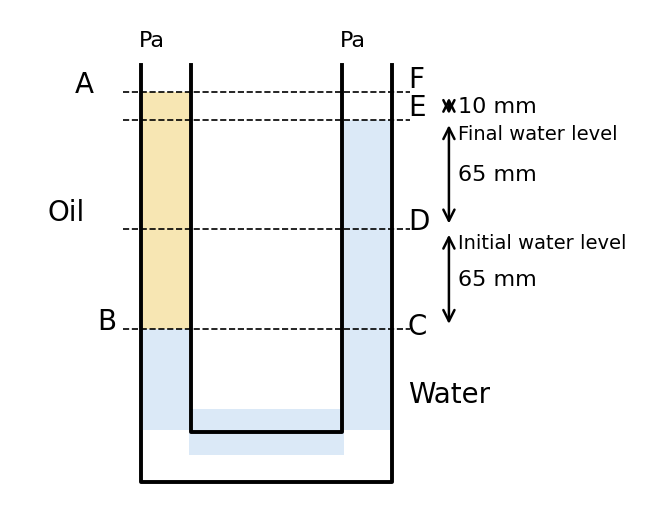
Previous-year questionA U-tube with both ends open to the atmosphere is partially filled with water. Oil, which is immiscible with water, is poured into one side until it stands at a distance of 10 mm above the water level on the other side. Meanwhile the water rises by 65 mm from its original level (see diagram). The density of the oil is [NEET 2017]
- 425 kg m⁻³
- 800 kg m⁻³
- 928 kg m⁻³
- 650 kg m⁻³
Show answer
Answer: (C) 928 kg m⁻³
Explanation: The oil column is 65 + 65 + 10 = 140 mm and it balances a water column of 130 mm. Hence ρ_oil = 1000 × 130/140 ≈ 928 kg m⁻³.
Question 2
Previous-year questionWhich of the following statements is not true? [NEET 2023]
- Coefficient of viscosity is a scalar quantity
- Surface tension is a scalar quantity
- Pressure is a vector quantity
- Relative density is a scalar quantity
Show answer
Answer: (C) Pressure is a vector quantity
Explanation: Pressure has no intrinsic direction because it acts equally in all directions at a point in a fluid, so it is a scalar and the statement calling it a vector is false. The coefficient of viscosity, surface tension and relative density are also scalars.
Question 3
Previous-year questionThe pressure experienced by a swimmer 20 m below the water surface in a lake is approximately: (density of water = 10³ kg m⁻³, g = 10 m s⁻², 1 atm ≈ 10⁵ Pa) [NEET 2024]
- 2 atm
- 3 atm
- 4 atm
- 1 atm
Show answer
Answer: (B) 3 atm
Explanation: Gauge pressure = hρg = 20 × 10³ × 10 = 2 × 10⁵ Pa = 2 atm. Absolute pressure = 1 atm + 2 atm = 3 atm.
Question 4
Previous-year questionTwo copper vessels A and B have the same base area but different shapes. A takes twice the volume of water that B requires to fill up to a particular common height. Then the correct statement is: [NEET 2022]
- Pressure on the base area of vessels A and B is the same.
- Pressure on the base area of vessels A and B is not the same.
- Both vessels A and B weigh the same.
- Vessel B weighs twice that of A.
Show answer
Answer: (A) Pressure on the base area of vessels A and B is the same.
Explanation: Pressure at the base depends only on the height of the liquid column: P = P₀ + hρg. Since the height is common, the base pressure is the same for both (hydrostatic paradox), even though A holds twice as much water.
Question 5
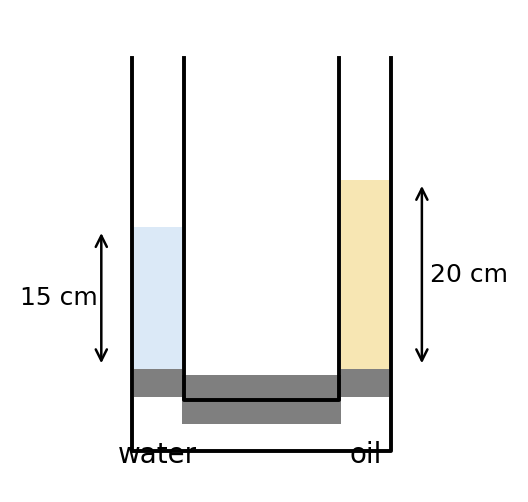
Previous-year questionIn the U-tube shown, water and oil are in the left and right limbs respectively. The heights of the water and oil columns above the common (mercury) interface are 15 cm and 20 cm. The density of the oil is: (ρ_water = 1000 kg/m³) [NEET 2019]
- 1200 kg/m³
- 750 kg/m³
- 1000 kg/m³
- 1333 kg/m³
Show answer
Answer: (B) 750 kg/m³
Explanation: At the common level of the two columns the pressures are equal: ρ_w h_w = ρ_oil h_oil. ρ_oil = 1000 × 15/20 = 750 kg/m³.
Question 6
Previous-year questionA U-tube with both ends open to the atmosphere is partially filled with water. Oil, immiscible with water, is poured into one side until it stands 10 mm above the water level on the other side; meanwhile the water rises by 65 mm from its original level. The density of the oil is: [NEET 2017]
- 425 kg m⁻³
- 800 kg m⁻³
- 928 kg m⁻³
- 650 kg m⁻³
Show answer
Answer: (C) 928 kg m⁻³
Explanation: Water rises 65 mm on one side, so it falls 65 mm on the oil side: water column above the interface = 130 mm. The oil column = 130 + 10 = 140 mm. Equating pressures at the interface level: ρ_oil × 140 = 1000 × 130. ρ_oil = 928 kg m⁻³.
Question 7
Previous-year questionTwo non-mixing liquids of densities ρ and nρ (n > 1) are put in a container. The height of each liquid is h. A solid cylinder of length L and density d is put in this container. The cylinder floats with its axis vertical and length pL (p < 1) in the denser liquid. The density d is equal to [NEET 2016]
- {1 + (n + 1)p}ρ
- {2 + (n + 1)p}ρ
- {2 + (n – 1)p}ρ
- {1 + (n – 1)p}ρ
Show answer
Answer: (D) {1 + (n – 1)p}ρ
Explanation: Balancing the weight against the two upthrusts, dL = (1 – p)Lρ + pL(nρ), which gives d = ρ{1 + (n – 1)p}.
Doing well? Create a free account to take timed tests on this topic and see your weak areas.
Question 8
Previous-year questionThe approximate depth of an ocean is 2700 m. The compressibility of water is 45.4 × 10⁻¹¹ Pa⁻¹ and the density of water is 10³ kg/m³. What fractional compression of water will be obtained at the bottom of the ocean? [AIPMT 2015]
- 1.0 × 10⁻²
- 1.2 × 10⁻²
- 1.4 × 10⁻²
- 0.8 × 10⁻²
Show answer
Answer: (B) 1.2 × 10⁻²
Explanation: Pressure at the bottom p = ρgh = 10³ × 10 × 2700 = 2.7 × 10⁷ Pa. Fractional compression ΔV/V = compressibility × p = 45.4 × 10⁻¹¹ × 2.7 × 10⁷ ≈ 1.2 × 10⁻².
Question 9
Previous-year questionThe compressibility of water is 4 × 10⁻⁵ per unit atmospheric pressure. The decrease in volume of 100 cm³ of water under a pressure of 100 atmospheres will be [AIPMT 1990]
- 0.4 cm³
- 4 × 10⁻⁵ cm³
- 0.025 cm³
- 0.004 cm³
Show answer
Answer: (A) 0.4 cm³
Explanation: By definition, K = (ΔV/V)/p, so ΔV = K × V × p. ΔV = 4 × 10⁻⁵ × 100 × 100 = 4 × 10⁻⁵ × 10⁴ = 0.4 cm³. Since K is quoted per atmosphere, the pressure may be used directly in atmospheres.
Question 10
Previous-year questionThe approximate depth of an ocean is 2700 m. The compressibility of water is 45.4 × 10⁻¹¹ Pa⁻¹ and the density of water is 10³ kg/m³. What fractional compression of water will be obtained at the bottom of the ocean? [CBSE AIPMT 2015]
- 0.8 × 10⁻²
- 1.0 × 10⁻²
- 1.2 × 10⁻²
- 1.4 × 10⁻²
Show answer
Answer: (C) 1.2 × 10⁻²
Explanation: Excess pressure at the bottom, p = ρgd = 10³ × 10 × 2700 = 2.7 × 10⁷ Pa. Compressibility K is the reciprocal of the bulk modulus, so ΔV/V = K × p = 45.4 × 10⁻¹¹ × 2.7 × 10⁷ = 1.226 × 10⁻² ≈ 1.2 × 10⁻².
Question 11
Previous-year questionTwo non-mixing liquids of densities ρ and nρ (with n > 1) are put in a container, the height of each liquid being h. A solid cylinder of length L and density d is placed in this container. The cylinder floats with its axis vertical and a length pL (p < 1) submerged in the denser liquid. The density d is equal to [NEET 2016]
- {2 + (n + 1)p}ρ
- {2 + (n − 1)p}ρ
- {1 + (n − 1)p}ρ
- {1 + (n + 1)p}ρ
Show answer
Answer: (C) {1 + (n − 1)p}ρ
Explanation: A length pL of the cylinder sits in the denser liquid (density nρ) and the remaining (1 − p)L in the lighter liquid (density ρ). By Archimedes' principle, the weight equals the total upthrust: ALdg = (1 − p)LA ρg + pLA(nρ)g d = (1 − p)ρ + pnρ = ρ − pρ + npρ = ρ[1 + (n − 1)p]. A useful check: putting n = 1 (identical liquids) gives d = ρ, as it must.
Question 12
Previous-year questionA barometer is constructed using a liquid of density 760 kg/m³. What would be the height of the liquid column when a mercury barometer reads 76 cm? (Density of mercury = 13600 kg/m³) [NEET (Oct.) 2020]
- 1.36 m
- 13.6 m
- 136 m
- 0.76 m
Show answer
Answer: (B) 13.6 m
Explanation: Both barometers must register the same atmospheric pressure, so the pressures at the base of the two columns are equal: h_l ρ_l g = h_m ρ_m g h_l = h_m ρ_m/ρ_l = 0.76 × 13600/760 = 0.76 × 17.9 = 13.6 m. The lighter the liquid, the taller the column needed — which is exactly why mercury is used in practice.
Question 13
Previous-year questionTwo non-mixing liquids of densities ρ and nρ (n > 1) are put in a container. The height of each liquid is h. A solid cylinder of length L and density d is put in this container. The cylinder floats with its axis vertical and length pL (p < 1) in the denser liquid. The density d is equal to: [AIPMT, 2016]
- {1 + (n + 1)p}ρ
- {2 + (n + 1)p}ρ
- {2 + (n − 1)p}ρ
- {1 + (n − 1)p}ρ
Show answer
Answer: (D) {1 + (n − 1)p}ρ
Explanation: Buoyancy: dLA g = [(1 − p)L · ρ + pL · nρ]Ag ⇒ d = ρ{1 + (n − 1)p}.
Question 14
Previous-year questionWhen a large bubble rises from the bottom of a lake to the surface, its radius doubles. If atmospheric pressure is equal to that of column of water height H, then the depth of lake is: [AIPMT, 1989, 1992] [AIIMS, 1982, 1995] [AFMC, 1997] [BHU, 2004]
- H
- 2H
- 7H
- 8H
Show answer
Answer: (C) 7H
Explanation: P₁V₁ = P₂V₂: (H + h)ρg × V = Hρg × 8V ⇒ H + h = 8H ⇒ h = 7H.
Question 15
A solid is held completely under the surface of a liquid of uniform density at rest. Which statement about the net force exerted by the liquid on the solid is correct?
- It becomes smaller when the solid is raised so that a part of it is above the surface.
- It acts vertically downward.
- It becomes larger when the solid is pushed deeper.
- It changes when the solid is turned to a new orientation while still fully immersed.
Show answer
Answer: (A) It becomes smaller when the solid is raised so that a part of it is above the surface.
Explanation: The net force by the liquid is the buoyant force, which acts vertically upward and equals the weight of the liquid displaced. For a fully immersed solid the displaced volume equals the solid's own volume, whatever the depth or orientation, so the force does not change with either. Raising the solid partly out reduces the displaced volume and hence reduces the force.
Want more Mechanical Properties of Fluids – Pressure questions?
E-GYAN NIDHI has 235 questions on this topic and 63,000+ in total, all free: timed CBT tests, NEET marking and instant analysis.
Register free Free Sunday Mock TestMore topics in PROPERTIES OF SOLIDS AND LIQUIDS
- Mechanical Properties of Solid – Elastic Behaviour of Material MCQs
- Mechanical Properties of Fluids – Fluid's Flow MCQs
- Mechanical Properties of Fluids – Surface Tension and Capillarity MCQs
- Thermal Properties of Matter – Thermometry and Thermal Expansion MCQs
- Thermal Properties of Matter – Specific Heat Capacity MCQs
- Thermal Properties of Matter – Heat Transfer MCQs