Ecosystem – Energy Flow and Ecological Pyramids: NEET MCQs with Answers
15 free questions on Ecosystem – Energy Flow and Ecological Pyramids for NEET (UG), starting with previous-year NEET and AIPMT questions. Try each one, then tap Show answer for the answer and a short explanation.
Syllabus covered: Energy Flow and Ecological Pyramids: Energy flow; Pyramids of number, biomass, energy
Question 1
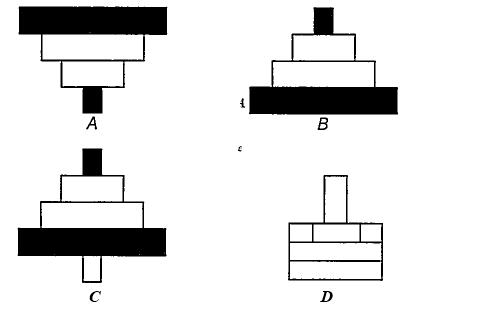
Previous-year questionWhich of the following representations shows the pyramid of numbers in a forest ecosystem? [AIPMT 2010]
- D
- A
- B
- C
Show answer
Answer: (D) C
Explanation: In a forest (tree) ecosystem the number of producers (a few large trees) is small, and these support a much greater number of herbivorous insects and birds, which in turn support a smaller number of carnivores. This gives a partly upright, spindle-shaped pyramid of numbers, represented by figure C.
Question 2
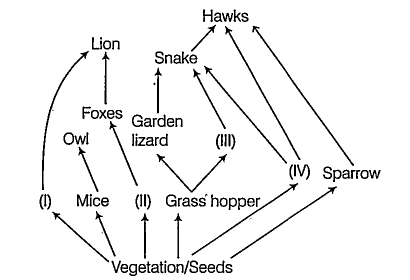
Previous-year questionIdentify the likely organisms I, II, III and IV in the food web shown below. [AIPMT 2012]
- Deer, Rabbit, Frog, Rat
- Dog, Squirrel, Bat, Deer
- Rat, Dog, Tortoise, Crow
- Squirrel, Cat, Rat, Pigeon
Show answer
Answer: (A) Deer, Rabbit, Frog, Rat
Explanation: In the food web, organism I feeds on vegetation/seeds and is eaten by the lion, so it is a primary consumer such as deer. Organism II also feeds on vegetation/seeds and is eaten by foxes, so it is a rabbit. Organism III feeds on grasshoppers and is eaten by snakes, so it is a secondary consumer such as a frog. Organism IV feeds on seeds and is eaten by both snakes and hawks, so it is a rat.
Question 3
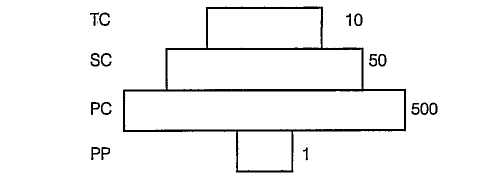
Previous-year questionGiven below is an imaginary pyramid of numbers. What could be one of the possibilities about certain organisms at some of the different levels? [AIPMT 2012]
- Level PC is insects and level SC is small insectivorous birds
- Level PP is phytoplanktons in sea and whale on top level TC
- Level one PP is pipal trees and the level SC is sheep
- Level PC is rats and level SC is cats
Show answer
Answer: (A) Level PC is insects and level SC is small insectivorous birds
Explanation: The figure shows a spindle-shaped pyramid of numbers characteristic of a single tree ecosystem. Here PP is one large tree (number = 1), which supports a very large number of herbivorous insects (PC = 500), which in turn support a smaller number of small insectivorous birds (SC = 50) and finally a still smaller number of top carnivores such as eagles or falcons (TC = 10).
Question 4
Previous-year questionWhich of the following ecological pyramids is generally inverted? [NEET 2019]
- Pyramid of numbers in grassland
- Pyramid of energy
- Pyramid of biomass in a forest
- Pyramid of biomass in a sea
Show answer
Answer: (D) Pyramid of biomass in a sea
Explanation: In the sea the producers are minute phytoplankton with a very short life span and a very rapid turnover, so their standing biomass at any moment is far less than that of the zooplankton and fishes they support; the pyramid of biomass is therefore inverted. The pyramid of energy is never inverted, and grassland pyramids of numbers and forest pyramids of biomass are upright.
Question 5
Previous-year questionWhat type of ecological pyramid would be obtained with the following data? [NEET 2018] Secondary consumer: 120 g Primary consumer: 60 g Primary producer: 10 g
- Inverted pyramid of biomass
- Pyramid of energy
- Upright pyramid of biomass
- Upright pyramid of numbers
Show answer
Answer: (A) Inverted pyramid of biomass
Explanation: The data are given as mass, so the pyramid is one of biomass. Since the biomass increases from the producer level (10 g) through the primary consumer level (60 g) to the secondary consumer level (120 g), the base is narrower than the apex and the pyramid is inverted – a situation typical of aquatic ecosystems.
Question 6
Previous-year questionWhich ecosystem has the maximum biomass? [NEET 2017]
- Grassland ecosystem
- Pond ecosystem
- Lake ecosystem
- Forest ecosystem
Show answer
Answer: (D) Forest ecosystem
Explanation: A forest contains large, long-lived trees whose trunks, branches and roots store an enormous quantity of organic matter, so the standing biomass of a forest ecosystem far exceeds that of grasslands, ponds or lakes. Aquatic ecosystems, dominated by microscopic phytoplankton, have the smallest standing biomass.
Question 7
Previous-year questionThe mass of living material at a trophic level at a particular time is called [AIPMT 2015]
- standing state
- net primary productivity
- standing crop
- gross primary productivity
Show answer
Answer: (C) standing crop
Explanation: Standing crop is the amount of living material present in a trophic level at a given moment, expressed as biomass (dry weight) or as number of individuals per unit area. The standing state, in contrast, is the amount of inorganic nutrients such as carbon, nitrogen and phosphorus present in the soil at any given time.
Doing well? Create a free account to take timed tests on this topic and see your weak areas.
Question 8
Previous-year questionIf 20 J of energy is trapped at the producer level, then how much energy will be available to the peacock as food in the following chain? [AIPMT 2014] plant → mice → snake → peacock
- 0.02 J
- 0.002 J
- 0.2 J
- 0.0002 J
Show answer
Answer: (A) 0.02 J
Explanation: Only 10% of the energy is transferred at each step. Plant = 20 J; mice = 10% of 20 = 2 J; snake = 10% of 2 = 0.2 J; peacock = 10% of 0.2 = 0.02 J. There are three transfers, so the energy reaching the peacock is 20 × (1/10)³ = 0.02 J.
Question 9
Previous-year questionPick up the correct food chain. [AIPMT 1991]
- Grass → Chameleon → Insect → Bird
- Grass → Fox → Rabbit → Bird
- Phytoplankton → Zooplankton → Fish
- Fallen leaves → Bacteria → Insect larvae
Show answer
Answer: (C) Phytoplankton → Zooplankton → Fish
Explanation: A grazing food chain must run producer → herbivore → carnivore, which phytoplankton → zooplankton → fish does. Chains placing a carnivore before its herbivore prey are wrong, and a chain starting with fallen leaves is a detritus food chain.
Question 10
Previous-year questionA food chain in which microorganisms break down the food formed by primary producers is called a [AIPMT 1991]
- parasitic food chain
- detritus food chain
- consumer food chain
- predator food chain
Show answer
Answer: (B) detritus food chain
Explanation: The detritus (or saprophytic) food chain begins with dead organic matter, which is acted upon by detritivores and decomposers — protozoans, bacteria and fungi — and then passes to organisms that feed on these detritivores, such as insect larvae and nematodes.
Question 11
Previous-year questionThe pyramid of numbers in a pond ecosystem is [AIPMT 1993]
- irregular
- inverted
- upright
- spindle-shaped
Show answer
Answer: (C) upright
Explanation: In a pond ecosystem the phytoplankton (producers) are maximum in number, followed by fewer zooplankton, still fewer small fishes and the least number of large fishes or top consumers. Hence the pyramid of numbers is upright (erect).
Question 12
Previous-year questionThe pyramid of numbers deals with the number of [AIPMT 1993]
- species in an area
- individuals in a community
- individuals in a trophic level
- sub-species in a community
Show answer
Answer: (C) individuals in a trophic level
Explanation: A pyramid of numbers is the graphic representation of the number of individuals per unit area present at each successive trophic level of a food chain, arranged with producers at the base and top carnivores at the apex.
Question 13
Previous-year questionThe second most important trophic level in a lake is that of [AIPMT 1994]
- zooplankton
- phytoplankton
- benthos
- neuston
Show answer
Answer: (A) zooplankton
Explanation: In a lake ecosystem the first trophic level is occupied by phytoplankton, the producers. The second trophic level is occupied by zooplankton, which are the primary consumers feeding on the phytoplankton. Benthos are the bottom dwellers and neuston are organisms of the air–water interface.
Question 14
Previous-year questionThe pyramid which cannot be inverted in a stable ecosystem is that of [AIPMT 1994]
- biomass
- number
- energy
- all of these
Show answer
Answer: (C) energy
Explanation: The pyramid of energy can never be inverted, because at each successive trophic level a certain amount of energy is irrevocably lost as heat, so the energy content must always decrease upwards. Pyramids of number and of biomass may be inverted, as in a single-tree ecosystem or in the sea.
Question 15
Previous-year questionIn a grass–deer–tiger food chain, if the grass biomass is one tonne, the tiger biomass shall be [AIPMT 1994]
- 100 kg
- 10 kg
- 200 kg
- 1 kg
Show answer
Answer: (B) 10 kg
Explanation: Applying Lindeman's 10% law to the chain grass (1000 kg) → deer → tiger: the deer biomass will be 10% of 1000 kg = 100 kg, and the tiger biomass will be 10% of 100 kg = 10 kg.
Want more Ecosystem – Energy Flow and Ecological Pyramids questions?
E-GYAN NIDHI has 186 questions on this topic and 63,000+ in total, all free: timed CBT tests, NEET marking and instant analysis.
Register free Free Sunday Mock Test