Ecology – Population: NEET MCQs with Answers
15 free questions on Ecology – Population for NEET (UG), starting with previous-year NEET and AIPMT questions. Try each one, then tap Show answer for the answer and a short explanation.
Syllabus covered: Population: Population attributes-growth, birth rate and death rate, age distribution.
Question 1
Previous-year questionA country with a high rate of population growth took measures to reduce it. The figure below shows the age–sex pyramids of populations A and B twenty years apart. Select the correct interpretation about them. [AIPMT 2009]
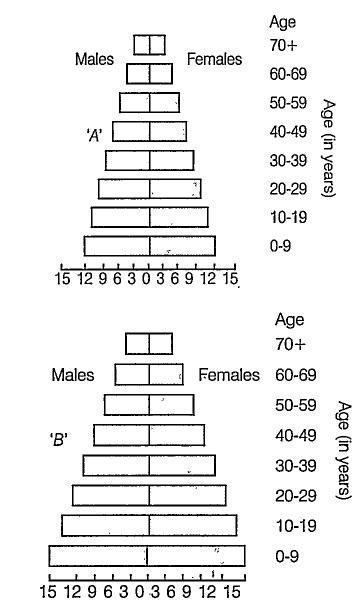
- 'A' is more recent and shows a slight reduction in the growth rate
- 'B' is the earlier pyramid and shows a stabilised growth rate
- 'B' is more recent, showing that the population is very young
- 'A' is the earlier pyramid and no change has occurred in the growth rate
Show answer
Answer: (A) 'A' is more recent and shows a slight reduction in the growth rate
Explanation: Pyramid 'B' has a distinctly broader pre-reproductive base than 'A', indicating a very rapidly growing (younger) population, whereas in 'A' the base has narrowed slightly. Since the country adopted measures to curb growth, 'A' must be the more recent pyramid and it shows a slight reduction in the growth rate.
Question 2
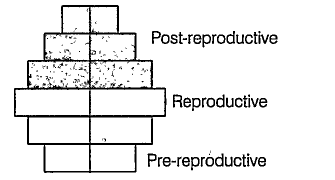
Previous-year questionWhat type of human population is represented by the following age pyramid? [AIPMT 2011]
- Vanishing population
- Stable population
- Declining population
- Expanding population
Show answer
Answer: (C) Declining population
Explanation: The given pyramid is urn-shaped — the pre-reproductive base is narrower than the reproductive middle — which represents a declining population. An expanding population gives a broad-based triangular pyramid and a stable population gives a bell-shaped one. The shape of an age pyramid thus reflects the growth status of the population.
Question 3
Previous-year questionMatch List I with List II. [NEET 2023]
List I:
A. Logistic growth
B. Exponential growth
C. Expanding age pyramid
D. Stable age pyramid
List II:
I. Unlimited resource availability condition
II. Limited resource availability condition
III. The per cent individuals of pre-reproductive age is largest, followed by reproductive and post-reproductive age groups
IV. The per cent individuals of pre-reproductive and reproductive age groups are the same
- A-II, B-III, C-I, D-IV
- A-II, B-IV, C-I, D-III
- A-II, B-IV, C-III, D-I
- A-II, B-I, C-III, D-IV
Show answer
Answer: (D) A-II, B-I, C-III, D-IV
Explanation: Logistic growth occurs under limited resources (A-II) — the population grows fast initially, then slows and levels off at the carrying capacity, giving a sigmoid curve. Exponential (geometric) growth requires unlimited resources (B-I) and gives a J-shaped curve; it is rarely seen in nature. An expanding pyramid is triangular with the largest pre-reproductive class (C-III), whereas a stable (bell-shaped) pyramid has roughly equal pre-reproductive and reproductive classes (D-IV).
Question 4
Previous-year questionThe process of growth is maximum during [NEET 2020]
- Lag phase
- Senescence
- Dormancy
- Log phase
Show answer
Answer: (D) Log phase
Explanation: In the log (exponential) phase both the number of individuals and the rate of growth are at their maximum, since resources are still adequate; growth slows in the stationary phase.
Question 5
Previous-year questionWhich of the following is NOT an attribute of a population? [NEET 2020]
- Natality
- Mortality
- Species interaction
- Sex ratio
Show answer
Answer: (C) Species interaction
Explanation: Birth rate, death rate, sex ratio and age distribution are attributes possessed by a population but not by an individual. Species interaction takes place between populations and is a community-level feature.
Question 6
Previous-year questionNatality refers to [NEET 2018]
- Death rate
- Birth rate
- Number of individuals entering a habitat
- Number of individuals leaving the habitat
Show answer
Answer: (B) Birth rate
Explanation: Natality is the number of births added to the population per unit time per individual; mortality is the death rate, while immigration and emigration are the entries and exits.
Question 7
Previous-year questionIn a growing population of a country, [NEET 2018]
- pre-reproductive individuals are more than the reproductive individuals.
- reproductive individuals are less than the post-reproductive individuals.
- pre-reproductive individuals are less than the reproductive individuals.
- reproductive and pre-reproductive individuals are equal in number.
Show answer
Answer: (A) pre-reproductive individuals are more than the reproductive individuals.
Explanation: A growing population has a triangular age pyramid with a broad base, meaning the pre-reproductive class outnumbers the reproductive class and will soon add heavily to the birth rate.
Doing well? Create a free account to take timed tests on this topic and see your weak areas.
Question 8
Previous-year questionThe asymptote in a logistic growth curve is obtained when [NEET 2017]
- K = N
- K > N
- K < N
- the value of 'r' approaches zero
Show answer
Answer: (A) K = N
Explanation: The curve flattens into an asymptote when the population size equals the carrying capacity, because at that point the resources can support no further increase.
Question 9
Previous-year questionWhen does the growth rate of a population following the logistic model equal zero? The logistic model is given as dN/dt = rN(1 – N/K). [NEET 2016]
- When N/K is exactly one
- When N nears the carrying capacity of the habitat
- When N/K equals zero
- When the death rate is greater than the birth rate
Show answer
Answer: (A) When N/K is exactly one
Explanation: If N = K, then N/K = 1 and the factor (1 – N/K) becomes zero, so dN/dt = 0 and the population stops growing — the asymptote of the sigmoid curve.
Question 10
Previous-year questionThe concept that population tends to increase geometrically while food supply increases arithmetically was put forward by [AIPMT 1995]
- Stuart Mill
- Adam Smith
- Charles Darwin
- Thomas Malthus
Show answer
Answer: (D) Thomas Malthus
Explanation: Thomas Malthus, in his 'Essay on the Principle of Population' (1798), pointed out that population tends to increase in geometric progression while food supply increases only in arithmetic progression, so that population is ultimately checked by want. This idea deeply influenced Darwin's concept of the struggle for existence. John Stuart Mill wrote 'Principles of Political Economy' and Adam Smith 'The Wealth of Nations'.
Question 11
Previous-year questionCompetition for light, nutrients and space is most severe between [AIPMT 1988]
- closely related organisms growing in different niches
- closely related organisms growing in the same area or niche
- distantly related organisms growing in the same habitat
- distantly related organisms growing in different niches
Show answer
Answer: (B) closely related organisms growing in the same area or niche
Explanation: Competition is most intense between closely related organisms sharing the same niche, because their requirements for food, light, nutrients and space overlap almost completely and these resources are limited. This is the basis of Gause's competitive exclusion principle.
Question 12
Previous-year questionAn orchid resembling the female of an insect, so as to be able to get pollinated, is due to the phenomenon of [AIPMT 1998]
- mimicry
- pseudocopulation
- pseudopollination
- pseudoparthenocarpy
Show answer
Answer: (B) pseudocopulation
Explanation: Pseudocopulation is a form of floral mimicry in which the flower imitates the appearance, scent or behaviour of a female insect, attracting the male insect to attempt copulation with it. In Ophrys speculum, the male wasp Colpa aurea repeats the act on several flowers and carries pollinia from one flower to another, thereby pollinating the orchid — a relationship beneficial only to the plant.
Question 13
Previous-year questionWhich of the following is a correct pair? [AIPMT 2002]
- Cuscuta — Parasite
- Dischidia — Insectivorous
- Opuntia — Predator
- Capsella — Hydrophyte
Show answer
Answer: (A) Cuscuta — Parasite
Explanation: Cuscuta (dodder or amarbel) is a total stem parasite; it is a leafless, chlorophyll-less twiner that produces haustoria to tap water and nutrients from the host phloem. Dischidia is an epiphyte, Opuntia is a xerophyte and Capsella (shepherd's purse) is an ordinary terrestrial mesophyte.
Question 14
Previous-year questionWhich type of association is found between an entomophilous flower and its pollinating agent? [AIPMT 2002]
- Mutualism
- Commensalism
- Cooperation
- Co-evolution
Show answer
Answer: (A) Mutualism
Explanation: Entomophilous flowers are pollinated by insects, and the relationship is mutualistic: the plant uses the insect to ensure cross-pollination, while the insect obtains nectar and pollen as food. Both partners are therefore benefitted, which is the defining criterion of mutualism.
Question 15
Previous-year questionChoose the correct sequence of stages of the growth curve for bacteria. [AIPMT 2002]
- lag, log, stationary, decline phase
- lag, log, stationary phase
- stationary, lag, log, decline phase
- decline, lag, log phase
Show answer
Answer: (A) lag, log, stationary, decline phase
Explanation: When microbes are grown in a closed system (batch culture), the growth curve shows four phases in sequence: (i) lag phase — adjustment with little division; (ii) log or exponential phase — maximum rate of division; (iii) stationary phase — division balanced by death as nutrients deplete and wastes accumulate; and (iv) decline or death phase.
Want more Ecology – Population questions?
E-GYAN NIDHI has 168 questions on this topic and 63,000+ in total, all free: timed CBT tests, NEET marking and instant analysis.
Register free Free Sunday Mock TestMore topics in Ecology and Environment
- Ecology – Organisms and its Environment MCQs
- Ecosystem – Ecosystem-Structure and Function MCQs
- Biodiversity – Concept of Biodiversity MCQs
- Ecology – Major Abiotic Factors MCQs
- Ecosystem – Productivity and Decomposition MCQs
- Ecosystem – Energy Flow and Ecological Pyramids MCQs
- Biodiversity Conservation MCQs