Ecology – Organisms and its Environment: NEET MCQs with Answers
15 free questions on Ecology – Organisms and its Environment for NEET (UG), starting with previous-year NEET and AIPMT questions. Try each one, then tap Show answer for the answer and a short explanation.
Syllabus covered: Organisms and its Environment: Population interactions- mutualism, competition, predation, parasitism;
Question 1
Previous-year questionThe following graph depicts changes in two populations (A and B) of herbivores in a grassy field. A possible reason for these changes is that [AIPMT 2015]
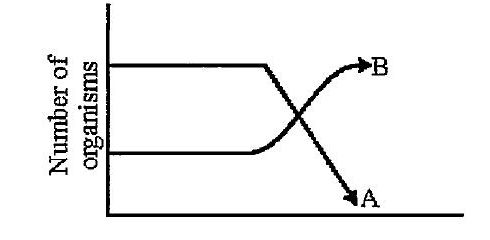
- Population B competed more successfully for food than population A.
- Population A produced more offspring than population B.
- Population A consumed the members of population B.
- Both plant populations in this habitat decreased.
Show answer
Answer: (A) Population B competed more successfully for food than population A.
Explanation: Population B increases exactly as population A declines, which is the pattern expected when two herbivores compete for the same limited food and the superior competitor (B) gradually displaces the other.
Question 2
Previous-year questionMatch the items in Column I with those in Column II. [NEET Oct. 2020]
Column I:
A. Herbivores–Plants
B. Mycorrhiza–Plants
C. Sheep–Cattle
D. Orchid–Tree
Column II:
(i) Commensalism
(ii) Mutualism
(iii) Predation
(iv) Competition
Column I:
A. Herbivores–Plants
B. Mycorrhiza–Plants
C. Sheep–Cattle
D. Orchid–Tree
Column II:
(i) Commensalism
(ii) Mutualism
(iii) Predation
(iv) Competition
- A-(iv), B-(ii), C-(i), D-(iii)
- A-(iii), B-(ii), C-(iv), D-(i)
- A-(ii), B-(i), C-(iii), D-(iv)
- A-(i), B-(iii), C-(iv), D-(ii)
Show answer
Answer: (B) A-(iii), B-(ii), C-(iv), D-(i)
Explanation: Herbivores grazing on plants is regarded as predation, since the herbivore is the predator and the plant is the prey (A-iii). Mycorrhiza — fungus and plant root — benefits both partners, hence mutualism (B-ii). Sheep and cattle in the same pasture compete for the same food, i.e. grass (C-iv). An orchid growing as an epiphyte on a tree gets a place to grow and access to light, while the tree is neither harmed nor benefitted — commensalism (D-i).
Question 3
Previous-year questionMatch List I with List II. [NEET 2023]
List I (Interacting species):
A. A leopard and a lion in a forest/grassland
B. A cuckoo laying eggs in a crow's nest
C. Fungi and roots of a higher plant in mycorrhizae
D. A cattle egret and cattle in a field
List II (Name of interaction):
I. Competition
II. Brood parasitism
III. Mutualism
IV. Commensalism
- A-I, B-II, C-IV, D-III
- A-III, B-IV, C-I, D-II
- A-II, B-III, C-I, D-IV
- A-I, B-II, C-III, D-IV
Show answer
Answer: (D) A-I, B-II, C-III, D-IV
Explanation: Leopard and lion sharing the same forest are both large carnivores occupying similar niches, hence competition (A-I). The cuckoo laying eggs in a crow's nest so that the host raises its chicks is brood parasitism (B-II). Mycorrhiza — fungal hyphae with roots of higher plants — benefits both partners, hence mutualism (C-III). The cattle egret gains insects flushed out by grazing cattle while the cattle are unaffected, hence commensalism (D-IV).
Question 4
Previous-year questionMatch the interactions in List I with the effect on species A and B given in List II. [NEET 2023]
List I (Interaction):
A. Mutualism
B. Commensalism
C. Amensalism
D. Parasitism
List II (Species A and B):
I. +(A), 0(B)
II. −(A), 0(B)
III. +(A), −(B)
IV. +(A), +(B)
List I (Interaction):
A. Mutualism
B. Commensalism
C. Amensalism
D. Parasitism
List II (Species A and B):
I. +(A), 0(B)
II. −(A), 0(B)
III. +(A), −(B)
IV. +(A), +(B)
- A-IV, B-I, C-II, D-III
- A-IV, B-III, C-I, D-II
- A-III, B-I, C-IV, D-II
- A-IV, B-II, C-I, D-III
Show answer
Answer: (A) A-IV, B-I, C-II, D-III
Explanation: In mutualism both partners benefit, i.e. +/+ (A-IV). In commensalism one species benefits while the other is unaffected, i.e. +/0 (B-I). In amensalism one species is harmed while the other is unaffected, i.e. −/0 (C-II). In parasitism the parasite benefits at the expense of the host, i.e. +/− (D-III).
Question 5
Previous-year questionSecondary metabolites such as nicotine, strychnine and caffeine are produced by plants for their [NEET 2020]
- Growth response
- Defence action
- Effect on reproduction
- Nutritive value
Show answer
Answer: (B) Defence action
Explanation: These chemicals make the plant unpalatable or toxic to herbivores, thereby serving as chemical defences against grazing and browsing.
Question 6
Previous-year questionWhich one of the following plants shows a very close relationship with a species of moth, where neither of the two can complete its life cycle without the other? [NEET 2018]
- Hydrilla
- Yucca
- Viola
- Banana
Show answer
Answer: (B) Yucca
Explanation: The Yucca plant is pollinated only by its partner moth, and the moth's larvae feed only on the developing Yucca seeds — an obligate mutualism in which the life cycles are tightly linked.
Question 7
Previous-year questionWhich one of the following population interactions is widely used in medical science for the production of antibiotics? [NEET 2018]
- Commensalism
- Mutualism
- Amensalism
- Parasitism
Show answer
Answer: (C) Amensalism
Explanation: Antibiotic production is an example of amensalism: the microbe secreting the antibiotic inhibits or kills other microbes while itself gaining no benefit from the interaction.
Doing well? Create a free account to take timed tests on this topic and see your weak areas.
Question 8
Previous-year questionSelect the mismatch. [NEET 2017]
- Rhodospirillum — Mycorrhiza
- Anabaena — Nitrogen fixer
- Rhizobium — Alfalfa
- Frankia — Alnus
Show answer
Answer: (A) Rhodospirillum — Mycorrhiza
Explanation: Mycorrhiza is formed by fungi such as Glomus, not by the bacterium Rhodospirillum. Anabaena fixes nitrogen, Rhizobium nodulates alfalfa and Frankia nodulates Alnus.
Question 9
Previous-year questionMycorrhizae are an example of [NEET 2017]
- Amensalism
- Antibiosis
- Mutualism
- Fungistasis
Show answer
Answer: (C) Mutualism
Explanation: In mycorrhiza the fungus absorbs phosphorus and other nutrients from the soil for the plant, and the plant supplies energy-yielding carbohydrates to the fungus — both partners benefit.
Question 10
Previous-year questionGause's principle of competitive exclusion states that [NEET 2016]
- more abundant species will exclude the less abundant species through competition.
- competition for the same resources excludes species having different food preferences.
- no two species can occupy the same niche indefinitely for the same limiting resources.
- larger organisms exclude smaller ones through competition.
Show answer
Answer: (C) no two species can occupy the same niche indefinitely for the same limiting resources.
Explanation: Two species competing for the same limiting resource cannot coexist indefinitely; the competitively inferior one is eventually eliminated unless the species partition the resource.
Question 11
Previous-year questionIn which of the following interactions are both partners adversely affected? [AIPMT 2015]
- Predation
- Parasitism
- Mutualism
- Competition
Show answer
Answer: (D) Competition
Explanation: Competition is a (–, –) interaction. In predation and parasitism one partner benefits while the other is harmed, and in mutualism both gain.
Question 12
Previous-year questionThe sum total of the individuals of the same kind of organisms constitutes a [AIPMT 1993]
- colony
- genus
- community
- species
Show answer
Answer: (D) species
Explanation: A species is a group of organisms similar in structure, function and behaviour that interbreed freely to produce fertile offspring. All individuals of the same kind therefore belong to one species. A community consists of populations of many different species living together.
Question 13
Previous-year questionThe study of the inter-relationships between living organisms and their environment is called [AIPMT 1993]
- ecology
- ecosystem
- phytogeography
- ethology
Show answer
Answer: (A) ecology
Explanation: Ecology (also called environmental biology) is the study of interactions among organisms and between organisms and their physical environment, at the levels of organism, population, community, ecosystem and biome. Ethology is the study of animal behaviour and phytogeography deals with the geographical distribution of plants.
Question 14
Previous-year questionA xeric environment is characterised by [AIPMT 1994]
- heavy precipitation
- low atmospheric humidity
- extremes of temperature
- a high rate of vapourisation
Show answer
Answer: (B) low atmospheric humidity
Explanation: Xeric (dry) conditions are essentially defined by low atmospheric humidity together with scanty precipitation. Such conditions occur in arid deserts, in extremely cold habitats (physiological drought) and in salt marshes. Plants growing there are xerophytes with sunken stomata, thick cuticle and succulent tissues.
Question 15
Previous-year questionIn India, tropical (rain) forests are found in [AIPMT 1994]
- Jammu and Kashmir
- Rajasthan
- Kerala and Assam
- no part of the country
Show answer
Answer: (C) Kerala and Assam
Explanation: Tropical rainforests need high temperature and heavy rainfall throughout the year; in India they occur in the Western Ghats (Kerala, Karnataka) and in north-eastern India including Assam. Jammu and Kashmir is temperate to alpine and Rajasthan is arid.
Want more Ecology – Organisms and its Environment questions?
E-GYAN NIDHI has 233 questions on this topic and 63,000+ in total, all free: timed CBT tests, NEET marking and instant analysis.
Register free Free Sunday Mock Test