Ecology – Major Abiotic Factors: NEET MCQs with Answers
15 free questions on Ecology – Major Abiotic Factors for NEET (UG), starting with previous-year NEET and AIPMT questions. Try each one, then tap Show answer for the answer and a short explanation.
Syllabus covered: Major Abiotic Factors
Question 1
Previous-year questionThe figure given below is a diagrammatic representation of the response of organisms to abiotic factors. What do (i), (ii) and (iii) represent respectively? [AIPMT 2010]
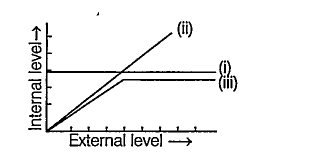
- Conformer, Regulator, Partial regulator
- Regulator, Partial regulator, Conformer
- Partial regulator, Regulator, Conformer
- Regulator, Conformer, Partial regulator
Show answer
Answer: (D) Regulator, Conformer, Partial regulator
Explanation: Curve (i) stays flat, i.e. the internal level remains constant irrespective of the external level — a regulator (e.g. birds, mammals, which maintain homeostasis physiologically). Curve (ii) rises continuously with the external level — a conformer (99% of animals and nearly all plants, whose internal state changes with the environment). Curve (iii) rises initially and then flattens — a partial regulator, able to regulate only over a limited range of environmental conditions.
Question 2
Previous-year questionThe presence of plants arranged into well-defined vertical layers depending on their height can be seen best in [NEET 2017]
- Tropical rain forest
- Grassland
- Temperate forest
- Tropical savannah
Show answer
Answer: (A) Tropical rain forest
Explanation: Tropical rain forests show the clearest vertical stratification — emergent trees, canopy, understorey, shrub and herb layers — because light decreases sharply from top to bottom.
Question 3
Previous-year questionMost animals are tree dwellers in a [AIPMT 2015]
- Thorn woodland
- Temperate deciduous forest
- Tropical rain forest
- Coniferous forest
Show answer
Answer: (C) Tropical rain forest
Explanation: The tropical rain forest has a tall, dense, multi-layered canopy that offers abundant food and shelter above the ground, so most of its animals are arboreal.
Question 4
Previous-year questionJust as a person moves from Delhi to Shimla to escape the heat of summer, thousands of migratory birds from Siberia and other extremely cold northern regions move to [AIPMT 2014]
- Western Ghats
- Meghalaya
- Corbett National Park
- Keoladeo National Park
Show answer
Answer: (D) Keoladeo National Park
Explanation: Every winter, thousands of migratory birds arrive at Keoladeo National Park (Bharatpur, Rajasthan) from Siberia and other cold northern regions — an example of escaping unfavourable conditions in space.
Question 5
Previous-year questionA fertile agricultural soil appears dark coloured at the surface as compared with soil one metre below. The reason for the colour of the top soil is that it is [AIPMT 1992]
- more moist
- rich in organic matter
- rich in iron, calcium and magnesium
- of recent formation
Show answer
Answer: (B) rich in organic matter
Explanation: The dark colour of the surface soil is due to the accumulation of humus — leached organic substances and decomposed organic matter. Humus acts as a reservoir of nutrients and water, reduces compaction and surface crusting, and increases infiltration, which is why humus-rich topsoil is the most fertile layer.
Question 6
Previous-year questionSoil particles determine its [AIPMT 1992]
- texture
- field capacity
- water holding capacity
- soil flora
Show answer
Answer: (A) texture
Explanation: Soil texture is defined by the relative proportion of particles of different size classes — gravel (2–75 mm), sand (0.05–2 mm), silt (0.002–0.05 mm) and clay (< 0.002 mm). Texture in turn influences percolation, aeration and water-holding capacity, but the primary attribute directly determined by particle size is the texture itself.
Question 7
Previous-year questionThe soil best suited for plant growth is [AIPMT 1993]
- clay
- loamy
- sandy
- gravel
Show answer
Answer: (B) loamy
Explanation: Loamy soil, containing roughly 20% clay, 40% silt and 40% sand, provides the best combination of aeration, drainage, nutrient content and water-retaining capacity, and is therefore the most suitable for plant growth. Pure clay is poorly aerated and waterlogged, while sandy and gravelly soils drain too fast and retain neither water nor nutrients.
Doing well? Create a free account to take timed tests on this topic and see your weak areas.
Question 8
Previous-year questionAnimals that can tolerate only a narrow range of salinity are [AIPMT 1994]
- stenohaline
- euryhaline
- anadromous
- catadromous
Show answer
Answer: (A) stenohaline
Explanation: Stenohaline organisms tolerate only a narrow range of salinity, whereas euryhaline organisms can withstand a wide range. Anadromous fishes (e.g. salmon) live in the sea but migrate to freshwater to spawn, while catadromous fishes (e.g. eel) live in freshwater and return to the sea to spawn.
Question 9
Previous-year questionWhich of the following does NOT possess stomata? [AIPMT 1995]
- Hydrophytes
- Mesophytes
- Xerophytes
- Submerged hydrophytes
Show answer
Answer: (D) Submerged hydrophytes
Explanation: Submerged hydrophytes remain completely inside water, so there is no transpiration and no need for stomatal gaseous exchange — gases diffuse directly across the thin cuticle-free epidermis. Hence such plants (e.g. Utricularia, Ceratophyllum, Hydrilla) lack stomata. Floating hydrophytes such as lotus, in contrast, bear stomata on the upper surface.
Question 10
Previous-year questionSunken stomata are a characteristic feature of [AIPMT 1995]
- hydrophytes
- mesophytes
- xerophytes
- halophytes
Show answer
Answer: (C) xerophytes
Explanation: Xerophytes possess sunken stomata that are generally restricted to the lower surface of the leaf and lie in pits below the epidermis, often shielded by epidermal hairs. The still, humid air trapped in these pits reduces the rate of transpiration and thus conserves water.
Question 11
Previous-year questionDesert plants are generally [AIPMT 1995]
- viviparous
- succulent
- herbaceous
- heterophyllous
Show answer
Answer: (B) succulent
Explanation: Most desert plants are succulent or fleshy xerophytes that store water in thickened stems or leaves, e.g. Opuntia, Bryophyllum, Euphorbia and Mesembryanthemum (ice plant). Vivipary is characteristic of mangroves and heterophylly of some aquatic plants.
Question 12
Previous-year questionBenthic animals are those which [AIPMT 1996]
- are submerged in area
- float on the sea surface
- are deep dwellers, resting on or attached to the sea bottom
- are free-floating organisms
Show answer
Answer: (C) are deep dwellers, resting on or attached to the sea bottom
Explanation: Benthic organisms live at the bottom of a water body, either attached to the substratum or resting on and burrowing into the bottom sediments. They include filter feeders such as clams and deposit feeders such as snails. Free-floating forms are plankton and actively swimming forms are nekton.
Question 13
Previous-year questionExtremities such as the tail and ear are relatively shorter in animals living in cooler regions as compared with those inhabiting warmer zones. This is [AIPMT 1996]
- Bergmann's rule
- Jordan's rule
- Gloger's rule
- Allen's rule
Show answer
Answer: (D) Allen's rule
Explanation: Allen's rule states that mammals of colder climates have shorter ears, limbs, tail and other extremities, which reduces the surface area available for heat loss. Bergmann's rule relates increasing body size to colder climates/higher latitude, Jordan's rule states that vertebral number increases with latitude, and Gloger's rule relates darker skin pigmentation to humid environments.
Question 14
Previous-year questionWhich of the following communities is more vulnerable to invasion by outside animals and plants? [AIPMT 1998]
- Temperate forests
- Oceanic island communities
- Mangroves
- Tropical evergreen forests
Show answer
Answer: (B) Oceanic island communities
Explanation: Island communities are species-poor and evolved in isolation without mainland competitors, predators and diseases, so introduced alien species establish easily and often cause extinctions, as NCERT notes for alien species invasions.
Question 15
Previous-year questionPlants such as Prosopis, Acacia and Capparis are representative examples of tropical [AIPMT 1998]
- deciduous forests
- evergreen forests
- grasslands
- thorn forests
Show answer
Answer: (D) thorn forests
Explanation: Tropical thorn forests (thorn shrub/scrub forests) occur where moisture conditions are intermediate between those of deserts and savannas. Acacia and Prosopis are non-succulent perennial plants and Capparis is a xerophytic shrub — all typical constituents of tropical thorn forests.
Want more Ecology – Major Abiotic Factors questions?
E-GYAN NIDHI has 306 questions on this topic and 63,000+ in total, all free: timed CBT tests, NEET marking and instant analysis.
Register free Free Sunday Mock Test