Biodiversity – Concept of Biodiversity: NEET MCQs with Answers
15 free questions on Biodiversity – Concept of Biodiversity for NEET (UG), starting with previous-year NEET and AIPMT questions. Try each one, then tap Show answer for the answer and a short explanation.
Syllabus covered: Concept of Biodiversity; Patterns of Biodiversity; Importance of Biodiversity; Loss of Biodiversity;
Question 1
Previous-year questionThe table in the figure gives the populations (in thousands) of ten species (A–J) in four areas (p–s), with the number of habitats in brackets against each area. A dash means the species is absent. Which area shows the maximum species diversity? [AIPMT 2008]
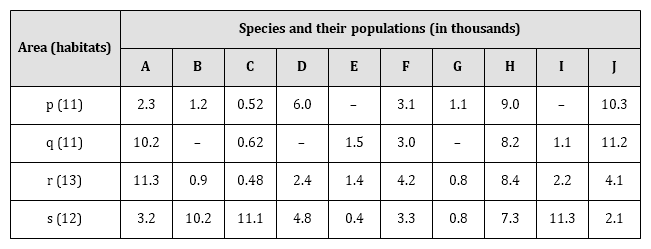
- s
- p
- q
- r
Show answer
Answer: (D) r
Explanation: Species diversity rises with the number of species present and with the variety of habitats. Area p lacks two species and area q lacks three, and each has only 11 habitats. Areas r and s both hold all ten species, but r has more habitats (13 against 12), so area r shows the maximum species diversity.
Question 2
Previous-year questionWhich of the following regions of the globe exhibits the highest species diversity? [NEET 2020]
- Madagascar
- Himalayas
- Amazon forests
- Western Ghats of India
Show answer
Answer: (C) Amazon forests
Explanation: The tropical Amazon rain forest of South America has the greatest biodiversity on the earth, with more than 40,000 species of plants, 3000 fishes, 1300 birds, 427 mammals, 427 amphibians, 378 reptiles and over 1,25,000 invertebrates, besides millions of species still unnamed.
Question 3
Previous-year questionAccording to Robert May, the global species diversity is about [NEET 2020]
- 20 million
- 50 million
- 7 million
- 1.5 million
Show answer
Answer: (C) 7 million
Explanation: Robert May's conservative and more scientifically sound estimate places global species diversity at about 7 million, although only slightly more than 1.5 million species have actually been described so far. Other estimates based on tropical extrapolations have ranged from 20 to 50 million.
Question 4
Previous-year questionWhich of the following is the most important cause for animals and plants being driven to extinction? [NEET 2019]
- Habitat loss and fragmentation
- Drought and floods
- Economic exploitation
- Alien species invasion
Show answer
Answer: (A) Habitat loss and fragmentation
Explanation: Habitat loss and fragmentation remains the most important cause of extinction. When a large continuous habitat is destroyed or broken into small fragments, mammals and birds requiring large territories, as well as migratory animals, are severely affected and their populations decline sharply.
Question 5
Previous-year questionNiche is [NEET 2018]
- all the biological factors in the organism's environment
- the physical space where an organism lives
- the functional role played by the organism where it lives
- the range of temperature that the organism needs to live
Show answer
Answer: (C) the functional role played by the organism where it lives
Explanation: The niche is the total functional role of a species in an ecosystem – what it eats, what eats it, its range of tolerance, its activity time and its interactions with other species. The physical space occupied by an organism is its habitat, not its niche; no two species can occupy exactly the same niche indefinitely.
Question 6
Previous-year questionAlexander von Humboldt described for the first time [NEET 2017]
- Laws of limiting factor
- Species area relationships
- Population growth equation
- Ecological biodiversity
Show answer
Answer: (B) Species area relationships
Explanation: After his pioneering explorations in the South American jungles, Alexander von Humboldt was the first to describe the species–area relationship, showing that within a region species richness increases with the area explored but only up to a limit, giving a rectangular hyperbola.
Question 7
Previous-year questionWhich of the following is the most important cause of animals and plants being driven to extinction? [NEET 2016]
- Over-exploitation
- Alien species invasion
- Habitat loss and fragmentation
- Co-extinctions
Show answer
Answer: (C) Habitat loss and fragmentation
Explanation: Habitat loss and fragmentation is the most important of the four causes of the Evil Quartet. The clearing of the tropical rain forests – once covering more than 14% of the land surface and now barely 6% – and their break-up into small isolated patches has done more damage to biodiversity than any other single factor.
Doing well? Create a free account to take timed tests on this topic and see your weak areas.
Question 8
Previous-year questionThe species confined to a particular region and not found elsewhere is termed as [AIPMT 2015]
- Alien
- Endemic
- Rare
- Keystone
Show answer
Answer: (B) Endemic
Explanation: An endemic species is one whose natural distribution is restricted to a particular geographical area and which is found nowhere else, for example Nepenthes khasiana in Meghalaya. A high degree of endemism is one of the defining criteria of a biodiversity hotspot.
Question 9
Previous-year questionSpecies diversity increases as one proceeds from [AIPMT 1994]
- high altitude to low altitude and high latitude to low latitude
- low altitude to high altitude and high latitude to low latitude
- low altitude to high altitude and low latitude to high latitude
- high altitude to low altitude and low latitude to high latitude
Show answer
Answer: (A) high altitude to low altitude and high latitude to low latitude
Explanation: Species diversity increases as one moves from high altitude to low altitude and from high latitude towards low latitude (the equator). This is because temperature rises and seasonal variability decreases in these directions, providing a warmer, more constant and more productive environment that supports a greater number of species.
Question 10
Previous-year questionWhich animal has become extinct from India? [AIPMT 1994]
- Snow leopard
- Hippopotamus
- Wolf
- Cheetah
Show answer
Answer: (D) Cheetah
Explanation: The cheetah has become extinct from India, the last recorded individuals having been shot in 1947 and the species declared extinct in the country in 1952. Asiatic cheetahs are now found only in Iran, and efforts have been made to breed and reintroduce cheetahs into the Indian sub-continent.
Question 11
Previous-year questionWildlife is destroyed most when [AIPMT 1994]
- there is lack of proper care
- there is mass-scale hunting for foreign trade
- its natural habitat is destroyed
- a natural calamity occurs
Show answer
Answer: (C) its natural habitat is destroyed
Explanation: Wildlife is destroyed most when its natural habitat is destroyed. Natural habitats are essential for the existence of organisms, and when they are destroyed the number of organisms and the number of species both decline sharply — which is why habitat loss heads 'The Evil Quartet'.
Question 12
Previous-year questionWhich of the following is mainly responsible for the extinction of wildlife? [AIPMT 1999]
- Destruction of habitats
- Pollution of air and water
- Hunting for flesh
- All of these
Show answer
Answer: (D) All of these
Explanation: All the factors listed contribute to the extinction of wildlife. Destruction of habitats deprives wild animals of the places where they could flourish, indiscriminate hunting greatly reduces their populations, and pollution adversely affects their life cycles — acting together they drive species towards extinction.
Question 13
Previous-year questionThe endangered largest living lemur, Indri indri, is an inhabitant of [AIPMT 2000]
- Madagascar
- Mauritius
- Sri Lanka
- India
Show answer
Answer: (A) Madagascar
Explanation: Lemurs are endemic to Madagascar and the neighbouring Comoro Islands; Indri indri is the largest living lemur. Lemurs are currently facing extinction mainly on account of habitat destruction and hunting, and Madagascar is recognised as one of the world's biodiversity hotspots.
Question 14
Previous-year questionThe occurrence of endemic species in South America and Australia is due to [AIPMT 2001]
- these species having become extinct from other regions
- continental separation
- there being no terrestrial route to these places
- retrogressive evolution
Show answer
Answer: (B) continental separation
Explanation: The high proportion of endemic species in South America and Australia is due to geographic isolation caused by continental separation (continental drift). Long isolation from other landmasses allowed independent evolution of the flora and fauna, so that many groups — e.g. marsupials in Australia — are found nowhere else.
Question 15
Previous-year questionWhich group of vertebrates comprises the highest number of endangered species? [AIPMT 2003]
- Reptiles
- Birds
- Mammals
- Fishes
Show answer
Answer: (C) Mammals
Explanation: Mammals comprise the highest number of endangered species among vertebrates. In India alone approximately 69 mammalian species and 40 bird species are listed as threatened, largely because large mammals require extensive habitats and are severely affected by habitat loss, fragmentation and hunting.
Want more Biodiversity – Concept of Biodiversity questions?
E-GYAN NIDHI has 237 questions on this topic and 63,000+ in total, all free: timed CBT tests, NEET marking and instant analysis.
Register free Free Sunday Mock Test