Cell – Eukaryotic Cells: NEET MCQs with Answers
15 free questions on Cell – Eukaryotic Cells for NEET (UG), starting with previous-year NEET and AIPMT questions. Try each one, then tap Show answer for the answer and a short explanation.
Syllabus covered: Eukaryotic Cells: Plant cell and animal cell; Cell envelope, cell membrane, cell wall; Cell organelles- structure and function; Endomembrane system-endoplasmic reticulum, Golgi bodies, lysosomes, vacuoles; mitochondria, ribosomes, plastids, micro bodies; Cytoskeleton, cilia, flagella, centrioles (ultra structure and function); Nucleus-nuclear membrane, chromatin, nucleolus.
Question 1
Previous-year questionIn the mitochondrion diagram, identify the correctly described part. [AIPMT Mains 2011]
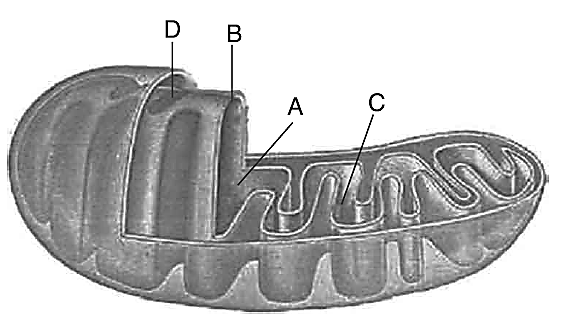
- D (outer membrane) — gives rise to the inner membrane by splitting
- B (inner membrane) — forms infoldings called cristae
- C (crista) — possesses a single circular DNA and ribosomes
- A (matrix) — major site for respiratory-chain enzymes
Show answer
Answer: (B) B (inner membrane) — forms infoldings called cristae
Explanation: The inner membrane (B) forms the infolded cristae.
Question 2
Previous-year questionIdentify components A, B, C and D in the diagram (from: cristae, inner membrane, cytoplasm, SER, RER, mitochondrial matrix, cell vacuole, nucleus). [AIPMT Mains 2010]
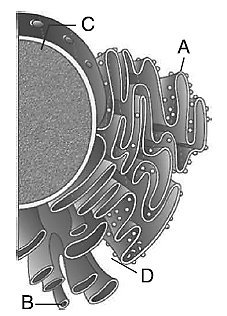
- A–RER, B–SER, C–nucleus, D–cytoplasm
- A–cristae, B–SER, C–nucleus, D–matrix
- A–matrix, B–RER, C–SER, D–vacuole
- A–RER, B–cristae, C–cytoplasm, D–inner membrane
Show answer
Answer: (A) A–RER, B–SER, C–nucleus, D–cytoplasm
Explanation: A is the rough ER, recognised by the ribosomes on its surface. B is a smooth tubule, the smooth ER. C leads into the nucleus, and D marks the cytoplasm outside the ER membranes. No mitochondrion is drawn in the figure, so cristae and matrix cannot be among the labelled parts.
Question 3
Previous-year questionSelect the alternative giving the correct identification and function of the organelle 'A' in the given diagram. [NEET 2013]
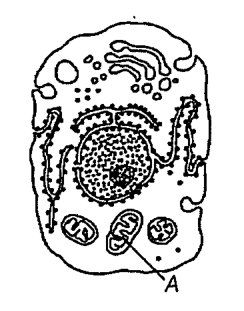
- Endoplasmic reticulum — synthesis of lipids
- Mitochondria — produce cellular energy in the form of ATP
- Golgi body — provides packaging material
- Lysosome — secretes hydrolytic enzymes
Show answer
Answer: (B) Mitochondria — produce cellular energy in the form of ATP
Explanation: Label A points to a mitochondrion, recognised by its double membrane and the infoldings of the inner membrane called cristae. Mitochondria are the sites of aerobic respiration and produce cellular energy in the form of ATP, which is why they are called the power houses of the cell.
Question 4
Previous-year questionRead the two statements given below and choose the correct answer. [NEET (Sawaimadhopur) 2024]
Statement I: The Golgi cisternae are concentrically arranged near the nucleus with distinct convex cis or the forming face and concave trans or the maturing face.
Statement II: The cis and trans faces of the organelle are identical and interconnected.
Statement I: The Golgi cisternae are concentrically arranged near the nucleus with distinct convex cis or the forming face and concave trans or the maturing face.
Statement II: The cis and trans faces of the organelle are identical and interconnected.
- Both Statement I and Statement II are false.
- Statement I is true but Statement II is false.
- Statement I is false but Statement II is true.
- Both Statement I and Statement II are true.
Show answer
Answer: (B) Statement I is true but Statement II is false.
Explanation: Golgi cisternae are concentrically arranged near the nucleus with a distinct convex cis (forming) face and a concave trans (maturing) face, so Statement I is true. The cis and trans faces are entirely different from each other, although interconnected, so Statement II is false.
Question 5
Previous-year questionMatch List-I with List-II and choose the correct answer from the options given below. [NEET (Sawaimadhopur) 2024]
List-I:
A. Cilia
B. Endoplasmic Reticulum
C. Mitochondria
D. Kinetochore
List-II:
I. Spindle fibres
II. Cristae
III. Axoneme
IV. Ribosomes
List-I:
A. Cilia
B. Endoplasmic Reticulum
C. Mitochondria
D. Kinetochore
List-II:
I. Spindle fibres
II. Cristae
III. Axoneme
IV. Ribosomes
- A–III, B–IV, C–II, D–I
- A–I, B–III, C–II, D–IV
- A–III, B–II, C–I, D–IV
- A–I, B–IV, C–II, D–III
Show answer
Answer: (A) A–III, B–IV, C–II, D–I
Explanation: Cilia have an axoneme as their core (III); ribosomes are attached to the rough endoplasmic reticulum (IV); cristae are infoldings of the mitochondrial inner membrane (II); kinetochores on the centromere are the sites of attachment of spindle fibres (I).
Question 6
Previous-year questionThe DNA found in chloroplasts is: [NEET 2024]
- Linear, double stranded
- Circular, double stranded
- Linear, single stranded
- Circular, single stranded
Show answer
Answer: (B) Circular, double stranded
Explanation: The stroma of the chloroplast contains small, double-stranded circular DNA molecules along with 70S ribosomes, similar to prokaryotic DNA. It is neither linear like nuclear DNA nor single-stranded.
Question 7
Previous-year questionWhat would happen if the pH inside lysosomes were raised to the alkaline range? [Re-NEET 2022]
- Hydrolytic enzymes will function more efficiently
- Hydrolytic enzymes will become inactive
- Lysosomal enzymes will be released into the cytoplasm
- Lysosomal enzymes will be more active
Show answer
Answer: (B) Hydrolytic enzymes will become inactive
Explanation: Lysosomal hydrolases (lipases, proteases, carbohydrases) are optimally active only at acidic pH. An increase of pH to alkaline would therefore make these enzymes inactive, not more active, and a pH change by itself does not rupture the lysosomal membrane.
Doing well? Create a free account to take timed tests on this topic and see your weak areas.
Question 8
Previous-year questionMatch the plastids in List-I with the substances they store in List-II and choose the correct answer. [NEET (Overseas) 2022]
List-I:
(a) Chromoplasts
(b) Amyloplasts
(c) Elaioplasts
(d) Aleuroplasts
List-II:
(i) Proteins
(ii) Oil and fats
(iii) Starch
(iv) Carotene
List-I:
(a) Chromoplasts
(b) Amyloplasts
(c) Elaioplasts
(d) Aleuroplasts
List-II:
(i) Proteins
(ii) Oil and fats
(iii) Starch
(iv) Carotene
- (a)-(iv), (b)-(iii), (c)-(ii), (d)-(i)
- (a)-(iv), (b)-(ii), (c)-(iii), (d)-(i)
- (a)-(iv), (b)-(iii), (c)-(i), (d)-(ii)
- (a)-(iv), (b)-(i), (c)-(iii), (d)-(ii)
Show answer
Answer: (A) (a)-(iv), (b)-(iii), (c)-(ii), (d)-(i)
Explanation: Chromoplasts contain fat-soluble carotenoid pigments such as carotene (iv); amyloplasts store starch (iii); elaioplasts store oils and fats (ii); aleuroplasts store proteins (i).
Question 9
Previous-year questionRead the two statements given below and choose the most appropriate answer. [NEET (Overseas) 2022]
Statement I: Membrane-bound organelles of the endomembrane system coordinate cellular functions.
Statement II: Mitochondria and chloroplasts are not considered a part of the endomembrane system.
Statement I: Membrane-bound organelles of the endomembrane system coordinate cellular functions.
Statement II: Mitochondria and chloroplasts are not considered a part of the endomembrane system.
- Statement-I is incorrect but Statement-II is correct
- Both Statement-I and Statement-II are correct
- Both Statement-I and Statement-II are incorrect
- Statement-I is correct but Statement-II is incorrect
Show answer
Answer: (B) Both Statement-I and Statement-II are correct
Explanation: The membrane-bound organelles of the endomembrane system (ER, Golgi complex, lysosomes, vacuoles) have coordinated functions, so Statement I is correct. Mitochondria, chloroplasts and peroxisomes are not considered part of this system because their functions are not coordinated with these components, so Statement II is also correct.
Question 10
Previous-year questionThe middle lamella can best be described as: [NEET 2021 (Paper-2)]
- A lignified layer which glues the neighbouring cells together.
- A membrane which connects cell membrane and cell wall.
- A structure which connects the cytoplasm of neighbouring cells.
- A layer which holds the different neighbouring cells together.
Show answer
Answer: (D) A layer which holds the different neighbouring cells together.
Explanation: The middle lamella is a layer mainly of calcium pectate that holds or glues the different neighbouring cells together. It is not lignified, it is not a membrane linking the cell membrane to the wall, and cytoplasmic connections between cells are made by plasmodesmata.
Question 11
Previous-year questionWhich of the following groups of three items is INCORRECTLY matched with its grouping category? [NEET 2021 (Paper-2)]
- ER, Golgi body, lysosome – Endomembrane system
- Chromoplast, chloroplast, leucoplast – Plastids
- Amyloplast, elaioplast, aleuroplast – Leucoplast
- Abrin, ricin, concanavalin – Toxins
Show answer
Answer: (D) Abrin, ricin, concanavalin – Toxins
Explanation: Abrin and ricin are toxins, but concanavalin A is a lectin, so grouping all three as toxins is incorrect. ER, Golgi body and lysosome belong to the endomembrane system; chromoplasts, chloroplasts and leucoplasts are plastids; and amyloplasts, elaioplasts and aleuroplasts are types of leucoplasts.
Question 12
Previous-year questionIdentify the incorrect statement among the following. [NEET 2021]
- Mature sieve tube elements possess a conspicuous nucleus and usual cytoplasmic organelles.
- Microbodies are present both in plant and animal cells.
- The perinuclear space forms a barrier between the materials present inside the nucleus and that of the cytoplasm.
- Nuclear pores act as passages for proteins and RNA molecules in both directions between nucleus and cytoplasm.
Show answer
Answer: (A) Mature sieve tube elements possess a conspicuous nucleus and usual cytoplasmic organelles.
Explanation: Mature sieve tube elements lack a nucleus; their functions are controlled by the nucleus of companion cells, so the statement giving them a conspicuous nucleus is incorrect. Microbodies occur in both plant and animal cells, the perinuclear space between the two nuclear membranes forms a barrier between nucleus and cytoplasm, and nuclear pores allow two-way movement of RNA and proteins.
Question 13
Previous-year questionMatch the structures in Column I with their functions in Column II and choose the correct option. [NEET (COVID-19) 2020]
Column I:
(a) Smooth endoplasmic reticulum
(b) Rough endoplasmic reticulum
(c) Golgi complex
(d) Centriole
Column II:
(i) Protein synthesis
(ii) Lipid synthesis
(iii) Glycosylation
(iv) Spindle formation
Column I:
(a) Smooth endoplasmic reticulum
(b) Rough endoplasmic reticulum
(c) Golgi complex
(d) Centriole
Column II:
(i) Protein synthesis
(ii) Lipid synthesis
(iii) Glycosylation
(iv) Spindle formation
- (a)-(ii), (b)-(i), (c)-(iii), (d)-(iv)
- (a)-(iii), (b)-(i), (c)-(ii), (d)-(iv)
- (a)-(iv), (b)-(ii), (c)-(i), (d)-(iii)
- (a)-(i), (b)-(ii), (c)-(iii), (d)-(iv)
Show answer
Answer: (A) (a)-(ii), (b)-(i), (c)-(iii), (d)-(iv)
Explanation: Smooth ER is the major site of lipid synthesis (ii); rough ER, bearing ribosomes, is involved in protein synthesis (i); the Golgi complex carries out glycosylation (iii); centrioles form the basal body and give rise to spindle fibres (iv).
Question 14
Previous-year questionMatch the organelles in Column I with their functions in Column II and choose the correct option. [NEET (Odisha) 2019]
Column I:
(a) Golgi apparatus
(b) Lysosomes
(c) Vacuoles
(d) Ribosomes
Column II:
(i) Synthesis of protein
(ii) Trap waste and excretory products
(iii) Formation of glycoproteins and glycolipids
(iv) Digesting biomolecules
Column I:
(a) Golgi apparatus
(b) Lysosomes
(c) Vacuoles
(d) Ribosomes
Column II:
(i) Synthesis of protein
(ii) Trap waste and excretory products
(iii) Formation of glycoproteins and glycolipids
(iv) Digesting biomolecules
- (a)-(iii), (b)-(iv), (c)-(ii), (d)-(i)
- (a)-(iv), (b)-(iii), (c)-(i), (d)-(ii)
- (a)-(iii), (b)-(ii), (c)-(iv), (d)-(i)
- (a)-(i), (b)-(ii), (c)-(iv), (d)-(iii)
Show answer
Answer: (A) (a)-(iii), (b)-(iv), (c)-(ii), (d)-(i)
Explanation: Golgi apparatus – formation of glycoproteins and glycolipids (iii); lysosomes – digesting biomolecules with hydrolytic enzymes (iv); vacuoles – trap waste and excretory products (ii); ribosomes – synthesis of protein (i).
Question 15
Previous-year questionIdentify the statement that is NOT correct. [NEET 2019]
- Lysosomes have numerous hydrolytic enzymes.
- The hydrolytic enzymes of lysosomes are active under acidic pH.
- Lysosomes are membrane bound structures.
- Lysosomes are formed by the process of packaging in the endoplasmic reticulum.
Show answer
Answer: (D) Lysosomes are formed by the process of packaging in the endoplasmic reticulum.
Explanation: Lysosomes are membrane-bound vesicles rich in hydrolytic enzymes (lipases, proteases, carbohydrases) that are optimally active at acidic pH. They are formed by packaging in the Golgi apparatus, not in the endoplasmic reticulum, so the statement naming the endoplasmic reticulum is the incorrect one.
Want more Cell – Eukaryotic Cells questions?
E-GYAN NIDHI has 1,542 questions on this topic and 63,000+ in total, all free: timed CBT tests, NEET marking and instant analysis.
Register free Free Sunday Mock TestMore topics in Cell Structure and Function
- Biomolecules – Enzymes MCQs
- Cell Division – Cell Division and The Cell Cycle MCQs
- Cell – Prokaryotic Cells MCQs
- Cell – What is a Cell? The Unit of Life MCQs
- Biomolecules – Nucleic Acids MCQs
- Biomolecules – Carbohydrates MCQs
- Biomolecules – Proteins MCQs
- Biomolecules – Lipids MCQs
- Biomolecules – Chemical constituents of living cells MCQs
- Cell Division – Mitosis and its significance MCQs
- Cell Division – Meiosis and its significance MCQs