Cell Division – Mitosis and its significance: NEET MCQs with Answers
15 free questions on Cell Division – Mitosis and its significance for NEET (UG), starting with previous-year NEET and AIPMT questions. Try each one, then tap Show answer for the answer and a short explanation.
Syllabus covered: Mitosis and its significance
Question 1
Previous-year questionA stage of mitosis is shown in the given diagram. Which stage is it and what are its characteristics? [NEET 2013]
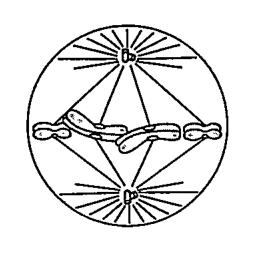
- Late prophase — chromosomes move to spindle equator
- Metaphase — spindle fibres attached to kinetochores, centromeres split and chromatids separate
- Metaphase — chromosomes moved to spindle equator, chromosomes made up of two sister chromatids
- Anaphase — centromeres split and chromatids separate and start moving away
Show answer
Answer: (C) Metaphase — chromosomes moved to spindle equator, chromosomes made up of two sister chromatids
Explanation: The stage shown is metaphase. In it the chromosomes have moved to the spindle equator and become aligned along the metaphase plate through spindle fibres attached to both poles, and each chromosome is still made up of two sister chromatids because the centromere has not yet split.
Question 2
Previous-year questionIn which stages of mitosis and meiosis, respectively, does the centromere of each chromosome split? [NEET (Manipur) 2023]
- Metaphase, Metaphase II
- Prophase, Telophase I
- Telophase, Anaphase I
- Anaphase, Anaphase II
Show answer
Answer: (D) Anaphase, Anaphase II
Explanation: The centromere splits at the onset of anaphase in mitosis and at the onset of anaphase II in meiosis, separating sister chromatids. In anaphase I only homologous chromosomes separate and centromeres stay intact; metaphase is only the alignment stage.
Question 3
Previous-year questionRegarding metaphase, which one of the following statements is NOT correct? [Re-NEET 2022]
- Complete disintegration of the nuclear envelope takes place
- Chromosomes are highly condensed
- Metaphase chromosomes are made up of four sister chromatids held together by the centromere
- Chromosomes lie at the equator of the cell
Show answer
Answer: (C) Metaphase chromosomes are made up of four sister chromatids held together by the centromere
Explanation: A metaphase chromosome consists of two sister chromatids held together by the centromere, not four, so that statement is incorrect. The nuclear envelope has completely disintegrated, chromosomes are maximally condensed and they align at the equatorial (metaphase) plate.
Question 4
Previous-year questionAssertion: The growth of a multicellular organism takes place because of mitosis. [NEET (Overseas) 2022]
Reason: Mitosis is also known as equational division and it provides genetic stability.
Reason: Mitosis is also known as equational division and it provides genetic stability.
- (A) is not correct but (R) is correct
- Both (A) and (R) are correct and (R) is the correct explanation of (A)
- Both (A) and (R) are correct but (R) is not the correct explanation of (A)
- (A) is correct but (R) is not correct
Show answer
Answer: (B) Both (A) and (R) are correct and (R) is the correct explanation of (A)
Explanation: Both statements are true. A multicellular organism grows because mitosis increases its cell number. Mitosis is an equational division: daughter cells receive the same chromosome number and genetic make-up as the parent, so the new cells formed during growth are genetically alike, which keeps the organism genetically stable as it grows. In this sense the Reason accounts for the Assertion.
Question 5
Previous-year questionThe figure given below represents which stage? [NEET (Paper-2) 2021]
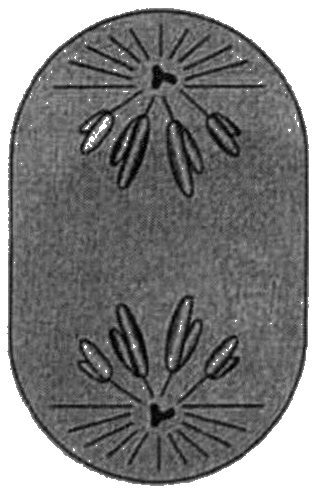
- Metaphase
- Transition to metaphase
- Anaphase
- Telophase
Show answer
Answer: (C) Anaphase
Explanation: The figure shows chromatids being pulled towards opposite poles by the spindle fibres, with their centromeres leading and the arms trailing — the characteristic feature of anaphase. In metaphase the chromosomes would be aligned at the equator, and in telophase they would be clustered at the poles with nuclear envelopes reforming.
Question 6
Previous-year questionDNA replication in bacteria occurs [NEET 2017]
- within the nucleolus
- prior to fission
- just before transcription
- during S phase
Show answer
Answer: (B) prior to fission
Explanation: A bacterium has no organised cell cycle with a distinct S phase; its circular DNA replicates immediately before the cell divides by binary fission.
Question 7
Previous-year questionWhich of the following options gives the correct sequence of events during mitosis? [NEET 2017]
- Condensation - nuclear membrane disassembly - arrangement at equator - centromere division - segregation - telophase
- Condensation - crossing over - nuclear membrane disassembly - segregation - telophase
- Condensation - arrangement at equator - centromere division - segregation - telophase
- Condensation - nuclear membrane disassembly - crossing over - segregation - telophase
Show answer
Answer: (A) Condensation - nuclear membrane disassembly - arrangement at equator - centromere division - segregation - telophase
Explanation: Mitosis proceeds by chromosome condensation and breakdown of the nuclear envelope in prophase, alignment at the equator in metaphase, centromere division and poleward segregation in anaphase, and reorganisation in telophase. Crossing over never occurs in mitosis.
Doing well? Create a free account to take timed tests on this topic and see your weak areas.
Question 8
Previous-year questionThe Anaphase Promoting Complex (APC) is a protein degradation machinery necessary for proper mitosis of animal cells. If APC is defective in a human cell, which of the following is expected to occur? [NEET 2017]
- Chromosomes will be fragmented
- Chromosomes will not segregate
- Recombination of chromosome arms will occur
- Chromosomes will not condense
Show answer
Answer: (B) Chromosomes will not segregate
Explanation: The APC triggers the destruction of the proteins that hold sister chromatids together; if it is defective the chromatids remain joined and segregation at anaphase fails.
Question 9
Previous-year questionSpindle fibres attach on to [NEET 2016]
- the telomere of the chromosome
- the kinetochore of the chromosome
- the centromere of the chromosome
- the kinetosome of the chromosome
Show answer
Answer: (B) the kinetochore of the chromosome
Explanation: The spindle microtubules bind to the kinetochores, the disc-shaped protein complexes assembled on the surface of the centromere.
Question 10
Previous-year questionWhich of the following is NOT a characteristic feature during mitosis in somatic cells? [NEET 2016]
- Spindle fibres
- Disappearance of nucleolus
- Chromosome movement
- Synapsis
Show answer
Answer: (D) Synapsis
Explanation: Pairing of homologous chromosomes, or synapsis, is confined to zygotene of prophase I of meiosis; the other three occur in mitosis.
Question 11
Previous-year questionMitotic anaphase differs from metaphase in possessing [AIPMT 1991]
- The same number of chromosomes and the same number of chromatids
- Half the number of chromosomes and half the number of chromatids
- Half the number of chromosomes and the same number of chromatids
- The same number of chromosomes and half the number of chromatids
Show answer
Answer: (D) The same number of chromosomes and half the number of chromatids
Explanation: At metaphase the centromeres of all the chromosomes lie at the equator with their arms directed towards the poles, each chromosome carrying two chromatids. In anaphase the centromere of each chromosome divides so that each sister chromatid acquires its own centromere, and on the book's reckoning each anaphase chromosome therefore carries half the number of chromatids.
Question 12
Previous-year questionIn salivary gland chromosomes, that is, polytene chromosomes, pairing is [AIPMT 1993]
- Absent
- Occasional
- Formed between non-homologous chromosomes
- Formed between homologous chromosomes
Show answer
Answer: (D) Formed between homologous chromosomes
Explanation: Polytene or salivary gland chromosomes were reported by Balbiani in 1881 from the salivary glands of the larva of Chironomus. They become giant through endoduplication, that is, repeated replication of chromatids without their separation, and each polytene chromosome is formed by the pairing of two homologous chromosomes.
Question 13
Previous-year questionThe best stage to observe the shape, size and number of chromosomes is [AIPMT 1994]
- Interphase
- Metaphase
- Prophase
- Telophase
Show answer
Answer: (B) Metaphase
Explanation: At metaphase chromosomes are maximally condensed and aligned at the equatorial plate, so their morphology, size and number are most easily studied. Karyotypes are prepared from metaphase chromosomes.
Question 14
Previous-year questionThe point at which polytene chromosomes appear to be attached together is called the [AIPMT 1995]
- Centriole
- Centromere
- Chromomere
- Chromocentre
Show answer
Answer: (D) Chromocentre
Explanation: Polytene chromosomes are formed by the pairing of two somatic homologous chromosomes which undergo repeated endomitosis, forming a number of strands. These strands remain attached to a common large chromocentre and are rich in heterochromatin.
Question 15
Previous-year questionColchicine is employed to diploidise a haploid cell as it [AIPMT 1996]
- Inhibits mitosis
- Inhibits formation of the mitotic spindle
- Allows replication of DNA twice in one cell cycle
- Inhibits formation of the centromere
Show answer
Answer: (B) Inhibits formation of the mitotic spindle
Explanation: Colchicine is a mitotic poison derived from the bulb-like corms of Colchicum autumnale, the autumn crocus. It binds to tubulin and thereby inhibits the formation of the spindle fibres, so the duplicated chromosomes are not separated and the haploid cell becomes diploid.
Want more Cell Division – Mitosis and its significance questions?
E-GYAN NIDHI has 284 questions on this topic and 63,000+ in total, all free: timed CBT tests, NEET marking and instant analysis.
Register free Free Sunday Mock TestMore topics in Cell Structure and Function
- Cell – Eukaryotic Cells MCQs
- Biomolecules – Enzymes MCQs
- Cell Division – Cell Division and The Cell Cycle MCQs
- Cell – Prokaryotic Cells MCQs
- Cell – What is a Cell? The Unit of Life MCQs
- Biomolecules – Nucleic Acids MCQs
- Biomolecules – Carbohydrates MCQs
- Biomolecules – Proteins MCQs
- Biomolecules – Lipids MCQs
- Biomolecules – Chemical constituents of living cells MCQs
- Cell Division – Meiosis and its significance MCQs