Biomolecules – Enzymes: NEET MCQs with Answers
15 free questions on Biomolecules – Enzymes for NEET (UG), starting with previous-year NEET and AIPMT questions. Try each one, then tap Show answer for the answer and a short explanation.
Syllabus covered: Enzymes: types, properties, enzyme action, classification and nomenclature of enzymes
Question 1
Previous-year questionWhich describes the given energy graph correctly? [NEET-II 2016]
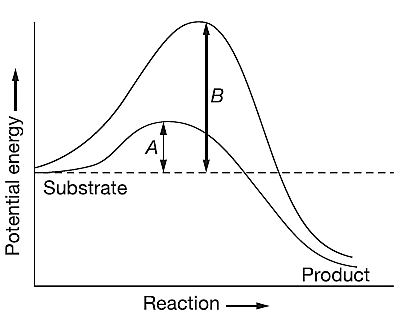
- Exothermic reaction with energy A (with enzyme) and B (without enzyme)
- Endothermic reaction with energy A (without enzyme) and B (with enzyme)
- Exothermic reaction with energy A (without enzyme) and B (with enzyme)
- Endothermic reaction with energy A (with enzyme) and B (without enzyme)
Show answer
Answer: (A) Exothermic reaction with energy A (with enzyme) and B (without enzyme)
Explanation: The product lies at a lower energy level than the substrate, so the reaction releases energy and is exothermic. The shorter arrow A is on the lower curve, so it is the activation energy with enzyme. The longer arrow B is on the higher curve, so it is the activation energy without enzyme, because an enzyme lowers the activation energy.
Question 2
Previous-year questionAn enzyme-activity curve is shown against a condition. What do the X and Y axes represent? [AIPMT Pre 2011]
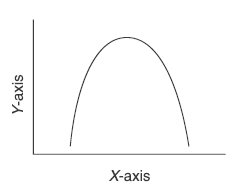
- X: temperature, Y: enzyme activity
- X: substrate concentration, Y: enzyme activity
- X: enzyme activity, Y: temperature
- X: enzyme activity, Y: pH
Show answer
Answer: (A) X: temperature, Y: enzyme activity
Explanation: A bell-shaped curve with enzyme activity on the Y-axis fits temperature on the X-axis: activity rises to an optimum, then falls as the enzyme denatures. Substrate concentration would give a curve that levels off, not one that falls. The dependent quantity, enzyme activity, is plotted on the Y-axis, so it cannot be the X-axis.
Question 3
Previous-year questionIn the energy diagram of an enzyme-catalysed reaction, identify A, B, C and D. [AIPMT Mains 2010]
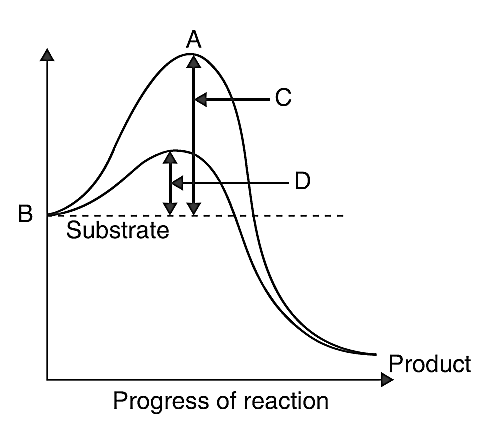
- A–potential energy, B–transition state, C–activation energy with enzyme, D–activation energy without enzyme
- A–transition state, B–potential energy, C–activation energy without enzyme, D–activation energy with enzyme
- A–potential energy, B–transition state, C–activation energy without enzyme, D–activation energy with enzyme
- A–activation energy with enzyme, B–transition state, C–activation energy without enzyme, D–potential energy
Show answer
Answer: (B) A–transition state, B–potential energy, C–activation energy without enzyme, D–activation energy with enzyme
Explanation: A is the peak of the curve, the high-energy transition state. B marks the vertical axis, the potential energy at substrate level. The longer arrow C on the higher curve is the activation energy without enzyme, and the shorter arrow D on the lower curve is the activation energy with enzyme, because an enzyme lowers the activation energy.
Question 4
Previous-year questionWhich graph represents the effect of substrate concentration on the velocity of an enzyme-catalysed reaction? [Re-NEET 2024]
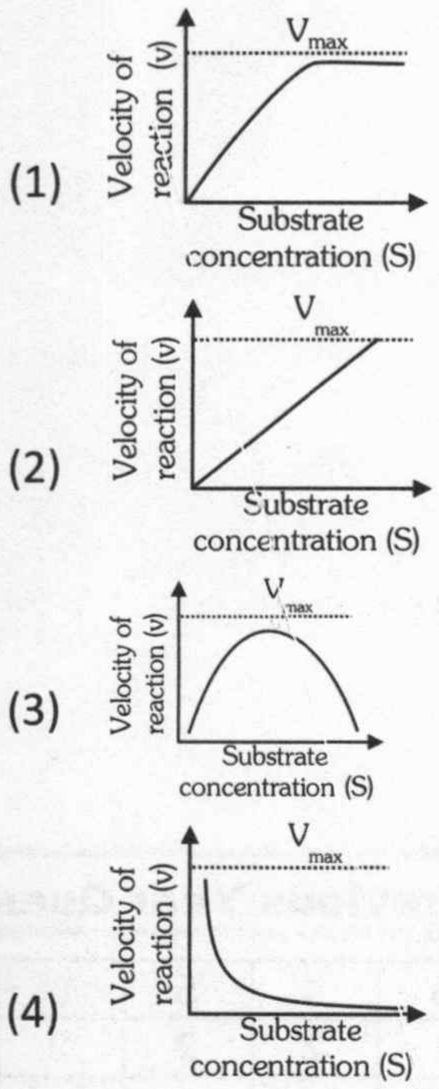
- Figure (1)
- Figure (2)
- Figure (3)
- Figure (4)
Show answer
Answer: (A) Figure (1)
Explanation: As substrate concentration increases, velocity rises at first and then levels off at Vmax because all active sites become saturated, giving a curve that rises and then flattens. Velocity does not keep rising in a straight line to Vmax, does not form a bell-shaped peak, and does not fall steeply with increasing substrate.
Question 5
Previous-year questionLigases are enzymes that catalyse the joining together of two compounds. Which of the following bonds is NOT formed by ligases? [Re-NEET 2024]
- C–C
- P–O
- C–O
- C–N
Show answer
Answer: (A) C–C
Explanation: As per NCERT, ligases catalyse the linking together of two compounds by joining C–O, C–S, C–N and P–O bonds. C–C bond is not in this list, so it is the answer.
Question 6
Previous-year questionMatch List-I with List-II: [NEET 2024 (Sawaimadhopur)]
List-I:
A. Ribozyme
B. Lecithin
C. GLUT-4
D. Vitamins
List-II:
I. Glucose transport
II. Non-proteinaceous enzyme
III. Lipid
IV. Coenzyme
List-I:
A. Ribozyme
B. Lecithin
C. GLUT-4
D. Vitamins
List-II:
I. Glucose transport
II. Non-proteinaceous enzyme
III. Lipid
IV. Coenzyme
- A-IV, B-III, C-II, D-I
- A-II, B-I, C-III, D-IV
- A-II, B-III, C-I, D-IV
- A-IV, B-III, C-I, D-II
Show answer
Answer: (C) A-II, B-III, C-I, D-IV
Explanation: Ribozyme is a non-proteinaceous (RNA) enzyme (A-II), lecithin is a phospholipid (B-III), GLUT-4 is a glucose transporter (C-I), and many vitamins act as coenzymes, e.g. niacin in NAD (D-IV).
Question 7
Previous-year questionThe catalytic cycle of enzyme action is described by the following steps: [NEET 2024 (Sawaimadhopur)]
A. The enzyme releases the products of the reaction and becomes free.
B. The substrate induces the enzyme to alter its shape.
C. The substrate binds to the active site of the enzyme.
D. An enzyme–product complex is formed.
Choose the correct answer from the options given below.
A. The enzyme releases the products of the reaction and becomes free.
B. The substrate induces the enzyme to alter its shape.
C. The substrate binds to the active site of the enzyme.
D. An enzyme–product complex is formed.
Choose the correct answer from the options given below.
- C → B → D → A
- B → C → D → A
- D → C → A → B
- C → B → A → D
Show answer
Answer: (A) C → B → D → A
Explanation: The substrate first binds the active site (C), which induces the enzyme to change shape to fit it more tightly (B); the enzyme–product complex then forms (D) and finally the enzyme releases the products and becomes free (A). Hence C → B → D → A.
Doing well? Create a free account to take timed tests on this topic and see your weak areas.
Question 8
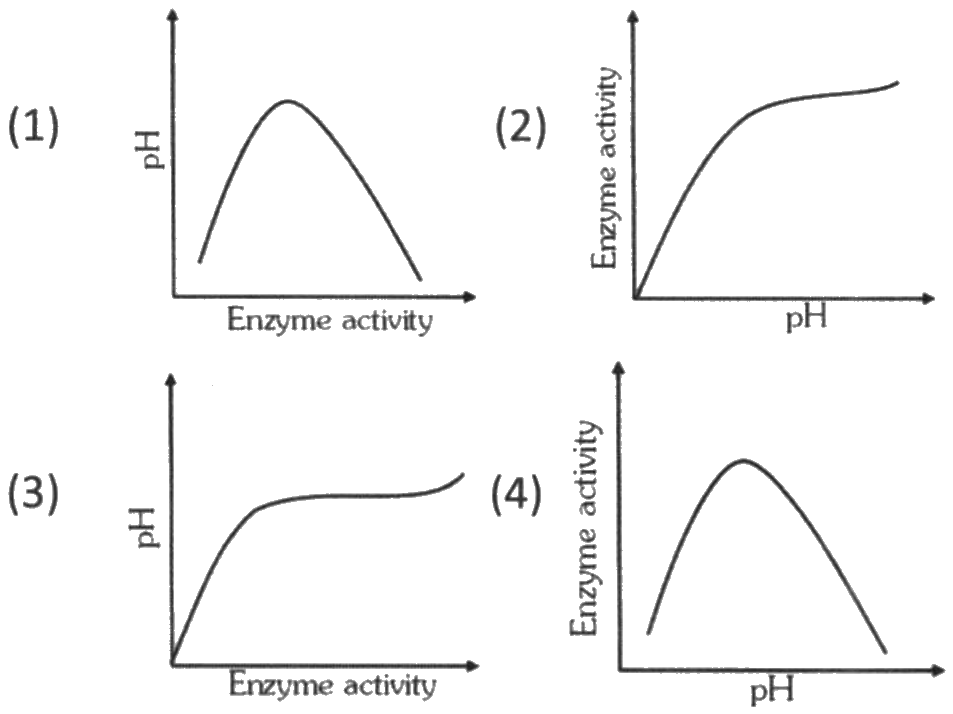
Previous-year questionWhich graph correctly shows how pH affects enzyme activity? [NEET 2024 (Sawaimadhopur)]
- Figure (1)
- Figure (2)
- Figure (3)
- Figure (4)
Show answer
Answer: (D) Figure (4)
Explanation: pH is the independent variable (x-axis) and enzyme activity the dependent variable (y-axis). Activity rises to a maximum at the optimum pH and falls on either side, giving a bell-shaped curve with pH on the x-axis. Graphs with pH on the y-axis have the axes swapped, and a curve that keeps rising shows no decline.
Question 9
Previous-year questionWhich statement about enzymes is incorrect? [NEET 2024 (Sawaimadhopur)]
- In thermophilic organisms enzymes can catalyze reactions at high temperature i.e. 90°C
- All enzymes are proteinaceous in nature
- Some enzymes have metal ions
- They are highly substrate specific
Show answer
Answer: (B) All enzymes are proteinaceous in nature
Explanation: Not all enzymes are proteins: ribozymes are catalytic RNA molecules, so the claim that all enzymes are proteinaceous is incorrect. Thermophile enzymes function at 80–90°C, many enzymes contain metal ions (e.g. zinc in carboxypeptidase) and enzymes are highly specific.
Question 10
Previous-year questionWhat is the prosthetic group of the enzyme that catalyses the decomposition H₂O₂ → H₂O + O₂? [Re-NEET 2022]
- Nicotinamide adenine dinucleotide
- Haem
- Zinc
- Niacin
Show answer
Answer: (B) Haem
Explanation: Catalase breaks down hydrogen peroxide into water and oxygen, and its prosthetic group is haem. NAD and niacin are coenzyme-related, and zinc is the metal cofactor of carboxypeptidase.
Question 11
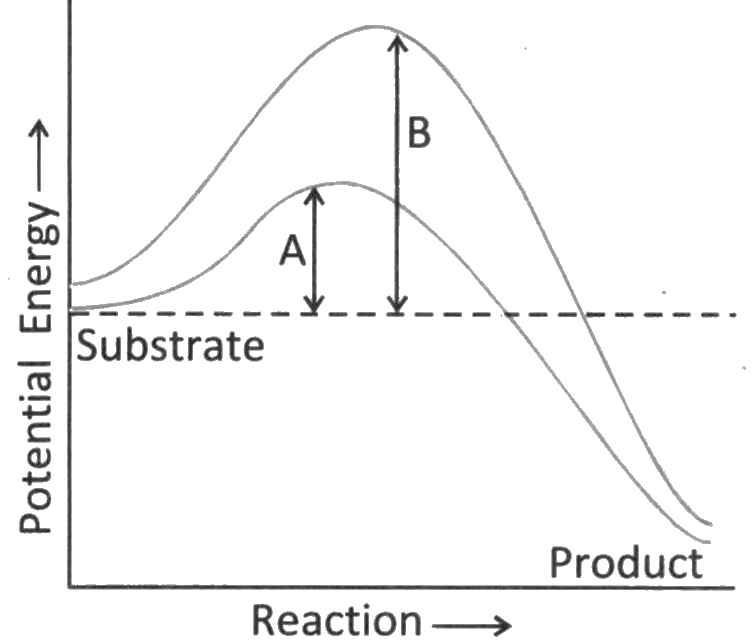
Previous-year questionWhich option correctly describes the graph shown below? [NEET-II 2016]
- Endothermic reaction with energy A in absence of enzyme and B in presence of enzyme
- Exothermic reaction with energy A in absence of enzyme and B in presence of enzyme
- Endothermic reaction with energy A in presence of enzyme and B in absence of enzyme
- Exothermic reaction with energy A in presence of enzyme and B in absence of enzyme
Show answer
Answer: (D) Exothermic reaction with energy A in presence of enzyme and B in absence of enzyme
Explanation: The product lies at a lower potential energy than the substrate, so the reaction releases energy (exothermic). An enzyme lowers the activation energy, so the smaller barrier A is with the enzyme and the larger barrier B is without it.
Question 12
Previous-year questionConsider the following statements. (A) A coenzyme or metal ion that is tightly bound to the enzyme protein is called a prosthetic group. (B) A complete catalytically active enzyme with its bound prosthetic group is called apoenzyme. Select the correct option. [NEET 2019]
- Both (A) and (B) are true
- (A) is true but (B) is false
- Both (A) and (B) are false
- (A) is false but (B) is true
Show answer
Answer: (B) (A) is true but (B) is false
Explanation: Prosthetic groups are indeed tightly bound cofactors, but the complete catalytically active enzyme with its prosthetic group is the holoenzyme, not the apoenzyme.
Question 13
Previous-year questionWhich one of the following statements is correct with reference to enzymes? [NEET 2017]
- Holoenzyme = apoenzyme + coenzyme
- Coenzyme = apoenzyme + holoenzyme
- Holoenzyme = coenzyme + cofactor
- Apoenzyme = holoenzyme + coenzyme
Show answer
Answer: (A) Holoenzyme = apoenzyme + coenzyme
Explanation: The catalytically active whole enzyme, the holoenzyme, is the protein part (apoenzyme) together with its non-protein cofactor or coenzyme.
Question 14
Previous-year questionWhich one of the following statements is INCORRECT? [AIPMT 2015]
- In competitive inhibition, the inhibitor molecule is not chemically changed by the enzyme
- The competitive inhibitor does not affect the rate of breakdown of the enzyme-substrate complex
- The presence of a competitive inhibitor decreases the Km of the enzyme for the substrate
- A competitive inhibitor reacts reversibly with the enzyme to form an enzyme-inhibitor complex
Show answer
Answer: (C) The presence of a competitive inhibitor decreases the Km of the enzyme for the substrate
Explanation: A competitive inhibitor raises the apparent Km, because more substrate is now needed to reach half-maximal velocity, while Vmax stays unchanged.
Question 15
Previous-year questionSelect the option which is NOT correct with respect to enzyme action. [AIPMT 2014]
- Substrate binds with the enzyme at its active site
- Addition of a lot of succinate does not reverse the inhibition of succinic dehydrogenase by malonate
- A non-competitive inhibitor binds the enzyme at a site distinct from that which binds the substrate
- Malonate is a competitive inhibitor of succinic dehydrogenase
Show answer
Answer: (B) Addition of a lot of succinate does not reverse the inhibition of succinic dehydrogenase by malonate
Explanation: Because malonate is a competitive inhibitor, raising the concentration of the true substrate succinate outcompetes it and reverses the inhibition.
Want more Biomolecules – Enzymes questions?
E-GYAN NIDHI has 343 questions on this topic and 63,000+ in total, all free: timed CBT tests, NEET marking and instant analysis.
Register free Free Sunday Mock TestMore topics in Cell Structure and Function
- Cell – Eukaryotic Cells MCQs
- Cell Division – Cell Division and The Cell Cycle MCQs
- Cell – Prokaryotic Cells MCQs
- Cell – What is a Cell? The Unit of Life MCQs
- Biomolecules – Nucleic Acids MCQs
- Biomolecules – Carbohydrates MCQs
- Biomolecules – Proteins MCQs
- Biomolecules – Lipids MCQs
- Biomolecules – Chemical constituents of living cells MCQs
- Cell Division – Mitosis and its significance MCQs
- Cell Division – Meiosis and its significance MCQs