Cell Division – Meiosis and its significance: NEET MCQs with Answers
15 free questions on Cell Division – Meiosis and its significance for NEET (UG), starting with previous-year NEET and AIPMT questions. Try each one, then tap Show answer for the answer and a short explanation.
Syllabus covered: Meiosis and its significance
Question 1
Previous-year questionMatch the events in List-I with the stages of prophase I (meiosis I) in List-II and choose the correct option. [Re-NEET 2024]
List-I (Event):
A. Chiasmata formation
B. Crossing over
C. Synaptonemal complex formation
D. Terminalisation of chiasmata
List-II (Stage of Prophase-I, Meiosis-I):
I. Pachytene
II. Diakinesis
III. Diplotene
IV. Zygotene
List-I (Event):
A. Chiasmata formation
B. Crossing over
C. Synaptonemal complex formation
D. Terminalisation of chiasmata
List-II (Stage of Prophase-I, Meiosis-I):
I. Pachytene
II. Diakinesis
III. Diplotene
IV. Zygotene
- A-III, B-I, C-IV, D-II
- A-II, B-I, C-III, D-IV
- A-III, B-I, C-II, D-IV
- A-II, B-III, C-IV, D-I
Show answer
Answer: (A) A-III, B-I, C-IV, D-II
Explanation: Chiasmata form in diplotene (A-III), crossing over occurs in pachytene (B-I), the synaptonemal complex forms in zygotene (C-IV) and chiasmata terminalise in diakinesis (D-II).
Question 2
Previous-year questionMatch the events in List-I with the sub-stages of prophase I in List-II and choose the correct option. [NEET (Sawaimadhopur) 2024]
List-I (Events):
A. Chromosomes start pairing together to form synaptonemal complex
B. Chromosomes visible under light microscope and compaction continues
C. Four chromatids of bivalent chromosomes become distinct and recombination nodules appear
D. Dissolution of synaptonemal complex
List-II (Prophase-I):
I. Pachytene
II. Zygotene
III. Diplotene
IV. Leptotene
- A-I, B-IV, C-III, D-II
- A-III, B-II, C-IV, D-I
- A-II, B-IV, C-I, D-III
- A-II, B-I, C-IV, D-III
Show answer
Answer: (C) A-II, B-IV, C-I, D-III
Explanation: Pairing of chromosomes to form the synaptonemal complex occurs in zygotene (A-II); chromosomes become visible under the light microscope as compaction continues in leptotene (B-IV); the four chromatids of a bivalent become distinct and recombination nodules appear in pachytene (C-I); and the synaptonemal complex dissolves in diplotene (D-III).
Question 3
Previous-year questionIn the figure given below, which label represents sister chromatids? [NEET (Sawaimadhopur) 2024]
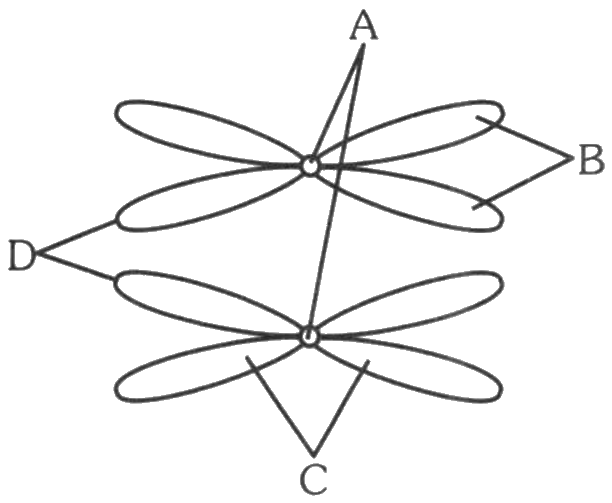
- B
- C
- D
- A
Show answer
Answer: (A) B
Explanation: The figure shows a bivalent: two homologous chromosomes, each made of two chromatids held at a centromere. Label A marks the two centromeres. Label B marks the arms of the two chromatids of one chromosome lying side by side, so B represents sister chromatids. Label C marks both arms of a single chromatid, and label D marks chromatids of the two different homologues, which are non-sister chromatids.
Question 4
Previous-year questionChoose the correct sequence of the sub-stages of prophase I of meiotic division. [NEET (Manipur) 2023]
(A) Zygotene
(B) Pachytene
(C) Diakinesis
(D) Leptotene
(E) Diplotene
(A) Zygotene
(B) Pachytene
(C) Diakinesis
(D) Leptotene
(E) Diplotene
- (D), (B), (A), (E), (C)
- (A), (B), (D), (E), (C)
- (D), (A), (B), (E), (C)
- (A), (D), (B), (C), (E)
Show answer
Answer: (C) (D), (A), (B), (E), (C)
Explanation: Prophase I proceeds through leptotene (D), zygotene (A), pachytene (B), diplotene (E) and diakinesis (C). The other options misplace zygotene/pachytene or put diakinesis before diplotene.
Question 5
Previous-year questionIdentify the correct statements from the following. [NEET 2023]
A. Tetrad formation is seen during leptotene.
B. During anaphase, the centromeres split and chromatids separate.
C. Terminalisation takes place during pachytene.
D. Nucleolus, Golgi complex and ER are reformed during telophase.
E. Crossing over takes place between sister chromatids of homologous chromosomes.
- B and D only
- A, C and E only
- B and E only
- A and C only
Show answer
Answer: (A) B and D only
Explanation: In anaphase the centromeres split and chromatids separate (B), and in telophase the nucleolus, Golgi complex and ER reform (D). Tetrads are seen in zygotene/pachytene, not leptotene (A); terminalisation occurs in diakinesis, not pachytene (C); and crossing over occurs between non-sister chromatids (E).
Question 6
Previous-year questionFormation of a bivalent (tetrad) is a characteristic feature seen in which of the following? [Re-NEET 2022]
- Synaptonemal complex in zygotene stage
- Chiasmata in diplotene stage
- Synaptonemal complex in pachytene stage
- Chiasmata in zygotene stage
Show answer
Answer: (A) Synaptonemal complex in zygotene stage
Explanation: In zygotene, homologous chromosomes pair with the help of the synaptonemal complex; the resulting complex of a pair of synapsed homologues is called a bivalent or tetrad. Chiasmata appear only in diplotene, and in pachytene the bivalents already exist and undergo crossing over.
Question 7
Previous-year questionIdentify the correct order of the following events of prophase I of meiosis. [Re-NEET 2022]
(a) Synapsis of homologous chromosomes
(b) Chromosomes become gradually visible under the microscope
(c) Crossing over between non-sister chromatids of homologous chromosomes
(d) Terminalisation of chiasmata
(e) Dissolution of the synaptonemal complex
(a) Synapsis of homologous chromosomes
(b) Chromosomes become gradually visible under the microscope
(c) Crossing over between non-sister chromatids of homologous chromosomes
(d) Terminalisation of chiasmata
(e) Dissolution of the synaptonemal complex
- (a), (b), (c), (d), (e)
- (b), (c), (d), (e), (a)
- (b), (a), (c), (e), (d)
- (a), (c), (d), (e), (b)
Show answer
Answer: (C) (b), (a), (c), (e), (d)
Explanation: Chromosomes become gradually visible in leptotene (b), synapsis occurs in zygotene (a), crossing over in pachytene (c), the synaptonemal complex dissolves in diplotene (e) and chiasmata terminalise in diakinesis (d). Hence the order is b, a, c, e, d.
Doing well? Create a free account to take timed tests on this topic and see your weak areas.
Question 8
Previous-year questionCrossing over, the exchange of genetic material between homologous chromosomes during meiosis, is catalysed by which enzyme? [Re-NEET 2022]
- Phosphorylase
- Recombinase
- Transferase
- Polymerase
Show answer
Answer: (B) Recombinase
Explanation: Crossing over between non-sister chromatids of homologous chromosomes during pachytene is an enzyme-mediated process, and the enzyme involved is recombinase (NCERT). Phosphorylase, transferase and polymerase do not mediate this exchange.
Question 9
Previous-year questionPick the most appropriate sequence of the following events as they occur in prophase I of meiosis I. [NEET (Overseas) 2022]
(a) Nuclear envelope breakdown
(b) Synaptonemal complex formation
(c) Compaction of chromosomes
(d) Terminalisation of chiasmata
(e) Crossing over
(a) Nuclear envelope breakdown
(b) Synaptonemal complex formation
(c) Compaction of chromosomes
(d) Terminalisation of chiasmata
(e) Crossing over
- (c) → (a) → (b) → (d) → (e)
- (b) → (c) → (a) → (d) → (e)
- (c) → (a) → (b) → (e) → (d)
- (c) → (b) → (e) → (d) → (a)
Show answer
Answer: (D) (c) → (b) → (e) → (d) → (a)
Explanation: Chromosomes first compact (leptotene, c), then the synaptonemal complex forms (zygotene, b), crossing over occurs (pachytene, e), chiasmata terminalise (diakinesis, d) and finally the nuclear envelope breaks down at the end of diakinesis (a). Options placing nuclear envelope breakdown early are wrong because it marks the transition to metaphase I.
Question 10
Previous-year questionAssertion: The beginning of diplotene is recognised by the dissolution of the synaptonemal complex and the formation of X-shaped structures called chiasmata. [NEET (Overseas) 2022]
Reason: In the oocytes of some vertebrates, diplotene can last for months or years.
Reason: In the oocytes of some vertebrates, diplotene can last for months or years.
- (A) is not correct but (R) is correct
- Both (A) and (R) are correct and (R) is the correct explanation of (A)
- Both (A) and (R) are correct but (R) is not the correct explanation of (A)
- (A) is correct but (R) is not correct
Show answer
Answer: (C) Both (A) and (R) are correct but (R) is not the correct explanation of (A)
Explanation: Both statements are true according to NCERT: diplotene begins with dissolution of the synaptonemal complex, and the separating homologues remain joined at X-shaped chiasmata; in oocytes of some vertebrates diplotene can last for months or years. However, the long duration of diplotene does not explain how its onset is recognised, so R is not the correct explanation of A.
Question 11
Previous-year questionWhich statement about meiosis is incorrect? [NEET (Paper-2) 2021]
- Meiosis involves two sequential cycles of nuclear and cell division called meiosis I and meiosis II but only a single cycle of DNA replication.
- Meiosis I is initiated after the parental chromosomes have replicated to produce sister chromatids at the S-phase.
- Meiosis involves pairing of non-homologous chromosomes and recombination between them.
- Four haploid cells are formed at the end of meiosis-II.
Show answer
Answer: (C) Meiosis involves pairing of non-homologous chromosomes and recombination between them.
Explanation: Meiosis involves pairing of homologous chromosomes, not non-homologous ones, and recombination between non-sister chromatids of homologues, so that statement is incorrect. The remaining statements are NCERT facts: two divisions with a single cycle of DNA replication, initiation after S phase, and four haploid cells at the end of meiosis II.
Question 12
Previous-year questionDissolution of the synaptonemal complex occurs during [NEET 2020]
- zygotene
- diplotene
- leptotene
- pachytene
Show answer
Answer: (B) diplotene
Explanation: The synaptonemal complex, formed in zygotene, breaks down in diplotene, allowing the homologues to move apart except at the chiasmata.
Question 13
Previous-year questionMatch the following with respect to meiosis. (A) Zygotene; (B) Pachytene; (C) Diplotene; (D) Diakinesis. (i) Terminalization; (ii) Chiasmata; (iii) Crossing over; (iv) Synapsis. [NEET 2020]
- A-(iv), B-(iii), C-(ii), D-(i)
- A-(i), B-(ii), C-(iv), D-(iii)
- A-(ii), B-(iv), C-(iii), D-(i)
- A-(iii), B-(iv), C-(i), D-(ii)
Show answer
Answer: (A) A-(iv), B-(iii), C-(ii), D-(i)
Explanation: Zygotene is marked by synapsis, pachytene by crossing over, diplotene by the appearance of chiasmata and diakinesis by their terminalization.
Question 14
Previous-year questionThe stage during which the separation of the paired homologous chromosomes begins is [NEET 2018]
- pachytene
- diplotene
- zygotene
- diakinesis
Show answer
Answer: (B) diplotene
Explanation: Diplotene begins with the dissolution of the synaptonemal complex, and the recombined homologues start to separate, remaining joined only at the chiasmata.
Question 15
Previous-year questionIn meiosis, crossing over is initiated at [NEET 2016]
- pachytene
- leptotene
- zygotene
- diplotene
Show answer
Answer: (A) pachytene
Explanation: Crossing over begins in pachytene, after synapsis is complete and the synaptonemal complex has fully formed.
Want more Cell Division – Meiosis and its significance questions?
E-GYAN NIDHI has 429 questions on this topic and 63,000+ in total, all free: timed CBT tests, NEET marking and instant analysis.
Register free Free Sunday Mock TestMore topics in Cell Structure and Function
- Cell – Eukaryotic Cells MCQs
- Biomolecules – Enzymes MCQs
- Cell Division – Cell Division and The Cell Cycle MCQs
- Cell – Prokaryotic Cells MCQs
- Cell – What is a Cell? The Unit of Life MCQs
- Biomolecules – Nucleic Acids MCQs
- Biomolecules – Carbohydrates MCQs
- Biomolecules – Proteins MCQs
- Biomolecules – Lipids MCQs
- Biomolecules – Chemical constituents of living cells MCQs
- Cell Division – Mitosis and its significance MCQs