Biomolecules – Proteins: NEET MCQs with Answers
15 free questions on Biomolecules – Proteins for NEET (UG), starting with previous-year NEET and AIPMT questions. Try each one, then tap Show answer for the answer and a short explanation.
Syllabus covered: Proteins: structure and function
Question 1
Previous-year questionThe given figure shows a hypothetical tetrapeptide portion of a protein with parts labelled A–D. Which one of the following options is correct? [NEET 2013]
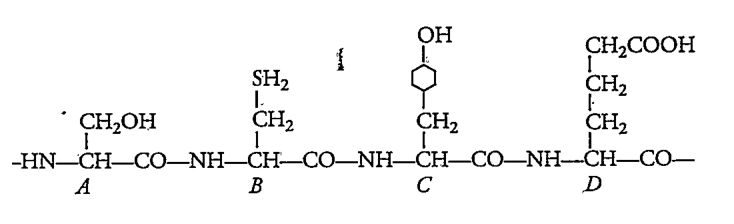
- A is the sulphur-containing amino acid methionine
- D is the acidic amino acid glutamic acid
- C is an aromatic amino acid, tryptophan
- A is the C-terminal amino acid and D is the N-terminal amino acid
Show answer
Answer: (B) D is the acidic amino acid glutamic acid
Explanation: The residue marked D carries a free —COOH group at the end of its side chain, which marks it as an acidic amino acid, glutamic acid. A has a —CH₂OH side chain (serine), not the sulphur-containing side chain of methionine. C has a phenol ring with an —OH group (tyrosine), not tryptophan. The chain runs from the amino end at A to the carboxyl end at D, so A is the N-terminal residue and D is the C-terminal residue, not the reverse.
Question 2
Previous-year questionMatch the levels of protein structure in List-I with the corresponding features/examples in List-II. [Re-NEET 2024]
List-I:
A. Primary structure of protein
B. Secondary structure of protein
C. Tertiary structure of protein
D. Quaternary structure of protein
List-II:
I. Human haemoglobin
II. Disulphide bonds
III. Polypeptide chain
IV. Alpha helix and β sheet
List-I:
A. Primary structure of protein
B. Secondary structure of protein
C. Tertiary structure of protein
D. Quaternary structure of protein
List-II:
I. Human haemoglobin
II. Disulphide bonds
III. Polypeptide chain
IV. Alpha helix and β sheet
- A-III, B-IV, C-II, D-I
- A-III, B-II, C-I, D-IV
- A-I, B-III, C-II, D-IV
- A-IV, B-III, C-II, D-I
Show answer
Answer: (A) A-III, B-IV, C-II, D-I
Explanation: The primary structure is the sequence of the polypeptide chain (A-III), the secondary structure includes α-helix and β-sheet (B-IV), the tertiary structure is stabilised by bonds such as disulphide bonds (C-II), and human haemoglobin with four subunits shows quaternary structure (D-I).
Question 3
Previous-year questionMatch the proteins in List-I with their descriptions in List-II. [NEET 2024 (Sawai Madhopur)]
List-I:
A. Collagen
B. GLUT-4
C. Trypsin
D. RuBisCO
List-II:
I. Enzyme
II. Most abundant enzyme in biosphere
III. Most abundant protein in animal world
IV. Enables glucose transport into cells
List-I:
A. Collagen
B. GLUT-4
C. Trypsin
D. RuBisCO
List-II:
I. Enzyme
II. Most abundant enzyme in biosphere
III. Most abundant protein in animal world
IV. Enables glucose transport into cells
- A–II, B–III, C–I, D–IV
- A–III, B–IV, C–I, D–II
- A–I, B–III, C–IV, D–II
- A–III, B–I, C–IV, D–II
Show answer
Answer: (B) A–III, B–IV, C–I, D–II
Explanation: Collagen is the most abundant protein in the animal world (A-III), GLUT-4 enables glucose transport into cells (B-IV), trypsin is an enzyme (C-I) and RuBisCO is the most abundant protein/enzyme in the biosphere (D-II).
Question 4
Previous-year questionWhich of the following can occur in the form of a zwitterion? [NEET 2024 (Sawai Madhopur)]
- Monosaccharide
- Amino acid
- Nucleic acid
- Fatty acid
Show answer
Answer: (B) Amino acid
Explanation: Amino acids have an ionisable amino group and carboxyl group, so they can exist as a zwitterion carrying both positive (–NH₃⁺) and negative (–COO⁻) charges. Monosaccharides, nucleic acids and fatty acids do not form zwitterions.
Question 5
Previous-year questionTwo statements are given below. Choose the most appropriate option. [Re-NEET 2022]
Statement I: Because their –NH₂ and –COOH groups are ionisable, amino acids have different structures at different pH.
Statement II: Amino acids can exist in the zwitterionic form at acidic and basic pH.
Statement I: Because their –NH₂ and –COOH groups are ionisable, amino acids have different structures at different pH.
Statement II: Amino acids can exist in the zwitterionic form at acidic and basic pH.
- Both Statement I and Statement II are correct
- Both Statement I and Statement II are incorrect
- Statement I is correct but Statement II is incorrect
- Statement I is incorrect but Statement II is correct
Show answer
Answer: (A) Both Statement I and Statement II are correct
Explanation: The –NH₂ and –COOH groups of amino acids are ionisable, so an amino acid has different structures in solutions of different pH, which makes Statement I correct. The zwitterion is the form NCERT shows between the fully protonated form in strong acid and the deprotonated form in strong base, and it persists over a wide pH range on both the mildly acidic and mildly basic sides of neutrality, so Statement II is also accepted as correct.
Question 6
Previous-year questionWhy are proteins at the primary level of structure also referred to as polypeptides? [Re-NEET 2022]
- They are linear chains
- They are polymers of peptide monomers
- Successive amino acids are joined by peptide bonds
- They can assume many conformations
Show answer
Answer: (C) Successive amino acids are joined by peptide bonds
Explanation: Proteins are polypeptides because their amino acid monomers are linked successively by peptide bonds. They are polymers of amino acids, not of 'peptide monomers'; being linear or able to fold into conformations does not explain the name.
Question 7
Previous-year questionIdentify the basic amino acid from the following. [NEET 2020]
- Glutamic acid
- Lysine
- Valine
- Tyrosine
Show answer
Answer: (B) Lysine
Explanation: Lysine has an extra amino group in its side chain, making it basic; glutamic acid is acidic, valine neutral and tyrosine aromatic.
Doing well? Create a free account to take timed tests on this topic and see your weak areas.
Question 8
Previous-year questionWhich of the following glucose transporters is insulin-dependent? [NEET 2019]
- GLUT I
- GLUT II
- GLUT III
- GLUT IV
Show answer
Answer: (D) GLUT IV
Explanation: GLUT-4, present in muscle and adipose tissue, is recruited to the plasma membrane in response to insulin and is therefore the insulin-dependent transporter.
Question 9
Previous-year questionThe amino acid tryptophan is the precursor for the synthesis of [NEET 2016]
- melatonin and serotonin
- thyroxine and triiodothyronine
- estrogen and progesterone
- cortisol and cortisone
Show answer
Answer: (A) melatonin and serotonin
Explanation: Tryptophan is hydroxylated and decarboxylated to serotonin, which is then converted to melatonin in the pineal gland.
Question 10
Previous-year questionConjugated proteins containing carbohydrates as the prosthetic group are known as [AIPMT 2000]
- Chromoproteins
- Glycoproteins
- Lipoproteins
- Nucleoproteins
Show answer
Answer: (B) Glycoproteins
Explanation: Conjugated proteins whose prosthetic group is a carbohydrate are glycoproteins (e.g. mucin, many membrane proteins, antibodies). Lipoproteins carry lipid, nucleoproteins carry nucleic acid and chromoproteins carry a pigmented prosthetic group.
Question 11
Previous-year questionWhich is an essential amino acid? [AIPMT 2000]
- Serine
- Aspartic acid
- Glycine
- Phenylalanine
Show answer
Answer: (D) Phenylalanine
Explanation: Essential or indispensable amino acids are those that humans and other vertebrates cannot synthesise and must obtain from the diet. There are nine such amino acids — histidine, isoleucine, leucine, lysine, methionine, phenylalanine, threonine, tryptophan and valine — and phenylalanine is one of them.
Question 12
Previous-year questionCollagen is a [AIPMT 2002]
- Fibrous protein
- Globular protein
- Lipid
- Carbohydrate
Show answer
Answer: (A) Fibrous protein
Explanation: Collagen is a major fibrous protein of connective tissue, occurring as the white fibres produced by fibroblasts. Its long parallel polypeptide chains give it high tensile strength, in contrast to the compact folded shape of globular proteins.
Question 13
Previous-year questionWhich of the following is the simplest amino acid? [AIPMT 2005]
- Alanine
- Asparagine
- Glycine
- Tyrosine
Show answer
Answer: (C) Glycine
Explanation: Proteins are polymers of amino acids joined by peptide bonds. Glycine is the simplest amino acid because its side chain, the R group, consists of only a single hydrogen atom.
Question 14
Previous-year questionThe amino acid tryptophan is the precursor for the synthesis of [NEET 2016]
- Melatonin and serotonin
- Thyroxine and triiodothyronine
- Oestrogen and progesterone
- Cortisol and cortisone
Show answer
Answer: (A) Melatonin and serotonin
Explanation: Tryptophan is the precursor for the synthesis of the indoleamines melatonin and serotonin. Thyroxine and triiodothyronine are produced from tyrosine in the thyroid gland, while oestrogen, progesterone, cortisol and cortisone are steroids derived from cholesterol.
Question 15
Previous-year questionWhich of the following is the least likely to be involved in stabilising the three-dimensional folding of most proteins? [NEET 2016]
- Hydrogen bonds
- Electrostatic interaction
- Hydrophobic interaction
- Ester bonds
Show answer
Answer: (D) Ester bonds
Explanation: The tertiary, that is, three-dimensional, structure of a protein is stabilised by hydrogen bonds, ionic and electrostatic bonds, van der Waals interactions, covalent disulphide bonds and hydrophobic interactions. Ester bonds are formed between sugar and phosphate in a nucleotide and play no part in stabilising a polypeptide chain.
Want more Biomolecules – Proteins questions?
E-GYAN NIDHI has 217 questions on this topic and 63,000+ in total, all free: timed CBT tests, NEET marking and instant analysis.
Register free Free Sunday Mock TestMore topics in Cell Structure and Function
- Cell – Eukaryotic Cells MCQs
- Biomolecules – Enzymes MCQs
- Cell Division – Cell Division and The Cell Cycle MCQs
- Cell – Prokaryotic Cells MCQs
- Cell – What is a Cell? The Unit of Life MCQs
- Biomolecules – Nucleic Acids MCQs
- Biomolecules – Carbohydrates MCQs
- Biomolecules – Lipids MCQs
- Biomolecules – Chemical constituents of living cells MCQs
- Cell Division – Mitosis and its significance MCQs
- Cell Division – Meiosis and its significance MCQs