Rigid Body, Centre of Mass and Its Motion – Centre of the mass of a two-particle system: NEET MCQs with Answers
15 free questions on Rigid Body, Centre of Mass and Its Motion – Centre of the mass of a two-particle system for NEET (UG), starting with previous-year NEET and AIPMT questions. Try each one, then tap Show answer for the answer and a short explanation.
Syllabus covered: Centre of the mass of a two-particle system, Centre of the mass of a rigid body;
Question 1
Previous-year questionThree identical spheres, each of mass M, are placed at the corners of a right-angled triangle with mutually perpendicular sides each equal to 2 m. Taking the point of intersection of the two mutually perpendicular sides as the origin and these sides along the x- and y-axes, the position vector of the centre of mass is: [NEET 2020]
- 2(î + ĵ)
- (î + ĵ)
- (2/3)(î + ĵ)
- (4/3)(î + ĵ)
Show answer
Answer: (C) (2/3)(î + ĵ)
Explanation: With the perpendicular sides along the axes, the three spheres sit at (0, 0), (2, 0) and (0, 2).
Because the masses are equal, each coordinate of the centre of mass is the average of the coordinates of the spheres.
x_cm = (0 + 2 + 0)/3 = 2/3 and y_cm = (0 + 0 + 2)/3 = 2/3.
So the position vector of the centre of mass is (2/3)(î + ĵ) in metres.
Because the masses are equal, each coordinate of the centre of mass is the average of the coordinates of the spheres.
x_cm = (0 + 2 + 0)/3 = 2/3 and y_cm = (0 + 0 + 2)/3 = 2/3.
So the position vector of the centre of mass is (2/3)(î + ĵ) in metres.
Question 2
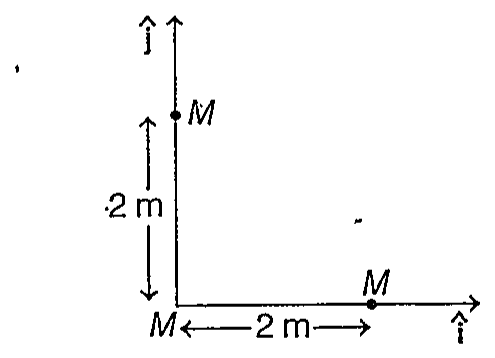
Previous-year questionThree identical spheres, each of mass M, are placed at the corners of a right-angled triangle whose two mutually perpendicular sides are each 2 m long (see figure). Taking the point where these two perpendicular sides meet as the origin, the position vector of the centre of mass is [NEET (Oct.) 2020]
- 2(î + ĵ)
- (î + ĵ)
- (2/3)(î + ĵ)
- (4/3)(î + ĵ)
Show answer
Answer: (C) (2/3)(î + ĵ)
Explanation: With the right-angle corner at the origin, the other two spheres are at 2î and 2ĵ. R_CM = [M(0) + M(2î) + M(2ĵ)]/(3M) = (2M/3M)(î + ĵ) = (2/3)(î + ĵ).
Question 3
Previous-year questionTwo particles A and B, initially at rest, move towards each other under a mutual force of attraction. At an instant when the speed of A is v and the speed of B is 3v, the speed of the centre of mass is: [NEET 2023]
- 2v
- zero
- v
- 4v
Show answer
Answer: (B) zero
Explanation: The attraction between A and B is an internal force and no external force acts on the pair, so the total momentum of the system stays at its initial value. Since both particles started from rest, that value is zero, and the centre of mass therefore remains permanently at rest whatever speeds the individual particles reach. The specific figures v and 3v are there only to tempt an averaging calculation.
Question 4
Previous-year questionAssertion (A): When a fire cracker (rocket) explodes in mid air, its fragments fly in such a way that they continue moving in the same path which the fire cracker would have followed had it not exploded.Reason (R): Explosion of the cracker (rocket) occurs due to internal forces only and no external force acts for this explosion. [Re-NEET 2022]
- Both (A) and (R) are correct and (R) is the correct explanation of (A)
- Both (A) and (R) are correct but (R) is not the correct explanation of (A)
- (A) is correct but (R) is not correct
- (A) is not correct but (R) is correct
Show answer
Answer: (D) (A) is not correct but (R) is correct
Explanation: The Reason is correct: an explosion is driven entirely by internal forces. The Assertion is wrong, because it is the centre of mass of the fragments that continues along the original parabolic path, while the individual fragments fly off along different paths.
Question 5
Previous-year questionTwo particles of mass 5 kg and 10 kg respectively are attached to the two ends of a rigid rod of length 1 m of negligible mass. The centre of mass of the system measured from the 5 kg particle is nearly at a distance of [NEET 2020]
- 50 cm
- 67 cm
- 80 cm
- 33 cm
Show answer
Answer: (B) 67 cm
Explanation: x_cm = (5 × 0 + 10 × 1)/15 = 0.67 m = 67 cm from the 5 kg mass.
Question 6
Previous-year questionIn a carbon monoxide molecule, the carbon and oxygen atoms are separated by 1.12 × 10⁻¹⁰ m. The distance of the centre of mass from the carbon atom is [AIPMT 1997]
- 0.64 × 10⁻¹⁰ m
- 0.56 × 10⁻¹⁰ m
- 0.51 × 10⁻¹⁰ m
- 0.48 × 10⁻¹⁰ m
Show answer
Answer: (A) 0.64 × 10⁻¹⁰ m
Explanation: Taking the carbon atom (12 amu) at the origin and oxygen (16 amu) at r = 1.12 × 10⁻¹⁰ m, x_CM = (12 × 0 + 16 × r)/(12 + 16) = (16/28) × 1.12 × 10⁻¹⁰ = 0.5714 × 1.12 × 10⁻¹⁰ = 0.64 × 10⁻¹⁰ m. The centre of mass lies nearer the heavier oxygen atom.
Question 7
Previous-year questionA cart of mass M is tied to one end of a massless rope of length 10 m; the other end is held by a man of mass M. The whole system rests on a smooth horizontal surface, with the man at x = 0 and the cart at x = 10 m. If the man pulls the cart using the rope, the man and the cart will meet at the point [AIPMT 1997]
- they will never meet
- x = 10 m
- x = 5 m
- x = 0
Show answer
Answer: (C) x = 5 m
Explanation: The pull of the man on the cart and the reaction of the cart on the man are internal forces (Newton's third law), and the surface is smooth. Hence the centre of mass stays fixed, and the two must meet there: x_CM = (M × 0 + M × 10)/(M + M) = 10M/2M = 5 m. Since the masses are equal, they meet exactly at the midpoint.
Doing well? Create a free account to take timed tests on this topic and see your weak areas.
Question 8
Previous-year questionThree identical metal balls, each of radius r, are placed touching one another on a horizontal surface so that an equilateral triangle is formed when the centres of the three balls are joined. The centre of mass of the system is located at the [AIPMT 1999]
- horizontal surface
- centre of one of the balls
- line joining the centres of any two balls
- point of intersection of the medians
Show answer
Answer: (D) point of intersection of the medians
Explanation: Each ball may be replaced by a point mass at its own centre, and the three masses are equal. The centre of mass of three equal masses placed at the vertices of a triangle is the centroid of that triangle, which is the point where the medians intersect.
Question 9
Previous-year questionA solid sphere of radius R rests on a smooth horizontal surface. A horizontal force F is applied at a height h above the lowest point. For the acceleration of the centre of mass to be maximum, [AIPMT 2002]
- h = R
- h = 2R
- h = 0
- the acceleration will be the same whatever the value of h may be
Show answer
Answer: (D) the acceleration will be the same whatever the value of h may be
Explanation: The acceleration of the centre of mass depends only on the net external force: a_CM = F/m. Changing the point of application alters the torque (and hence the angular acceleration), but not the resultant force. So a_CM is unaffected by h. The height h would matter for the rotational motion, not for the translation of the centre of mass.
Question 10
Previous-year questionA rod of length 3 m has a mass per unit length that is directly proportional to the distance x measured from one of its ends. The centre of gravity of the rod, measured from that same end, lies at [AIPMT 2002]
- 1.5 m
- 2 m
- 2.5 m
- 3 m
Show answer
Answer: (B) 2 m
Explanation: Let the linear mass density be λ = kx, so dm = kx dx. x_CG = ∫x dm / ∫dm = ∫₀³ x(kx)dx / ∫₀³ kx dx = [x³/3]₀³ / [x²/2]₀³ = 9 / 4.5 = 2 m. The centre of gravity is shifted towards the heavier (denser) end, as expected.
Question 11
Previous-year questionA system consists of two particles of masses m₁ and m₂. If the particle of mass m₁ is pushed towards the centre of mass through a distance d, through what distance must the particle of mass m₂ be moved so that the centre of mass stays in its original position? [AIPMT 2004]
- m₁d/(m₁ + m₂)
- m₁d/m₂
- d
- m₂d/m₁
Show answer
Answer: (B) m₁d/m₂
Explanation: For the centre of mass to remain fixed, the weighted displacements must cancel: m₁d = m₂d′ ⟹ d′ = (m₁/m₂)d, and m₂ must move away from the centre of mass. If the two masses were equal, the second would simply move the same distance d in the opposite sense.
Question 12
Previous-year questionTwo bodies of masses 1 kg and 3 kg have position vectors (î + 2ĵ + k̂) and (−3î − 2ĵ + k̂) respectively. The position vector of the centre of mass of this system is [CBSE AIPMT 2009]
- −2î + 2k̂
- −2î − ĵ + k̂
- 2î − ĵ − 2k̂
- −î + ĵ + k̂
Show answer
Answer: (B) −2î − ĵ + k̂
Explanation: r_CM = (m₁r₁ + m₂r₂)/(m₁ + m₂) = [1(î + 2ĵ + k̂) + 3(−3î − 2ĵ + k̂)]/(1 + 3) = [(î − 9î) + (2ĵ − 6ĵ) + (k̂ + 3k̂)]/4 = (−8î − 4ĵ + 4k̂)/4 = −2î − ĵ + k̂.
Question 13
Previous-year questionA ball of mass M moving at 2 m/s strikes another ball of mass 1 kg that is moving in the same direction at 1 m/s. If the kinetic energy of the centre of mass is 4/3 J, the magnitude of M is [AIPMT 2010]
- 1/2 kg
- 0.25 kg
- 0.050 kg
- 2 kg
Show answer
Answer: (A) 1/2 kg
Explanation: v_CM = (m₁v₁ + m₂v₂)/(m₁ + m₂) = (2M + 1)/(M + 1). KE of the centre of mass = ½(M + 1)v_CM² = (2M + 1)²/[2(M + 1)] = 4/3 ⟹ 3(2M + 1)² = 8(M + 1) ⟹ 12M² + 12M + 3 = 8M + 8 ⟹ 12M² + 4M − 5 = 0 ⟹ M = (−4 + 16)/24 = 1/2 kg (rejecting the negative root).
Question 14
Previous-year questionThree masses are placed along the X-axis: 300 g at the origin, 500 g at x = 40 cm and 400 g at x = 70 cm. The distance of the centre of mass of the system from the origin is [AIPMT 2012]
- 40 cm
- 45 cm
- 50 cm
- 30 cm
Show answer
Answer: (A) 40 cm
Explanation: CM_x = (m₁x₁ + m₂x₂ + m₃x₃)/(m₁ + m₂ + m₃) = (300 × 0 + 500 × 40 + 400 × 70)/(300 + 500 + 400) = (0 + 20000 + 28000)/1200 = 48000/1200 = 40 cm.
Question 15
Previous-year questionTwo persons of masses 55 kg and 65 kg are at the opposite ends of a boat 3 m long weighing 100 kg. The 55 kg man walks up to the 65 kg man and sits beside him. If the boat is in still water, the centre of mass of the system shifts by [AIPMT 2012]
- 3 m
- 2.3 m
- zero
- 0.75 m
Show answer
Answer: (C) zero
Explanation: The man walking is an internal rearrangement; no net external horizontal force acts on the (boat + persons) system. Since F_ext = 0, the acceleration of the centre of mass is zero, and as the system started at rest the centre of mass does not move at all. The boat itself shifts, but the centre of mass of the whole system stays fixed — the shift is zero.
Want more Rigid Body, Centre of Mass and Its Motion – Centre of the mass of a two-particle system questions?
E-GYAN NIDHI has 252 questions on this topic and 63,000+ in total, all free: timed CBT tests, NEET marking and instant analysis.
Register free Free Sunday Mock Test