Dynamics of Rotational Motion: NEET MCQs with Answers
15 free questions on Dynamics of Rotational Motion for NEET (UG), starting with previous-year NEET and AIPMT questions. Try each one, then tap Show answer for the answer and a short explanation.
Question 1
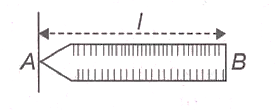
Previous-year questionA uniform rod AB of length l and mass m is free to rotate about A. The rod is released from rest in the horizontal position. The initial angular acceleration of the rod is: [AIPMT, 2007]
- 3g/2l
- 2g/3l
- g/l (approximately)
- (3/2) g l
Show answer
Answer: (A) 3g/2l
Explanation: Torque about A: τ = mg(l/2). Moment of inertia about A: I = ml²/3. Hence α = τ/I = (mgl/2)/(ml²/3) = 3g/2l.
Question 2
Previous-year questionA bicycle wheel rolls without slipping on a level road. If the velocity of the centre of mass is v_CM, the true statement is [AIPMT 2001]
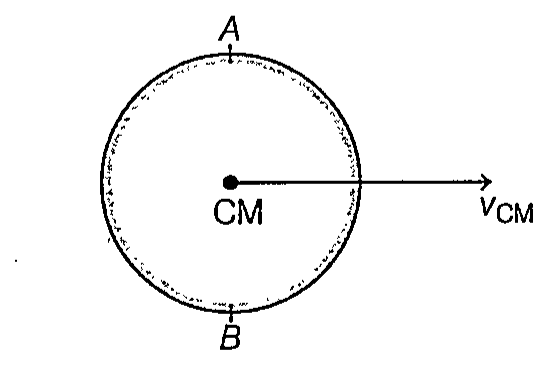
- The velocity of point A is 2v_CM and the velocity of point B is zero
- The velocity of point A is zero and the velocity of point B is 2v_CM
- The velocity of point A is 2v_CM and the velocity of point B is −v_CM
- The velocities of both A and B are v_CM
Show answer
Answer: (A) The velocity of point A is 2v_CM and the velocity of point B is zero
Explanation: For rolling without slipping, v_CM = ωR. At the topmost point A the rotational velocity ωR adds to v_CM : v_A = v_CM + ωR = 2v_CM. At the contact point B the rotational velocity opposes it: v_B = v_CM − ωR = 0. The contact point is instantaneously at rest, which is exactly what "without slipping" means.
Question 3
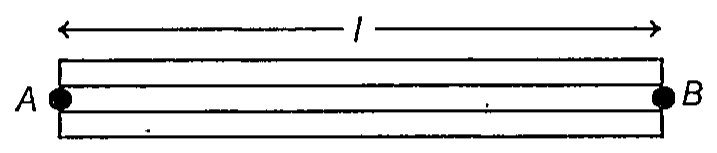
Previous-year questionA uniform rod of length l and mass m is free to rotate in a vertical plane about the end A. The rod, initially in a horizontal position, is released. Its initial angular acceleration is (the moment of inertia of the rod about A being ml²/3) [AIPMT 2007]
- 3g/2l
- 2l/3g
- 3g/2l²
- mgl/2
Show answer
Answer: (A) 3g/2l
Explanation: With the rod horizontal, its weight mg acts at the centre, a distance l/2 from A: τ = mg(l/2). α = τ/I = (mgl/2)/(ml²/3) = 3g/2l. A quick check of the options: only 3g/2l has the dimensions of angular acceleration (s⁻²).
Question 4
Previous-year questionAn energy of 484 J is spent in increasing the speed of a flywheel from 60 rpm to 360 rpm. The moment of inertia of the flywheel is [NEET 2022]
- 0.7 kg·m²
- 3.22 kg·m²
- 30.8 kg·m²
- 0.07 kg·m²
Show answer
Answer: (A) 0.7 kg·m²
Explanation: ω₁ = 2π rad/s, ω₂ = 12π rad/s. ½I(144π² − 4π²) = 484 ⇒ I = 968/(140π²) = 0.7 kg·m².
Question 5
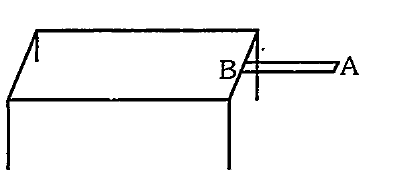
Previous-year questionA thin uniform stick of length ℓ and mass m is held horizontally with end B hinged at the edge of a table. When end A is released, the initial acceleration of the centre of mass is [AIPMT 2007]
- (3/4)g
- (3/7)g
- (2/7)g
- (1/7)g
Show answer
Answer: (A) (3/4)g
Explanation: α = τ/I = mg(ℓ/2)/(mℓ²/3) = 3g/2ℓ. Acceleration of the centre (at ℓ/2 from the hinge) = α(ℓ/2) = 3g/4.
Question 6
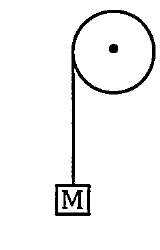
Previous-year questionA fixed pulley of radius 20 cm and moment of inertia 0.32 kg·m² has a massless cord wound on its rim with a 2 kg mass at the end. The pulley rotates without friction. The acceleration of the mass is (g = 10 m/s²) [AIPMT 2007]
- 2 m/s²
- 10 m/s²
- 5 m/s²
- 4 m/s²
Show answer
Answer: (A) 2 m/s²
Explanation: For the block: mg − T = ma; for the pulley: TR = Iα = Ia/R. So a = g/(1 + I/mR²) = 10/(1 + 0.32/(2 × 0.04)) = 10/(1 + 4) = 2 m/s².
Question 7
Previous-year questionA disc of radius 2 m and mass 100 kg rolls on a horizontal floor. Its centre of mass has a speed of 20 cm/s. How much work is needed to stop it? [NEET 2019]
- 3 J
- 30 kJ
- 2 J
- 1 J
Show answer
Answer: (A) 3 J
Explanation: For a rolling disc the total kinetic energy is ¾Mv² = 0.75 × 100 × (0.2)² = 3 J, so 3 J of work must be done to stop it.
Doing well? Create a free account to take timed tests on this topic and see your weak areas.
Question 8
Previous-year questionA solid cylinder of mass 2 kg and radius 4 cm is rotating about its axis at the rate of 3 rpm. The torque required to stop it after 2π revolutions is [NEET 2019]
- 2 × 10⁻⁶ N m
- 2 × 10⁻³ N m
- 12 × 10⁻⁴ N m
- 2 × 10⁶ N m
Show answer
Answer: (A) 2 × 10⁻⁶ N m
Explanation: I = ½(2)(0.04)² = 1.6 × 10⁻³ kg m² and ω = 3 × 2π/60 = 0.1π rad/s. With θ = 2π × 2π rad, τ = Iω²/2θ ≈ 2 × 10⁻⁶ N m.
Question 9
Previous-year questionA solid sphere is in rolling motion. In rolling motion a body possesses translational kinetic energy K_t as well as rotational kinetic energy K_r simultaneously. The ratio K_t : (K_t + K_r) for the sphere is [NEET 2018]
- 7 : 10
- 5 : 7
- 2 : 5
- 10 : 7
Show answer
Answer: (B) 5 : 7
Explanation: With K_r/K_t = 2/5, we get K_t : (K_t + K_r) = 1 : (1 + 2/5) = 5 : 7.
Question 10
Previous-year questionA rope is wound around a hollow cylinder of mass 3 kg and radius 40 cm. What is the angular acceleration of the cylinder if the rope is pulled with a force of 30 N? [NEET 2017]
- 0.25 rad/s²
- 25 rad/s²
- 5 m/s²
- 25 m/s²
Show answer
Answer: (B) 25 rad/s²
Explanation: I = mr² = 3 × 0.16 = 0.48 kg m² and τ = 30 × 0.4 = 12 N m, so α = 12/0.48 = 25 rad/s².
Question 11
Previous-year questionA disk and a sphere of the same radius but different masses roll off on two inclined planes of the same altitude and length. Which of the two objects gets to the bottom of the plane first? [NEET 2016]
- the disk
- the sphere
- both reach at the same time
- it depends on their masses
Show answer
Answer: (B) the sphere
Explanation: The time of descent depends only on k²/R², which is 2/5 for the sphere against ½ for the disk. The sphere has the greater acceleration and arrives first, whatever the masses.
Question 12
Previous-year questionA solid cylinder of mass 50 kg and radius 0.5 m is free to rotate about a horizontal axis. A massless string is wound round the cylinder with one end attached to it and the other hanging freely. The tension in the string required to produce an angular acceleration of 2 revolutions s⁻² is [AIPMT 2014]
- 25 N
- 50 N
- 78.5 N
- 157 N
Show answer
Answer: (D) 157 N
Explanation: α = 4π rad/s² and I = 6.25 kg m², so τ = 78.5 N m and the tension is T = τ/R = 157 N.
Question 13
Previous-year questionThe ratio of the accelerations of a solid sphere of mass m and radius R rolling down an incline of angle θ without slipping to that of the same sphere slipping down the incline without rolling is [AIPMT 2014]
- 5 : 7
- 2 : 3
- 2 : 5
- 7 : 5
Show answer
Answer: (A) 5 : 7
Explanation: Rolling gives a = (5/7)g sinθ while pure sliding on a smooth incline gives a = g sinθ. The ratio is therefore 5 : 7.
Question 14
Previous-year questionA ring of mass m and radius r rotates about an axis passing through its centre and perpendicular to its plane with angular velocity ω. Its kinetic energy is [AIPMT 1988]
- ½mr²ω²
- mrω²
- mr²ω²
- ⅓mr²ω²
Show answer
Answer: (A) ½mr²ω²
Explanation: For a ring about its central perpendicular axis, I = mr². K = ½Iω² = ½mr²ω².
Question 15
Previous-year questionA solid cylinder of mass M and radius R rolls down an inclined plane of height h without slipping. The speed of its centre of mass when it reaches the bottom is [AIPMT 1989]
- √(2gh)
- √(4gh/3)
- √(3gh/4)
- √(4g/h)
Show answer
Answer: (B) √(4gh/3)
Explanation: For a rolling solid cylinder the total kinetic energy is ½Mv² + ½(½MR²)(v/R)² = ¾Mv². Energy conservation: Mgh = ¾Mv² v² = 4gh/3 v = √(4gh/3).
Want more Dynamics of Rotational Motion questions?
E-GYAN NIDHI has 239 questions on this topic and 63,000+ in total, all free: timed CBT tests, NEET marking and instant analysis.
Register free Free Sunday Mock TestMore topics in ROTATIONAL MOTION
- Rigid Body, Centre of Mass and Its Motion – Centre of the mass of a two-particle system MCQs
- Moment of Inertia – The moment of inertia MCQs
- Torque and Equilibrium of Rigid Body MCQs
- Kinematics of Rotational Motion and Angular Velocity – Basic concepts of rotational motion MCQs
- Angular Momentum and Its Conservation – angular momentum MCQs