Angular Momentum and Its Conservation – angular momentum: NEET MCQs with Answers
15 free questions on Angular Momentum and Its Conservation – angular momentum for NEET (UG), starting with previous-year NEET and AIPMT questions. Try each one, then tap Show answer for the answer and a short explanation.
Syllabus covered: angular momentum, conservation of angular momentum and its applications
Question 1
Previous-year questionA man standing on a turntable with two equal loads in his outstretched hands rotates, then folds his arms. Then I. Linear momentum is conserved II. Angular momentum is conserved III. Angular velocity increases IV. Kinetic energy decreases [NEET 2021]
- I, II
- I, III
- II, III
- III, IV
Show answer
Answer: (C) II, III
Explanation: No external torque acts, so angular momentum is conserved (II). Folding the arms reduces I, so ω increases (III). Kinetic energy L²/2I increases, and linear momentum is not the relevant conserved quantity here.
Question 2
Previous-year questionA flywheel in the shape of a ring, mass 0.2 kg and radius 10 cm, rotates at 5/π rev/s about its central perpendicular axis. Its angular momentum and kinetic energy are [AIPMT 2006]
- 2 × 10⁻² J·s, 0.1 J
- 2 × 10⁻³ J·s, 0.01 J
- 2 × 10⁻² J·s, 1 J
- 0.2 J·s, 0.1 J
Show answer
Answer: (A) 2 × 10⁻² J·s, 0.1 J
Explanation: ω = 2π × 5/π = 10 rad/s. I = mr² = 0.2 × 0.01 = 2 × 10⁻³ kg·m². L = Iω = 2 × 10⁻² J·s; K = ½Iω² = ½ × 2 × 10⁻³ × 100 = 0.1 J.
Question 3
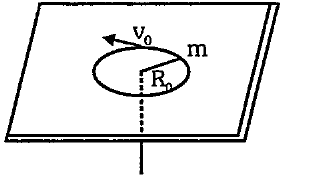
Previous-year questionA mass m moves in a circle of radius R₀ with speed v₀ on a smooth horizontal plane, attached to a string passing through a smooth hole in the plane. The tension is gradually increased until the radius becomes R₀/2. The final kinetic energy is [AIPMT 2015]
- ¼mv₀²
- 2mv₀²
- ½mv₀²
- mv₀²
Show answer
Answer: (B) 2mv₀²
Explanation: Tension is radial, so L is conserved: mv₀R₀ = mv(R₀/2) ⇒ v = 2v₀. K = ½m(2v₀)² = 2mv₀².
Question 4
Previous-year questionTwo discs of the same moment of inertia rotating about their regular axis passing through the centre and perpendicular to the plane of the disc, with angular velocities ω₁ and ω₂, are brought into contact face to face with their axes of rotation coinciding. The loss of energy during this process is [NEET 2017]
- ¼I(ω₁ – ω₂)²
- I(ω₁ – ω₂)²
- (1/8)I(ω₁ – ω₂)²
- ½I(ω₁ + ω₂)²
Show answer
Answer: (A) ¼I(ω₁ – ω₂)²
Explanation: The common angular speed is (ω₁ + ω₂)/2. The loss is ½I(ω₁² + ω₂²) – ½(2I)[(ω₁ + ω₂)/2]² = ¼I(ω₁ – ω₂)².
Question 5
Previous-year questionA force F = αî + 3ĵ + 6k̂ is acting at the point r = 2î – 6ĵ – 12k̂. The value of α for which the angular momentum about the origin is conserved is [AIPMT 2015]
- 2
- zero
- 1
- –1
Show answer
Answer: (D) –1
Explanation: Conservation of L requires zero torque, so r × F = 0 and the two vectors must be parallel. Matching components gives α = –1.
Question 6
Previous-year questionA solid homogeneous sphere of mass M and radius R moves on a rough horizontal surface, partly rolling and partly sliding. During this kind of motion of the sphere, [AIPMT 1988]
- total kinetic energy is conserved
- the angular momentum of the sphere about the point of contact with the plane is conserved
- only the rotational kinetic energy about the centre of mass is conserved
- angular momentum about the centre of mass is conserved
Show answer
Answer: (B) the angular momentum of the sphere about the point of contact with the plane is conserved
Explanation: At the point of contact the frictional force acts tangentially, the weight acts through that vertical line and the normal reaction also passes through it — so every force acting on the sphere passes through the contact point. Hence the torque about the point of contact is zero and the angular momentum about it is conserved. Total kinetic energy is not conserved, because sliding friction dissipates energy.
Question 7
Previous-year questionA particle of mass m = 5 kg moves with a uniform speed v = 3√2 in the XOY plane along the line Y = X + 4. The magnitude of the angular momentum of the particle about the origin is [AIPMT 1991]
- 60 unit
- 40√2 unit
- zero
- 7.5 unit
Show answer
Answer: (A) 60 unit
Explanation: Write the line as x − y + 4 = 0. The perpendicular distance from the origin is d = |0 − 0 + 4| / √(1² + (−1)²) = 4/√2 = 2√2. L = mvd = 5 × 3√2 × 2√2 = 5 × 3 × 2 × 2 = 60 unit.
Doing well? Create a free account to take timed tests on this topic and see your weak areas.
Question 8
Previous-year questionAngular momentum is a [AIPMT 1994]
- vector (axial)
- vector (polar)
- scalar
- None of these
Show answer
Answer: (A) vector (axial)
Explanation: L = r × p is defined by a cross product, so it is directed along the rotation axis and its sense is fixed by the right-hand rule. Such a quantity does not reverse under inversion of the coordinate axes the way a true (polar) vector does — it is an axial vector, also called a pseudovector. Torque and angular velocity are axial in the same way.
Question 9
Previous-year questionThe angular momentum of a body of mass m, moment of inertia I and angular velocity ω rad/s is equal to [AIPMT 1996]
- Iω
- Iω²
- I/ω
- I/ω²
Show answer
Answer: (A) Iω
Explanation: Angular momentum is the rotational analogue of linear momentum p = mv, with the moment of inertia I playing the role of mass and ω the role of velocity: L = Iω. (Iω² is twice the rotational kinetic energy, not the angular momentum.)
Question 10
Previous-year questionA boy suddenly comes and sits on a circular rotating table. What will remain conserved? [AIPMT 2002]
- Angular velocity
- Angular momentum
- Linear momentum
- Kinetic energy
Show answer
Answer: (B) Angular momentum
Explanation: No external torque acts about the vertical rotation axis, so τ_ext = dL/dt = 0 and L stays constant. The boy's arrival increases the moment of inertia, so the angular velocity must decrease; the kinetic energy K = L²/2I also decreases.
Question 11
Previous-year questionA disc is rotating with angular velocity ω. If a child sits on it, what is conserved? [AIPMT 2002]
- Linear momentum
- Angular momentum
- Kinetic energy
- Moment of inertia
Show answer
Answer: (B) Angular momentum
Explanation: The child's weight acts vertically downward, along the rotation axis, and therefore exerts no torque about that axis. With no external torque, angular momentum is conserved. The moment of inertia clearly increases, ω decreases, and since K = L²/2I the kinetic energy falls — so none of those is conserved.
Question 12
Previous-year questionA thin circular ring of mass M and radius r rotates about its axis with a constant angular velocity ω. Four objects, each of mass m, are placed gently at the opposite ends of two perpendicular diameters of the ring. The angular velocity of the ring will then be [AIPMT 2003]
- (M + 4m)ω/M
- (M − 4m)ω/(M + 4m)
- Mω/(4m)
- Mω/(M + 4m)
Show answer
Answer: (D) Mω/(M + 4m)
Explanation: Conservation of angular momentum with no external torque: I₁ω₁ = I₂ω₂ I₁ = Mr², and I₂ = Mr² + 4mr² = (M + 4m)r² Mr²ω = (M + 4m)r²ω₂ ⟹ ω₂ = Mω/(M + 4m).
Question 13
Previous-year questionA round disc of moment of inertia I₂ about its axis perpendicular to its plane and passing through its centre is placed over another disc of moment of inertia I₁ that is rotating with angular velocity ω about the same axis. The final angular velocity of the combined discs is [AIPMT 2004]
- I₂ω/(I₁ + I₂)
- ω
- I₁ω/(I₁ + I₂)
- (I₁ + I₂)ω/I₁
Show answer
Answer: (C) I₁ω/(I₁ + I₂)
Explanation: With no external torque about the common axis, the angular momentum is conserved. Before: L = I₁ω (the upper disc is not rotating). After: L = (I₁ + I₂)ω′ I₁ω = (I₁ + I₂)ω′ ⟹ ω′ = I₁ω/(I₁ + I₂).
Question 14
Previous-year questionA thin circular ring of mass M and radius r rotates about its axis with constant angular velocity ω. Two objects, each of mass m, are then attached gently to the opposite ends of a diameter of the ring. The ring now rotates with an angular velocity given by [AIPMT 2010, 2009, 1998]
- (M + 2m)ω/(2m)
- 2Mω/(M + 2m)
- (M + 2m)ω/M
- Mω/(M + 2m)
Show answer
Answer: (D) Mω/(M + 2m)
Explanation: The masses are placed gently, so no external torque acts about the axis and angular momentum is conserved. Initial: L = Mr²ω Final: I′ = Mr² + 2mr² = (M + 2m)r² Mr²ω = (M + 2m)r²ω′ ⟹ ω′ = Mω/(M + 2m). The ring slows down because its moment of inertia has increased.
Question 15
Previous-year questionTwo discs rotate about their own axes, each axis being normal to the disc and passing through its centre. Disc D₁ has a mass of 2 kg, a radius of 0.2 m and an initial angular velocity of 50 rad s⁻¹, while disc D₂ has a mass of 4 kg, a radius of 0.1 m and an initial angular velocity of 200 rad s⁻¹. The two discs are then brought into contact face to face with their rotation axes coincident. The final angular velocity of the system (in rad s⁻¹) is [NEET 2013]
- 40
- 60
- 100
- 120
Show answer
Answer: (C) 100
Explanation: I₁ = ½m₁r₁² = ½ × 2 × (0.2)² = 0.04 kg m² I₂ = ½m₂r₂² = ½ × 4 × (0.1)² = 0.02 kg m² No external torque acts about the common axis, so angular momentum is conserved: ω_f = (I₁ω₁ + I₂ω₂)/(I₁ + I₂) = (0.04 × 50 + 0.02 × 200)/(0.04 + 0.02) = (2 + 4)/0.06 = 100 rad s⁻¹.
Want more Angular Momentum and Its Conservation – angular momentum questions?
E-GYAN NIDHI has 156 questions on this topic and 63,000+ in total, all free: timed CBT tests, NEET marking and instant analysis.
Register free Free Sunday Mock TestMore topics in ROTATIONAL MOTION
- Rigid Body, Centre of Mass and Its Motion – Centre of the mass of a two-particle system MCQs
- Moment of Inertia – The moment of inertia MCQs
- Torque and Equilibrium of Rigid Body MCQs
- Kinematics of Rotational Motion and Angular Velocity – Basic concepts of rotational motion MCQs
- Dynamics of Rotational Motion MCQs