Moment of Inertia – The moment of inertia: NEET MCQs with Answers
15 free questions on Moment of Inertia – The moment of inertia for NEET (UG), starting with previous-year NEET and AIPMT questions. Try each one, then tap Show answer for the answer and a short explanation.
Syllabus covered: The moment of inertia, the radius of gyration, values of moments of inertia for simple geometrical objects, parallel and perpendicular axes theorems, and their applications.
Question 1
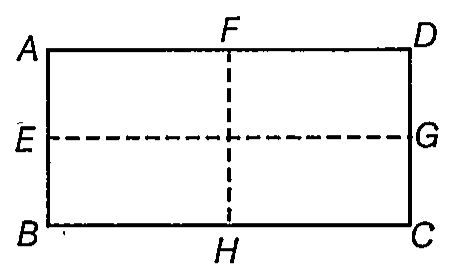
Previous-year questionIn a rectangle ABCD it is given that BC = 2AB. The moment of inertia is minimum along the axis through [AIPMT 1993]
- BC
- BD
- HF
- EG
Show answer
Answer: (D) EG
Explanation: Moment of inertia is smallest about the axis from which the mass distribution is least spread out. EG is the axis parallel to the longer sides and passing through the centre, so the material extends only over the shorter dimension on either side of it — the distances are smallest. By contrast, the diagonal BD and the axis HF have the mass distributed much farther out. Hence I is minimum about EG.
Question 2
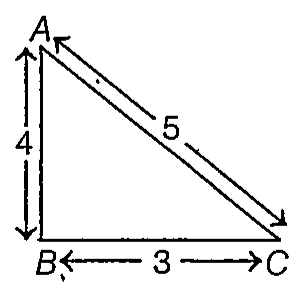
Previous-year questionABC is a triangular plate of uniform thickness whose sides are in the ratio shown in the figure. I_AB, I_BC and I_CA are the moments of inertia of the plate about AB, BC and CA as axes respectively. Which one of the following relations is correct? [AIPMT 1995]
- I_AB > I_BC
- I_BC > I_AC
- I_AB + I_BC = I_CA
- I_CA is maximum
Show answer
Answer: (B) I_BC > I_AC
Explanation: The moment of inertia of a uniform triangular plate about one of its sides depends on the altitude drawn to that side: the larger the altitude, the farther the mass lies from the axis. With sides BC = 3, AB = 4 and CA = 5, the altitude on BC is 4, the altitude on AB is 3 and the altitude on CA is (3 × 4)/5 = 2.4. Hence I_BC > I_AB > I_CA, so I_BC > I_AC is the correct relation. The relation I_AB + I_BC = I_CA cannot hold, because the perpendicular-axis theorem applies only to an axis perpendicular to the plate, not to three axes lying in its plane; and I_CA is the smallest of the three, not the largest.
Question 3
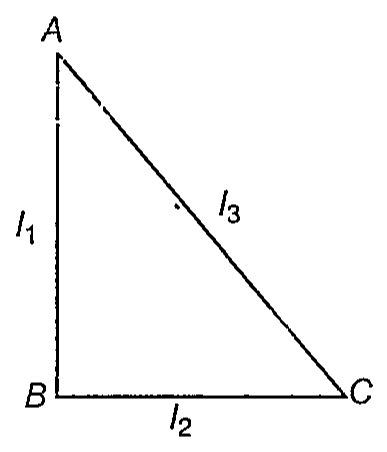
Previous-year questionABC is a right-angled triangular plate of uniform thickness with AB > BC, as shown in the figure. I₁, I₂ and I₃ are the moments of inertia about AB, BC and AC respectively. Which of the following relations is correct? [AIPMT 2000]
- I₁ = I₂ = I₃
- I₂ > I₁ > I₃
- I₃ < I₂ < I₁
- I₃ > I₁ > I₂
Show answer
Answer: (B) I₂ > I₁ > I₃
Explanation: For a plate of fixed mass, the moment of inertia about an axis grows with the average squared distance of the mass from that axis. The mass distribution lies farthest from the shortest side BC, so I₂ is the largest. The hypotenuse AC passes closest to the bulk of the material, so I₃ is the smallest. Hence I₂ > I₁ > I₃.
Question 4
Previous-year questionThe ratio of the moments of inertia of two spheres about their diameters, having the same mass and radii in the ratio 1 : 2, is [NEET 2022]
- 4 : 1
- 1 : 2
- 1 : 4
- 2 : 1
Show answer
Answer: (C) 1 : 4
Explanation: I ∝ R² for equal mass. I₁/I₂ = (1/2)² = 1/4.
Question 5
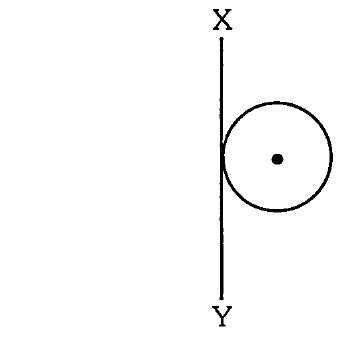
Previous-year questionThe radius of gyration of a solid sphere of mass 5 kg about the tangential axis XY is 5 m. If the radius of the sphere is 5x/√7 m, the value of x is [NEET 2024]
- 5
- √2
- √3
- √5
Show answer
Answer: (D) √5
Explanation: About a tangent I = (7/5)MR² = MK² ⇒ K² = (7/5)R² = (7/5)(25x²/7) = 5x². With K = 5: 25 = 5x² ⇒ x = √5.
Question 6
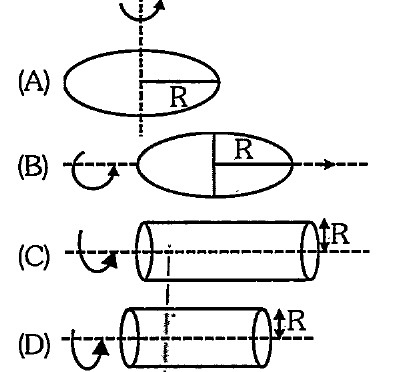
Previous-year questionA thin circular ring (A), a circular disc (B), a hollow cylinder (C) and a solid cylinder (D) have the same radius R and the same mass. Their moments of inertia about the axes shown are I_A, I_B, I_C and I_D. Then [NEET 2024]
- I_A = 2I_B and 2I_C = I_D
- 2I_A = I_C and I_B = 2I_D
- I_A = I_B = I_C = 2I_D
- I_A = I_C and 2I_B = I_D
Show answer
Answer: (D) I_A = I_C and 2I_B = I_D
Explanation: Ring about its central normal axis: I_A = MR². Disc about a diameter: I_B = MR²/4. Hollow cylinder about its axis: I_C = MR². Solid cylinder about its axis: I_D = MR²/2. Hence I_A = I_C and 2I_B = I_D.
Question 7
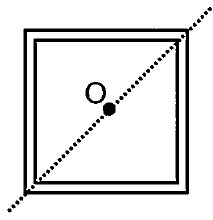
Previous-year questionFour identical rods, each of mass M and length L, form a square. The moment of inertia of this system about a diagonal of the square is [NEET 2021]
- (2/3)ML²
- (4/3)ML²
- (5/3)ML²
- (10/3)ML²
Show answer
Answer: (A) (2/3)ML²
Explanation: Each rod makes 45° with the diagonal and its centre is at distance L/(2√2) from it. MI of a rod about an axis through its centre at 45°: (ML²/12)sin²45° = ML²/24; parallel shift adds M(L²/8). Each rod: ML²/24 + ML²/8 = ML²/6. Four rods: 2ML²/3.
Doing well? Create a free account to take timed tests on this topic and see your weak areas.
Question 8
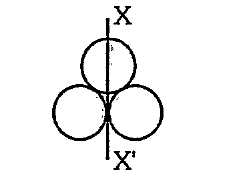
Previous-year questionThree identical spherical shells, each of mass m and radius r, are placed as shown. Axis XX′ touches two of the shells and passes through a diameter of the third. The moment of inertia of the system about XX′ is [AIPMT 2015]
- 3mr²
- (16/5)mr²
- 4mr²
- (11/5)mr²
Show answer
Answer: (C) 4mr²
Explanation: Shell with XX′ as diameter: (2/3)mr². Each shell touched tangentially: (2/3)mr² + mr² = (5/3)mr². Total = 2/3 + 10/3 = 4mr².
Question 9
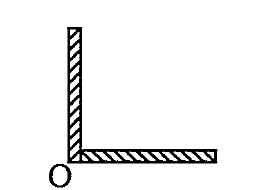
Previous-year questionTwo identical rods, each of mass M and length L, are joined at right angles at O as shown. The moment of inertia about an axis through O perpendicular to the plane of the rods is [AIPMT 2004]
- 2ML²/3
- ML²/3
- ML²/6
- ML²/12
Show answer
Answer: (A) 2ML²/3
Explanation: Each rod rotates about a perpendicular axis through one end: ML²/3. Two rods: 2ML²/3.
Question 10
Previous-year questionThree objects, A (a solid sphere), B (a thin circular disc) and C (a circular ring), each have the same mass M and radius R. They all spin with the same angular speed ω about their own symmetry axes. The amounts of work W required to bring them to rest satisfy [NEET 2018]
- W_C > W_B > W_A
- W_A > W_B > W_C
- W_B > W_A > W_C
- W_A > W_C > W_B
Show answer
Answer: (A) W_C > W_B > W_A
Explanation: W = ½Iω², and for equal M and R the moments of inertia rank as I_ring (MR²) > I_disc (½MR²) > I_sphere ((2/5)MR²). Hence W_C > W_B > W_A.
Question 11
Previous-year questionFrom a disc of radius R and mass M, a circular hole of diameter R whose rim passes through the centre is cut out. The moment of inertia of the remaining part of the disc about a perpendicular axis passing through the centre is [NEET 2016]
- 15MR²/32
- 13MR²/32
- 11MR²/32
- 9MR²/32
Show answer
Answer: (B) 13MR²/32
Explanation: The removed disc has radius R/2 and mass M/4, and its centre is R/2 from the axis, so its contribution is ½(M/4)(R/2)² + (M/4)(R/2)² = 3MR²/32. Subtracting from ½MR² = 16MR²/32 gives 13MR²/32.
Question 12
Previous-year questionThe moment of inertia of a disc of mass M and radius R about a tangent to its rim lying in the plane of the disc is [AIPMT 1999]
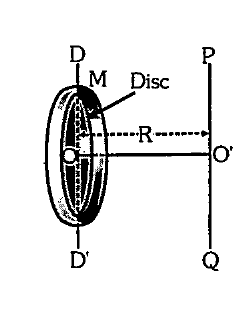
- (2/3)MR²
- (3/2)MR²
- (4/5)MR²
- (5/4)MR²
Show answer
Answer: (D) (5/4)MR²
Explanation: About a diameter, I_d = MR²/4. A tangent in the plane of the disc is parallel to a diameter and a distance R from it, so by the parallel-axis theorem: I = MR²/4 + MR² = (5/4)MR².
Question 13
Previous-year questionA circular disc is to be manufactured using iron and aluminium. To make its moment of inertia about a geometrical axis as large as possible, the disc should be made so that [AIPMT 2002]
- aluminium is at the interior and iron surrounds it
- iron is at the interior and aluminium surrounds it
- aluminium and iron layers are in alternate order
- a sheet of iron is used at both external surfaces with aluminium as the inner material
Show answer
Answer: (A) aluminium is at the interior and iron surrounds it
Explanation: Moment of inertia depends on how the mass is distributed relative to the axis — mass placed farther out contributes far more, since the contribution goes as r². Iron is much denser than aluminium, so the iron should be placed as far from the axis as possible. Hence aluminium should form the interior and iron should surround it.
Question 14
Previous-year questionThe ratio of the radius of gyration of a circular disc about a tangential axis lying in the plane of the disc, to that of a circular ring of the same radius about a tangential axis in the plane of the ring, is [AIPMT 2004]
- 2 : 3
- 2 : 1
- √5 : √6
- 1 : √2
Show answer
Answer: (C) √5 : √6
Explanation: Disc, tangent in its own plane: I_d = MR²/4 + MR² = (5/4)MR² ⟹ K_d = √(5/4) R. Ring, tangent in its own plane: I_r = MR²/2 + MR² = (3/2)MR² ⟹ K_r = √(3/2) R. K_d/K_r = √(5/4) / √(3/2) = √(5/4 × 2/3) = √(5/6) = √5 : √6.
Question 15
Previous-year questionThe moment of inertia of a uniform circular disc of radius R and mass M about an axis passing through the edge of the disc and normal to its plane is [AIPMT 2006]
- ½MR²
- MR²
- (7/2)MR²
- (3/2)MR²
Show answer
Answer: (D) (3/2)MR²
Explanation: About the central normal axis, I_CM = ½MR². The new axis is parallel to it and a distance R away, so by the parallel-axis theorem: I = ½MR² + MR² = (3/2)MR².
Want more Moment of Inertia – The moment of inertia questions?
E-GYAN NIDHI has 192 questions on this topic and 63,000+ in total, all free: timed CBT tests, NEET marking and instant analysis.
Register free Free Sunday Mock TestMore topics in ROTATIONAL MOTION
- Rigid Body, Centre of Mass and Its Motion – Centre of the mass of a two-particle system MCQs
- Torque and Equilibrium of Rigid Body MCQs
- Kinematics of Rotational Motion and Angular Velocity – Basic concepts of rotational motion MCQs
- Angular Momentum and Its Conservation – angular momentum MCQs
- Dynamics of Rotational Motion MCQs