Reagent and Reaction Intermediates Common types of organic reactions- Substitution, addition, elimination, and rearrangement.: NEET MCQs with Answers
8 free questions on Reagent and Reaction Intermediates Common types of organic reactions- Substitution, addition, elimination, and rearrangement. for NEET (UG), starting with previous-year NEET and AIPMT questions. Try each one, then tap Show answer for the answer and a short explanation.
Question 1
Previous-year questionWhich of the following carbocations is the most stable? [NEET 2024]
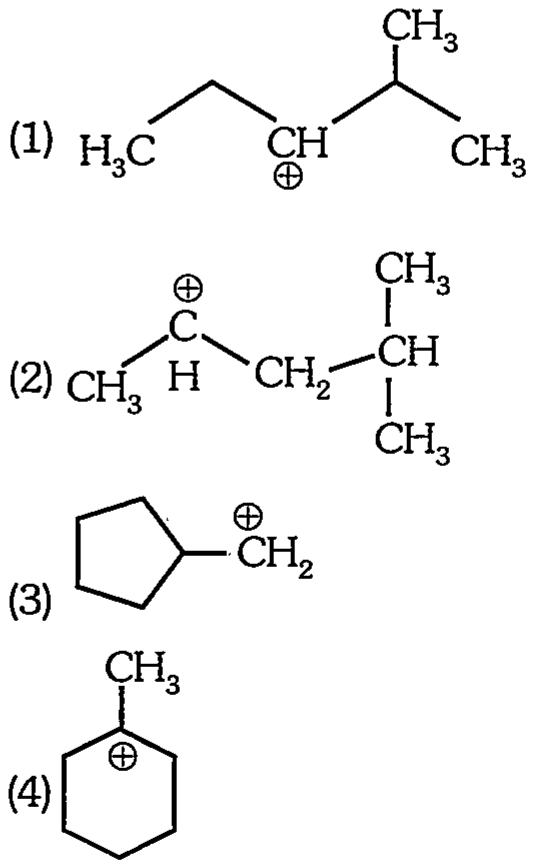
- Structure (1)
- Structure (2)
- Structure (3)
- Structure (4)
Show answer
Answer: (D) Structure (4)
Explanation: The 1-methylcyclohexyl cation is tertiary and is stabilised by +I effect and hyperconjugation with many α-hydrogens. The two open-chain cations are secondary and the cyclopentylmethyl cation is a primary CH₂⁺, so they are less stable.
Question 2
Previous-year questionWhich of the following carbocations is the most stable? [Re-NEET 2022]
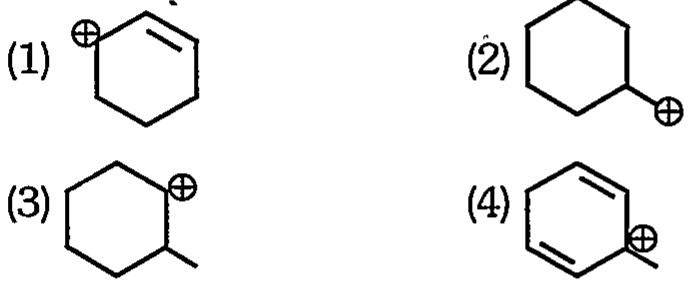
- Structure (1)
- Structure (2)
- Structure (3)
- Structure (4)
Show answer
Answer: (D) Structure (4)
Explanation: The most stable carbocation is the methyl-substituted cyclohexadienyl cation. It is tertiary, and the positive ring carbon is conjugated with two C=C bonds, so the charge is delocalised over three carbons by resonance and is further stabilised by the methyl group (+I, hyperconjugation). The cyclohexenyl cation is only singly allylic and secondary, the 2-methylcyclohexyl cation is secondary and stabilised only by hyperconjugation, and the cyclohexylmethyl cation is primary, with no resonance.
Question 3
Previous-year questionWhich of the following carbocations is the most stable? [NEET (Odisha) 2019]
- (CH₃)₃C–C⁺H–CH₃
- CH₃–CH₂–C⁺H–CH₂–CH₃
- CH₃–C⁺H–CH₂–CH₂–CH₃
- CH₃–CH₂–C⁺H₂
Show answer
Answer: (C) CH₃–C⁺H–CH₂–CH₂–CH₃
Explanation: CH₃–CH₂–C⁺H₂ is primary and the other three cations are secondary. Among the secondary cations, stability depends on the number of α-hydrogens available for hyperconjugation: (CH₃)₃C–C⁺H–CH₃ has 3 (the tert-butyl carbon has none), CH₃CH₂–C⁺H–CH₂CH₃ has 4, and CH₃–C⁺H–CH₂CH₂CH₃ has 5 (3 from CH₃ + 2 from CH₂). So the pentan-2-yl cation is the most stable.
Question 4
Previous-year questionIonisation of the C–Cl bond in which of the following compounds would produce the most stable carbocation (carbonium ion)? [AIPMT 2015]
- (CH₃)₃C–Cl
- C₆H₅–CH₂–Cl
- O₂N–CH₂–CH₂–Cl
- (CH₃)₂CH–Cl
Show answer
Answer: (B) C₆H₅–CH₂–Cl
Explanation: C₆H₅–CH₂–Cl ionises to the benzyl cation C₆H₅CH₂⁺, whose positive charge is delocalised into the benzene ring by resonance, making it the most stable cation here. The tert-butyl cation is stabilised only by +I effect and hyperconjugation, the isopropyl cation is secondary, and in O₂N–CH₂–CH₂⁺ the strongly electron-withdrawing –NO₂ group (–I) destabilises the primary cation.
Question 5
Previous-year questionThe correct statement regarding an electrophile is [NEET 2017]
- An electrophile is a negatively charged species and forms a bond by accepting a pair of electrons from another electrophile.
- Electrophiles are generally neutral species and form a bond by accepting a pair of electrons from a nucleophile.
- An electrophile can be either a neutral or a positively charged species and forms a bond by accepting a pair of electrons from a nucleophile.
- An electrophile is a negatively charged species and forms a bond by accepting a pair of electrons from a nucleophile.
Show answer
Answer: (C) An electrophile can be either a neutral or a positively charged species and forms a bond by accepting a pair of electrons from a nucleophile.
Explanation: Electrophiles are electron-deficient reagents. Some are positively charged (NO₂⁺, CH₃⁺) and some are neutral molecules with an incomplete octet or a polarised multiple bond (BF₃, AlCl₃, >C=O), and all of them accept an electron pair from a nucleophile.
Question 6
Previous-year questionWhich of the following statements is not correct for a nucleophile? [AIPMT 2015]
- A nucleophile is a Lewis acid.
- Ammonia is a nucleophile.
- Nucleophiles attack sites of low electron density.
- Nucleophiles are not electron seeking.
Show answer
Answer: (A) A nucleophile is a Lewis acid.
Explanation: A nucleophile donates an electron pair, which by definition makes it a Lewis base, not a Lewis acid. The other three statements are all correct descriptions of nucleophilic behaviour.
Question 7
In an organic reaction, the substrate is the reactant that supplies carbon to the new bond, and the other reactant is the reagent. If both reactants supply carbon to the new bond, the choice of substrate is arbitrary. In which reaction is the choice arbitrary?
- CH₃CH₂Br + OH⁻ → CH₃CH₂OH + Br⁻
- CH₂=CH₂ + Br₂ → BrCH₂CH₂Br
- CH₃CH₂Br + CN⁻ → CH₃CH₂CN + Br⁻
- CH₃CH₂Br + NH₃ → CH₃CH₂NH₂ + HBr
Show answer
Answer: (C) CH₃CH₂Br + CN⁻ → CH₃CH₂CN + Br⁻
Explanation: In the reaction with cyanide, the new C–C bond is formed between the ethyl carbon and the cyanide carbon, so both reactants supply carbon to it. In the other reactions the new bond joins carbon to oxygen, bromine or nitrogen, so only the organic reactant supplies carbon. There the organic molecule is clearly the substrate.
Doing well? Create a free account to take timed tests on this topic and see your weak areas.
Question 8
Compare the methyl cation CH₃⁺ with the methyl anion CH₃⁻. Which statement correctly describes the carbon atom in each species?
- Both are sp³ hybridised and tetrahedral, because carbon always keeps four electron domains
- CH₃⁺ is sp³ hybridised and pyramidal with a vacant sp³ orbital; CH₃⁻ is sp² hybridised and planar
- CH₃⁺ is sp² hybridised and planar with a vacant p orbital; CH₃⁻ is sp³ hybridised and pyramidal with a lone pair
- Both are sp² hybridised and planar, with the lone pair of CH₃⁻ in an unhybridised p orbital
Show answer
Answer: (C) CH₃⁺ is sp² hybridised and planar with a vacant p orbital; CH₃⁻ is sp³ hybridised and pyramidal with a lone pair
Explanation: The carbon of a carbocation uses three sp² orbitals for its three σ bonds, so the species is planar with bond angles near 120°. The unhybridised p orbital is empty and lies perpendicular to that plane. A carbanion carbon has four electron pairs, three bonding and one lone pair, so it is sp³ hybridised and pyramidal.
Want more Reagent and Reaction Intermediates Common types of organic reactions- Substitution, addition, elimination, and rearrangement. questions?
E-GYAN NIDHI has 44 questions on this topic and 63,000+ in total, all free: timed CBT tests, NEET marking and instant analysis.
Register free Free Sunday Mock TestMore topics in SOME BASIC PRINCIPLES OF ORGANIC CHEMISTRY
- Fundamental about Carbon, Classification and Nomenclature Tetravalency of carbon – Shapes of simple molecules MCQs
- Isomerism of Organic Compounds Isomerism - structural and stereoisomerism. MCQs
- Bond Fission and Electron Displacement in Organic Molecules Nomenclature (Trivial and IUPAC) Covalent bond fission - Homolytic and heterolytic – free radicals MCQs