Isomerism of Organic Compounds Isomerism - structural and stereoisomerism.: NEET MCQs with Answers
15 free questions on Isomerism of Organic Compounds Isomerism - structural and stereoisomerism. for NEET (UG), starting with previous-year NEET and AIPMT questions. Try each one, then tap Show answer for the answer and a short explanation.
Question 1
Previous-year questionWhich of the biphenyls shown below is optically active? [NEET 2016]
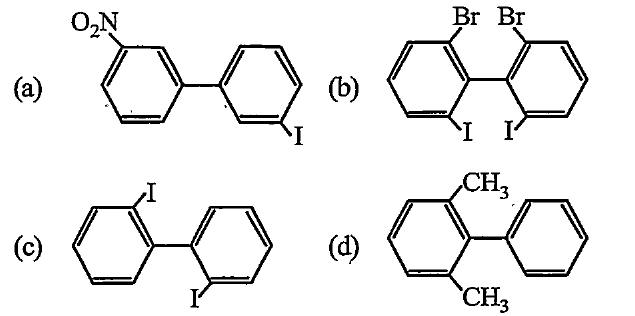
- Structure (a)
- Structure (b)
- Structure (c)
- Structure (d)
Show answer
Answer: (B) Structure (b)
Explanation: Biphenyls become chiral when bulky groups at all four ortho positions prevent free rotation about the central bond and the molecule lacks a symmetry plane. Only structure (b), with substituents at all the ortho positions arranged unsymmetrically, satisfies both conditions.
Question 2
Previous-year questionA compound of molecular formula C₇H₁₆ shows optical isomerism. The compound will be [AIPMT 2001]
- 2,3-Dimethylpentane
- 2,2-Dimethylbutane
- 2-Methylhexane
- None of these
Show answer
Answer: (A) 2,3-Dimethylpentane
Explanation: Optical isomerism needs a carbon bearing four different groups. In 2,3-dimethylpentane, CH₃—CH(CH₃)—CH(CH₃)—CH₂—CH₃, C3 carries a methyl group, an ethyl group, a hydrogen and an isopropyl group: four different substituents, so C3 is a chiral centre and the molecule is optically active. In 2-methylhexane, (CH₃)₂CH—CH₂CH₂CH₂CH₃, C2 carries two identical methyl groups, so it is not chiral. 2,2-Dimethylbutane is C₆H₁₄, so it does not match the molecular formula, and its quaternary carbon carries three methyls in any case.
Question 3
Previous-year questionWhich of the following pairs of Fischer projections of butane-2,3-diol (CH₃ at top and bottom) are enantiomers? [AIPMT 2003]
- OH on the right at C2 and on the left at C3, paired with OH on the left at C2 and on the right at C3
- OH on the right at C2 and on the left at C3, paired with OH on the left at both C2 and C3
- OH on the right at C2 and on the left at C3, paired with OH on the right at both C2 and C3
- OH on the left at C2 and on the right at C3, paired with OH on the left at both C2 and C3
Show answer
Answer: (A) OH on the right at C2 and on the left at C3, paired with OH on the left at C2 and on the right at C3
Explanation: In a Fischer projection of butane-2,3-diol with CH₃ at top and bottom, OH groups on opposite sides give the chiral (2R,3R) and (2S,3S) forms, while OH groups on the same side give the achiral meso form (2R,3S), which has an internal mirror plane. Enantiomers must be non-superimposable mirror images. The structure with OH right at C2 and left at C3 and the structure with OH left at C2 and right at C3 are exact left-to-right reversals of each other; both are chiral, so they are enantiomers. Every other pair sets a chiral form against the meso form (OH on the same side at both carbons). Such stereoisomers are not mirror images, so they are diastereomers.
Question 4
Previous-year questionWhich of the following is not chiral? [AIPMT 2006 · NCERT (New) Pg. 177]
- 2-Hydroxypropanoic acid
- Butan-2-ol
- 2,3-Dibromopentane
- 3-Bromopentane
Show answer
Answer: (D) 3-Bromopentane
Explanation: Test each molecule for a carbon bearing four different groups. 3-Bromopentane is CH₃CH₂—CHBr—CH₂CH₃. The carbon carrying bromine holds Br, H and two ethyl groups. Because two of its substituents are identical it is not an asymmetric carbon, and the molecule has a plane of symmetry, so it is achiral. The others are all chiral: 2-hydroxypropanoic acid (lactic acid) has C2 carrying CH₃, OH, COOH and H; butan-2-ol has C2 carrying CH₃, C₂H₅, OH and H; 2,3-dibromopentane has two distinct chiral centres.
Question 5
Previous-year questionIf there is no rotation of plane-polarised light by a compound in a specific solvent, though the compound is thought to be chiral, it may mean that [AIPMT 2007 · NCERT (New) Pg. 179]
- the compound is certainly meso
- there is no compound in the solvent
- the compound may be a racemic mixture
- the compound is certainly chiral
Show answer
Answer: (C) the compound may be a racemic mixture
Explanation: The stem carries two qualifiers: the compound is thought to be chiral, and the conclusion is only what it may mean. The answer must be equally hedged. A chiral compound present as a racemic mixture, with equal amounts of the d and l enantiomers, shows zero net rotation because the rotation produced by one enantiomer is cancelled by the other. This is external compensation, and it explains the observation while remaining consistent with the compound being chiral. The claim that the compound is certainly meso fails twice: a meso compound is achiral by definition, which contradicts the premise, and 'certainly' cannot be justified from one null observation. Zero rotation is no evidence that the compound is certainly chiral, and an empty solvent is not a chemical explanation.
Question 6
Previous-year questionHow many stereoisomers does the molecule CH₃CH=CHCH₂CHBrCH₃ have? [AIPMT 2008]
- 8
- 2
- 4
- 6
Show answer
Answer: (C) 4
Explanation: Two independent sources of stereoisomerism are present. Geometrical: the C=C carries a methyl and a hydrogen on one carbon and a CH₂ chain and a hydrogen on the other. Since each doubly bonded carbon has two different groups, cis and trans forms are possible — 2 arrangements. Optical: the carbon bearing bromine holds CH₃, Br, H and the CH₂CH=CHCH₃ chain — four different groups, so it is a chiral centre giving 2ⁿ = 2¹ = 2 optical forms. The two kinds of isomerism are independent, so they multiply: total stereoisomers = 2 × 2 = 4 The molecule has one C=C capable of cis–trans isomerism and one chiral centre.
Question 7
Previous-year questionWhich is the most stable enol form of pentane-2,4-dione? [NEET 2021]
- CH₂=C(OH)–CH₂–CO–CH₃
- CH₃–C(OH)=CH–CO–CH₃
- CH₂=C(OH)–C(H)=CH(OH)
- CH₃–C(OH)=C=C(OH)–CH₃
Show answer
Answer: (B) CH₃–C(OH)=CH–CO–CH₃
Explanation: In CH₃–C(OH)=CH–CO–CH₃ the C=C is conjugated with the C=O group, and the enolic –OH forms an intramolecular hydrogen bond with the carbonyl oxygen, giving a stable six-membered chelate ring. In CH₂=C(OH)–CH₂–CO–CH₃ the C=C is not conjugated with the C=O group, so this stabilisation is absent. The four-carbon structure CH₂=C(OH)–CH=CH(OH) does not have the skeleton of pentane-2,4-dione, and the allene CH₃–C(OH)=C=C(OH)–CH₃ is not a reasonable enol tautomer of the dione.
Doing well? Create a free account to take timed tests on this topic and see your weak areas.
Question 8
Previous-year questionWhich of the compounds given below can show tautomerism? [AIPMT 2015]
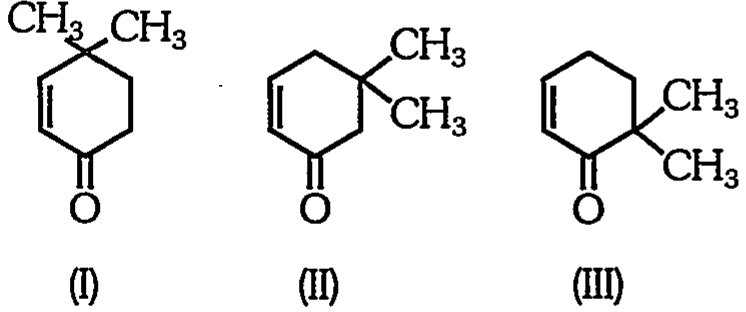
- I and III
- II and III
- I, II and III
- I and II
Show answer
Answer: (C) I, II and III
Explanation: Keto–enol tautomerism needs an α-hydrogen (or a vinylogous γ-hydrogen) that can migrate to the carbonyl oxygen. I and II have a CH₂ group α to the C=O (C-6), so both enolise. In III the α-carbon C-6 carries two methyl groups, but the α,β-unsaturated ketone has γ-hydrogens at C-4, so it can form a dienol (vinylogous enolisation). Hence all three show tautomerism.
Question 9
Previous-year questionWhich one of the following compounds can exhibit geometrical isomerism? [NEET (Manipur) 2023]
- Pent-1-ene
- 2,3-Dimethylbut-2-ene
- 2-Methylprop-1-ene
- 3,4-Dimethylhex-3-ene
Show answer
Answer: (D) 3,4-Dimethylhex-3-ene
Explanation: Geometrical isomerism requires each doubly bonded carbon to carry two different groups. In 3,4-dimethylhex-3-ene, CH₃CH₂C(CH₃)=C(CH₃)CH₂CH₃, each C of the double bond bears CH₃ and C₂H₅, so cis/trans forms exist. Pent-1-ene and 2-methylprop-1-ene have a =CH₂ end, and 2,3-dimethylbut-2-ene has two identical CH₃ groups on each carbon.
Question 10
Which of the following does NOT show geometrical isomerism?
- Pent-2-ene, CH₃–CH=CH–CH₂–CH₃
- 1,2-Dichloroethene, ClCH=CHCl
- 2-Methylbut-2-ene, (CH₃)₂C=CH–CH₃
- But-2-ene, CH₃–CH=CH–CH₃
Show answer
Answer: (C) 2-Methylbut-2-ene, (CH₃)₂C=CH–CH₃
Explanation: Geometrical isomerism needs two different groups on each carbon of the double bond. In 2-methylbut-2-ene one doubly bonded carbon carries two identical methyl groups, so cis and trans forms are not possible. Pent-2-ene, 1,2-dichloroethene and but-2-ene each have two different groups on both carbons of the double bond and show cis–trans isomerism.
Question 11
Which pair consists of two types of isomerism that both fall under stereoisomerism?
- Optical isomerism and geometrical isomerism
- Position isomerism and geometrical isomerism
- Chain isomerism and position isomerism
- Metamerism and functional isomerism
Show answer
Answer: (A) Optical isomerism and geometrical isomerism
Explanation: Stereoisomers have the same atoms joined in the same order and differ only in the arrangement of groups in space. Optical and geometrical isomerism are both of this kind. Chain, position, functional isomerism and metamerism change the connectivity, so they are structural isomerism.
Question 12
How many configurational (stereo) isomers are possible for CH₃–CH=CH–CH(Cl)–CH(Br)–CH₃?
- 4
- 16
- 8
- 6
Show answer
Answer: (C) 8
Explanation: The C2=C3 double bond carries different groups on each carbon, so it can be cis or trans. C-4 and C-5 are both asymmetric and, being differently substituted, give no meso form. The number of stereoisomers is 2³ = 8.
Question 13
How many of the following can exist as a pair of enantiomers?
(a) Butan-2-ol
(b) Propan-2-ol
(c) 2-Chlorobutane
(d) 2-Methylbutane
(e) 3-Methylhexane
(a) Butan-2-ol
(b) Propan-2-ol
(c) 2-Chlorobutane
(d) 2-Methylbutane
(e) 3-Methylhexane
- Three
- Two
- Five
- Four
Show answer
Answer: (A) Three
Explanation: A molecule exists as a pair of enantiomers when it has a carbon bonded to four different groups. Butan-2-ol (H, OH, CH₃, C₂H₅), 2-chlorobutane (H, Cl, CH₃, C₂H₅) and 3-methylhexane (H, CH₃, C₂H₅, C₃H₇) each have such a carbon. In propan-2-ol and in 2-methylbutane the central carbon carries two identical methyl groups, so both are achiral; three compounds qualify.
Question 14
Match List-I with List-II. List-I: (A) Methyl propanoate, (B) Propanamide, (C) Ethanenitrile, (D) But-1-ene. List-II: (p) position isomer of but-2-ene, (q) next higher homologue of ethanamide, (r) metamer of ethyl ethanoate, (s) functional isomer of methyl isocyanide.
- A-r, B-s, C-q, D-p
- A-s, B-q, C-r, D-p
- A-q, B-r, C-s, D-p
- A-r, B-q, C-s, D-p
Show answer
Answer: (D) A-r, B-q, C-s, D-p
Explanation: Methyl propanoate (C₂H₅COOCH₃) and ethyl ethanoate (CH₃COOC₂H₅) have the same formula with the alkyl groups redistributed about the ester link, so they are metamers. Propanamide (C₂H₅CONH₂) is one CH₂ larger than ethanamide. Ethanenitrile (CH₃CN) and methyl isocyanide (CH₃NC) differ in the functional group, and but-1-ene and but-2-ene differ only in the position of the double bond.
Question 15
An alcohol and an ether that are functional isomers of each other must each contain at least how many carbon atoms?
- 4
- 3
- 1
- 2
Show answer
Answer: (D) 2
Explanation: An ether needs an alkyl group on each side of the oxygen, so the smallest ether, CH₃–O–CH₃, has two carbons. Its formula C₂H₆O is the same as that of ethanol, CH₃CH₂OH. With one carbon, only methanol is possible and no ether exists, so the minimum is two.
Want more Isomerism of Organic Compounds Isomerism - structural and stereoisomerism. questions?
E-GYAN NIDHI has 151 questions on this topic and 63,000+ in total, all free: timed CBT tests, NEET marking and instant analysis.
Register free Free Sunday Mock TestMore topics in SOME BASIC PRINCIPLES OF ORGANIC CHEMISTRY
- Fundamental about Carbon, Classification and Nomenclature Tetravalency of carbon – Shapes of simple molecules MCQs
- Bond Fission and Electron Displacement in Organic Molecules Nomenclature (Trivial and IUPAC) Covalent bond fission - Homolytic and heterolytic – free radicals MCQs
- Reagent and Reaction Intermediates Common types of organic reactions- Substitution, addition, elimination, and rearrangement. MCQs