Fundamental about Carbon, Classification and Nomenclature Tetravalency of carbon – Shapes of simple molecules: NEET MCQs with Answers
15 free questions on Fundamental about Carbon, Classification and Nomenclature Tetravalency of carbon – Shapes of simple molecules for NEET (UG), starting with previous-year NEET and AIPMT questions. Try each one, then tap Show answer for the answer and a short explanation.
Syllabus covered: Shapes of simple molecules - hybridization (s and p): Classification of organic compounds based on functional groups: and those containing halogens, oxygen, nitrogen, and sulphur; Homologous series:
Question 1
Previous-year questionWhat is the correct IUPAC name of the compound shown below? [Re-NEET 2024]
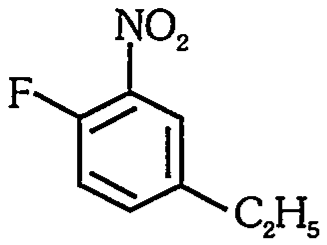
- 4-ethyl-1-fluoro-2-nitrobenzene
- 4-ethyl-1-fluoro-6-nitrobenzene
- 3-ethyl-6-fluoro-1-nitrobenzene
- 1-ethyl-4-fluoro-3-nitrobenzene
Show answer
Answer: (A) 4-ethyl-1-fluoro-2-nitrobenzene
Explanation: All three groups (ethyl, fluoro, nitro) are cited as prefixes, so the ring is numbered to give the lowest locant set. Numbering F = 1, NO₂ = 2, C₂H₅ = 4 gives {1,2,4}, which is lower than {1,3,4}, {1,3,6} or {1,4,6}. Prefixes are then written alphabetically: 4-ethyl-1-fluoro-2-nitrobenzene.
Question 2
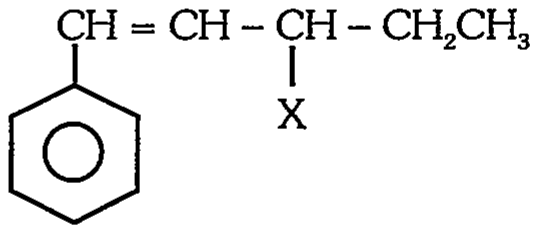
Previous-year questionThe compound shown below is an example of a/an ______. [NEET 2023]
- aryl halide
- allylic halide
- vinylic halide
- benzylic halide
Show answer
Answer: (B) allylic halide
Explanation: In C₆H₅–CH=CH–CH(X)–CH₂CH₃ the halogen is attached to an sp³ carbon that is directly next to a C=C double bond, i.e. an allylic carbon, so it is an allylic halide. It is not benzylic because the C–X carbon is not attached directly to the ring, and not vinylic or aryl because X is not on an sp² carbon.
Question 3
Previous-year questionIn the compound OHC–CH=CH–CH₂COOCH₃, what is the hybridisation of carbons C₁ and C₂, respectively? [Re-NEET 2022]
- sp² and sp³
- sp² and sp²
- sp³ and sp²
- sp³ and sp³
Show answer
Answer: (A) sp² and sp³
Explanation: The principal group is the ester, so C₁ is the ester carbonyl carbon (–COOCH₃), which is sp² (it forms a C=O). C₂ is the CH₂ carbon next to it, with four σ bonds, so it is sp³.
Question 4
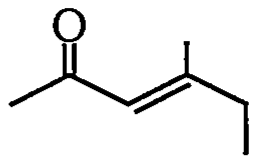
Previous-year questionWhat is the correct IUPAC name of the compound shown below? [NEET 2022 (Overseas)]
- 4-methylhex-3-en-2-one
- 4-ethylpent-3-en-2-one
- 3-methylhex-3-en-4-one
- 2-ethylhex-3-en-4-one
Show answer
Answer: (A) 4-methylhex-3-en-2-one
Explanation: The compound is CH₃–CO–CH=C(CH₃)–CH₂CH₃. The longest chain containing C=O has six carbons; numbering from the end nearer the carbonyl gives C=O at C-2, C=C at C-3 and CH₃ at C-4: 4-methylhex-3-en-2-one. The pent-3-en-2-one name uses a shorter chain, and the hex-3-en-4-one names give the principal group a higher locant.
Question 5
Previous-year questionGive the IUPAC name of the compound CH₃–CO–CH₂–C(CH₃)(CN)–CH₃. [NEET 2021 (Paper-2)]
- 2-Cyano-2-methyl-4-oxopentane
- 4-Cyano-4-methyl-2-pentanone
- 4-Cyano-4-methyl-2-oxopentane
- 2,2-Dimethyl-4-oxopentanenitrile
Show answer
Answer: (D) 2,2-Dimethyl-4-oxopentanenitrile
Explanation: The nitrile (–CN) ranks above the ketone, so its carbon is C-1 and the name ends in '-nitrile'. Counting from the CN carbon: C-2 bears two methyl groups and C-4 is the carbonyl carbon, giving 2,2-dimethyl-4-oxopentanenitrile. 'Cyano' as a prefix is used only when a higher group is present.
Question 6
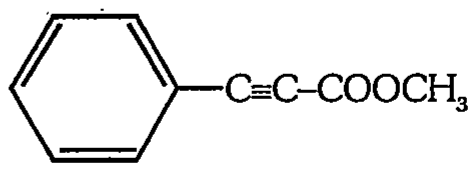
Previous-year questionFor the compound shown below, find (i) the number of sp²-hybridised carbon atoms and (ii) the number of π bonds. [NEET 2020 (COVID-19)]
- 7, 5
- 8, 6
- 7, 6
- 8, 5
Show answer
Answer: (C) 7, 6
Explanation: C₆H₅–C≡C–COOCH₃: the six ring carbons and the ester carbonyl carbon are sp² (7); the two alkyne carbons are sp and the CH₃ carbon is sp³. π bonds: 3 in the benzene ring + 2 in C≡C + 1 in C=O = 6.
Question 7
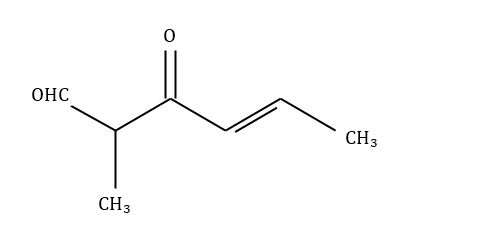
Previous-year questionWhat is the IUPAC name of the compound shown below? [NEET 2017]
- 5-formylhex-2-en-3-one
- 5-methyl-4-oxohex-2-en-5-al
- 3-keto-2-methylhex-5-enal
- 3-keto-2-methylhex-4-enal
Show answer
Answer: (D) 3-keto-2-methylhex-4-enal
Explanation: The compound is OHC–CH(CH₃)–CO–CH=CH–CH₃. The aldehyde is the principal group, so the CHO carbon is C-1: C-2 carries CH₃, C-3 is the keto carbon and the double bond starts at C-4, giving 3-keto-2-methylhex-4-enal (modern: 2-methyl-3-oxohex-4-enal). Placing the double bond at C-5 is wrong numbering.
Doing well? Create a free account to take timed tests on this topic and see your weak areas.
Question 8
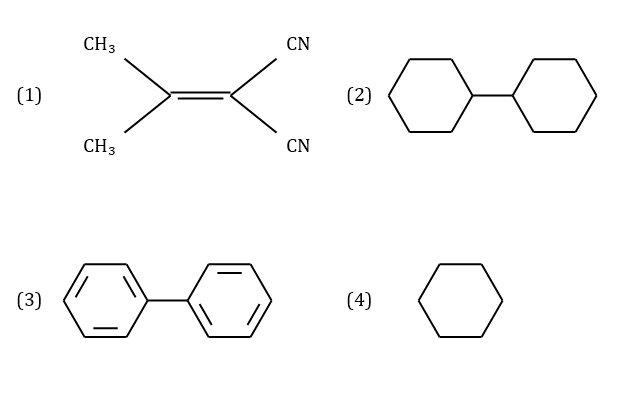
Previous-year questionIdentify the molecule, among those given below, in which all the atoms lie in one plane. [NEET-II 2016]
- Structure (1)
- Structure (2)
- Structure (3)
- Structure (4)
Show answer
Answer: (C) Structure (3)
Explanation: In biphenyl all carbons are sp² hybridised, and rotation about the central C–C single bond allows the two planar benzene rings, with their H atoms, to lie in one plane. (Free biphenyl is actually somewhat twisted in the gas phase, but it is the only molecule here that can have all its atoms coplanar.) (CH₃)₂C=C(CN)₂ has CH₃ groups whose sp³ carbons carry out-of-plane H atoms, and bicyclohexyl and cyclohexane contain only sp³ carbons in non-planar rings.
Question 9
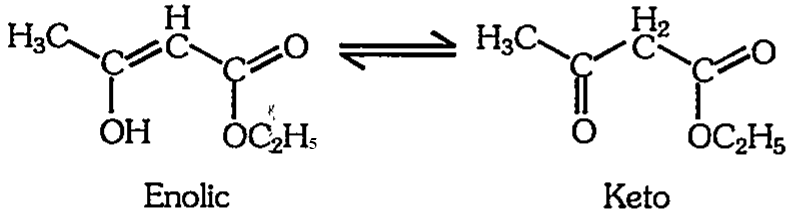
Previous-year questionEthyl acetoacetate exists in keto and enol forms as shown below. How many σ and π bonds are present in its enolic form? [AIPMT 2015]
- 16 sigma bonds and 1 pi-bond
- 9 sigma bonds and 2 pi-bonds
- 9 sigma bonds and 1 pi-bond
- 18 sigma bonds and 2 pi-bonds
Show answer
Answer: (D) 18 sigma bonds and 2 pi-bonds
Explanation: The enol form is CH₃–C(OH)=CH–COOC₂H₅ (C₆H₁₀O₃, 19 atoms, open chain). An acyclic molecule has (number of atoms − 1) σ bonds = 19 − 1 = 18 σ bonds. The π bonds are one in C=C and one in C=O, i.e. 2 π bonds.
Question 10
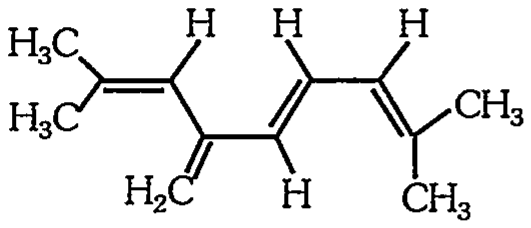
Previous-year questionFind the total number of π-bond electrons in the structure given below. [AIPMT 2015]
- 8
- 12
- 16
- 4
Show answer
Answer: (A) 8
Explanation: The structure contains four C=C double bonds and no other multiple bonds. Each double bond has one π bond holding 2 electrons, so total π electrons = 4 × 2 = 8.
Question 11
Previous-year questionWhich of the following molecules shows the order of hybridisation sp², sp², sp, sp from the left-hand atom to the right-hand atom? [NEET 2018]
- HC≡C–C≡CH
- CH₂=CH–C≡CH
- CH₃–CH=CH–CH₃
- CH₂=CH–CH=CH₂
Show answer
Answer: (B) CH₂=CH–C≡CH
Explanation: In but-1-en-3-yne the first two carbons form a double bond (sp² each) while the last two form a triple bond (sp each). The other molecules give sp,sp,sp,sp; sp³,sp²,sp²,sp³ and sp²,sp²,sp²,sp² respectively.
Question 12
Previous-year questionThe IUPAC name of OHC–CH(CH₃)–CO–CH=CH–CH₃ is [NEET 2017]
- 5-Formylhex-2-en-3-one
- 5-Methyl-4-oxohex-2-en-5-al
- 3-Keto-2-methylhex-5-enal
- 3-Keto-2-methylhex-4-enal
Show answer
Answer: (D) 3-Keto-2-methylhex-4-enal
Explanation: The aldehyde group is senior to the ketone, so –CHO must be the suffix and its carbon is C-1 of the six-carbon chain. This places the methyl group at C-2, the keto group at C-3 and the double bond at C-4, giving 3-keto-2-methylhex-4-enal.
Question 13
The IUPAC name of CH₃–CH₂–CH=CH–C≡CH is:
- Hex-4-en-1-yne
- Hex-1-yn-3-ene
- Hex-3-en-5-yne
- Hex-3-en-1-yne
Show answer
Answer: (D) Hex-3-en-1-yne
Explanation: The multiple bonds together must get the lowest locant set. Numbering from the triple-bond end gives the set 1,3, which is lower than 3,5 from the other end, so the triple bond is at C-1 and the double bond at C-3. With 'ene' cited before 'yne', the name is hex-3-en-1-yne.
Question 14
The IUPAC name of CH₃–CH=C(Br)–COOC₂H₅ is:
- Ethyl 2-bromobut-3-enoate
- Ethyl 3-bromobut-2-enoate
- Ethyl 2-bromobut-2-enoate
- Ethyl 2-bromobutanoate
Show answer
Answer: (C) Ethyl 2-bromobut-2-enoate
Explanation: The compound is the ethyl ester of a four-carbon unsaturated acid. Numbering from the ester carbon as C-1 puts the bromine on C-2 and the double bond between C-2 and C-3. The acid part is therefore 2-bromobut-2-enoate and the ester is ethyl 2-bromobut-2-enoate.
Question 15
A cyclooctyne ring carries an ethyl group on the ring carbon directly next to one of the two triple-bonded carbons. Its IUPAC name is:
- 8-Ethylcyclooctyne
- 3-Ethylcyclooctyne
- 1-Ethylcyclooct-2-yne
- 4-Ethylcyclooctyne
Show answer
Answer: (B) 3-Ethylcyclooctyne
Explanation: In a cycloalkyne the triple-bonded carbons are C-1 and C-2. Numbering continues in the direction that gives the substituent the lowest locant, so the carbon next to C-2 is C-3. The name is 3-ethylcyclooctyne; numbering the other way would give the higher locant 8.
Want more Fundamental about Carbon, Classification and Nomenclature Tetravalency of carbon – Shapes of simple molecules questions?
E-GYAN NIDHI has 211 questions on this topic and 63,000+ in total, all free: timed CBT tests, NEET marking and instant analysis.
Register free Free Sunday Mock TestMore topics in SOME BASIC PRINCIPLES OF ORGANIC CHEMISTRY
- Isomerism of Organic Compounds Isomerism - structural and stereoisomerism. MCQs
- Bond Fission and Electron Displacement in Organic Molecules Nomenclature (Trivial and IUPAC) Covalent bond fission - Homolytic and heterolytic – free radicals MCQs
- Reagent and Reaction Intermediates Common types of organic reactions- Substitution, addition, elimination, and rearrangement. MCQs