Bond Fission and Electron Displacement in Organic Molecules Nomenclature (Trivial and IUPAC) Covalent bond fission - Homolytic and heterolytic – free radicals: NEET MCQs with Answers
15 free questions on Bond Fission and Electron Displacement in Organic Molecules Nomenclature (Trivial and IUPAC) Covalent bond fission - Homolytic and heterolytic – free radicals for NEET (UG), starting with previous-year NEET and AIPMT questions. Try each one, then tap Show answer for the answer and a short explanation.
Syllabus covered: free radicals, carbocations, and carbanions; stability of carbocations and free radicals, electrophiles, and nucleophiles. Electronic displacement in a covalent bond - Inductive effect, electromeric effect, resonance, and hyperconjugation.
Question 1
Previous-year questionA methyl group attached to a positively charged carbon atom stabilises the carbocation because of: [Re-NEET 2024]
- –I inductive effect
- electromeric effect
- hyperconjugation
- mesomeric effect
Show answer
Answer: (C) hyperconjugation
Explanation: The C–H σ-bonds of the methyl group overlap with the vacant p-orbital of the adjacent positive carbon, delocalising the positive charge (hyperconjugation, 'no-bond resonance'). Methyl has a +I effect (not –I), and it has no mesomeric effect; the electromeric effect is a temporary effect in the presence of an attacking reagent.
Question 2
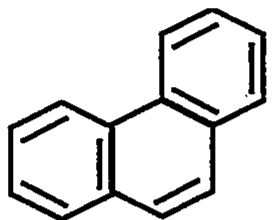
Previous-year questionPhenanthrene, whose structure is given below, is aromatic and obeys Hückel's (4n + 2)π electron rule. What is the value of n? [NEET (Sawaimadhopur) 2024]
- 1
- 2
- 3
- 0
Show answer
Answer: (C) 3
Explanation: Phenanthrene (C₁₄H₁₀) has 7 C=C bonds, i.e. 14 π electrons. Setting 4n + 2 = 14 gives 4n = 12, so n = 3.
Question 3
Previous-year questionMatch the amines in List-I with their pK_b values in List-II. [NEET (Sawaimadhopur) 2024]
List-I (Amine):
A. Benzenamine
B. Phenylmethanamine
C. Methanamine
D. N-Ethylethanamine
List-II (pK_b value):
I. 3.38
II. 9.38
III. 4.70
IV. 3.0
List-I (Amine):
A. Benzenamine
B. Phenylmethanamine
C. Methanamine
D. N-Ethylethanamine
List-II (pK_b value):
I. 3.38
II. 9.38
III. 4.70
IV. 3.0
- A–III, B–II, C–I, D–IV
- A–II, B–I, C–III, D–IV
- A–I, B–III, C–II, D–IV
- A–II, B–III, C–I, D–IV
Show answer
Answer: (D) A–II, B–III, C–I, D–IV
Explanation: Lower pK_b means a stronger base. Benzenamine (aniline) is weakest (pK_b 9.38) because its lone pair is delocalised into the ring; phenylmethanamine (benzylamine) has pK_b 4.70; methanamine 3.38; and N-ethylethanamine (diethylamine), the strongest base, 3.0. Hence A–II, B–III, C–I, D–IV.
Question 4
Previous-year questionRead the two statements given below and choose the correct answer from the options. [NEET (Manipur) 2023]
Statement I: In an organic compound, when inductive and electromeric effects operate in opposite directions, the inductive effect predominates.
Statement II: Hyperconjugation is observed in o-xylene.
Statement I: In an organic compound, when inductive and electromeric effects operate in opposite directions, the inductive effect predominates.
Statement II: Hyperconjugation is observed in o-xylene.
- Statement-I is true but Statement-II is false.
- Statement-I is false but Statement-II is true.
- Both Statement-I and Statement-II are true.
- Both Statement-I and Statement-II are false.
Show answer
Answer: (B) Statement-I is false but Statement-II is true.
Explanation: Statement I is false: when inductive and electromeric effects act in opposite directions, the electromeric effect predominates because it is a temporary but complete transfer of a π-electron pair. Statement II is true: o-xylene has methyl groups attached to the benzene ring, whose α-C–H bonds conjugate with the ring π system (hyperconjugation).
Question 5
Previous-year questionWhich of the following compounds/species is the least basic? [NEET (Manipur) 2023]
- (H₂N)₂C=O
- (H₂N)₂C⁺–OH
- (H₂N)₂C=NH
- (H₂N)₂C=N⁺H₂
Show answer
Answer: (B) (H₂N)₂C⁺–OH
Explanation: Neutral guanidine, (H₂N)₂C=NH, is a very strong base because its conjugate acid is highly resonance-stabilised, and neutral urea, (H₂N)₂C=O, is a weak base that can still be protonated. The two cations are far weaker bases than either, because a positively charged species has almost no tendency to take a second proton. O-protonated urea, (H₂N)₂C⁺–OH, is taken as the least basic: its positive charge draws in the nitrogen lone pairs, so they are not available. The guanidinium ion is also practically non-basic, so this last comparison is between two extremely weak bases.
Question 6
Previous-year questionWhich of the following gives the correct order of acid strength of the given molecules? [NEET (Overseas) 2022]
- C₂H₅OH < H₂O < CH₃COOH < C₆H₅OH
- C₂H₅OH < H₂O < C₆H₅OH < CH₃COOH
- H₂O < C₂H₅OH < C₆H₅OH < CH₃COOH
- H₂O < C₆H₅OH < C₂H₅OH < CH₃COOH
Show answer
Answer: (B) C₂H₅OH < H₂O < C₆H₅OH < CH₃COOH
Explanation: Ethanol (pKa ≈ 16) is a weaker acid than water (pKa ≈ 15.7) because the +I effect of the ethyl group destabilises the ethoxide ion. Phenol (pKa ≈ 10) is more acidic since the phenoxide ion is resonance-stabilised, and acetic acid (pKa ≈ 4.76) is the strongest because the carboxylate ion has two equivalent resonance structures. Order: C₂H₅OH < H₂O < C₆H₅OH < CH₃COOH.
Question 7
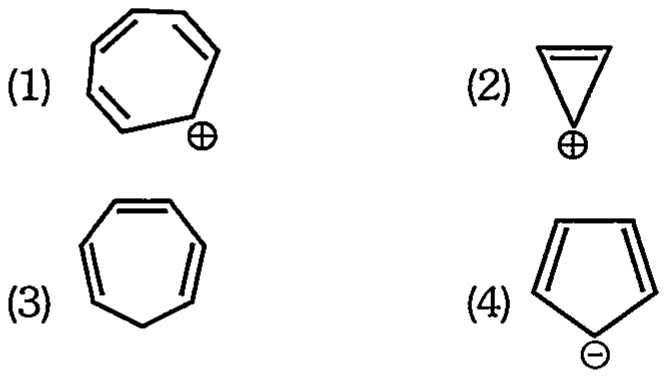
Previous-year questionWhich of the following compounds is NOT aromatic? [NEET 2022]
- Structure (1)
- Structure (2)
- Structure (3)
- Structure (4)
Show answer
Answer: (C) Structure (3)
Explanation: Aromatic species are cyclic, planar, fully conjugated and have (4n + 2) π electrons. Cycloheptatriene has an sp³ CH₂ carbon in the ring, so it is not fully conjugated and is non-aromatic. The tropylium cation (6π), cyclopropenyl cation (2π) and cyclopentadienyl anion (6π) are aromatic.
Doing well? Create a free account to take timed tests on this topic and see your weak areas.
Question 8
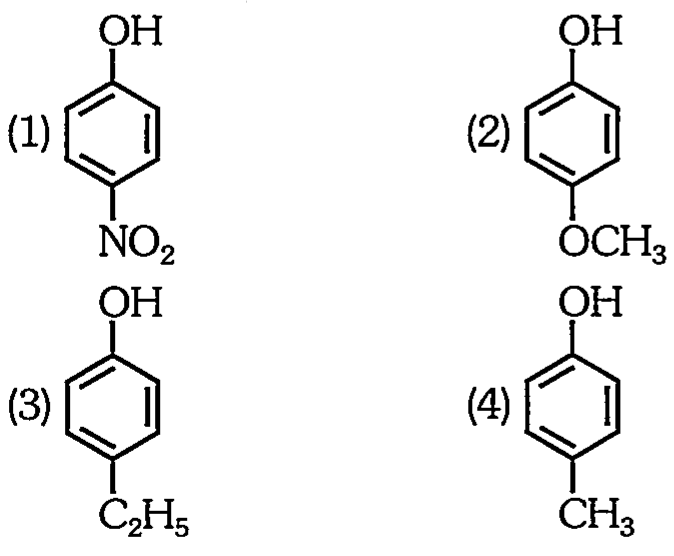
Previous-year questionWhich of the following substituted phenols is the strongest acid? [NEET (COVID-19) 2020]
- Structure (1)
- Structure (2)
- Structure (3)
- Structure (4)
Show answer
Answer: (A) Structure (1)
Explanation: The –NO₂ group at the para position withdraws electrons by –R and –I effects, stabilising the phenoxide ion, so p-nitrophenol is the strongest acid. –OCH₃ (+R), –C₂H₅ and –CH₃ (+I, hyperconjugation) are electron-donating and decrease acidity relative to phenol.
Question 9
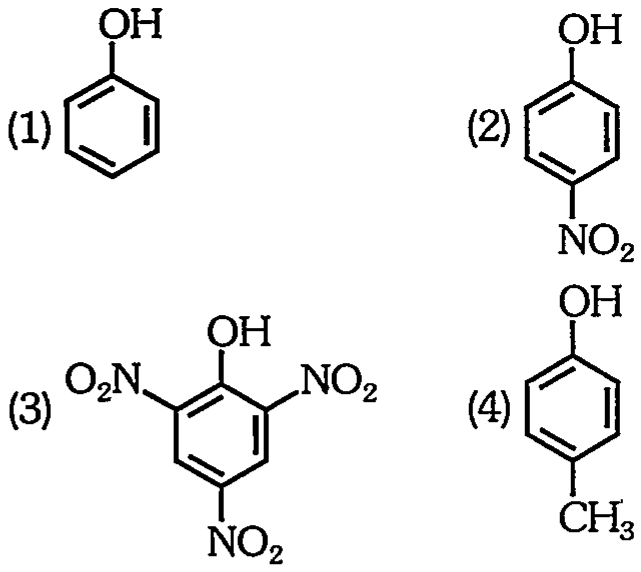
Previous-year questionWhich of the following compounds is the most acidic? [NEET 2017]
- Structure (1)
- Structure (2)
- Structure (3)
- Structure (4)
Show answer
Answer: (C) Structure (3)
Explanation: Electron-withdrawing –NO₂ groups at the ortho and para positions stabilise the phenoxide ion by –R and –I effects, increasing acidity. 2,4,6-Trinitrophenol (picric acid) has three such groups and is the most acidic (pKa ≈ 0.4), more than p-nitrophenol and phenol. p-Cresol is the least acidic because –CH₃ is electron-donating.
Question 10
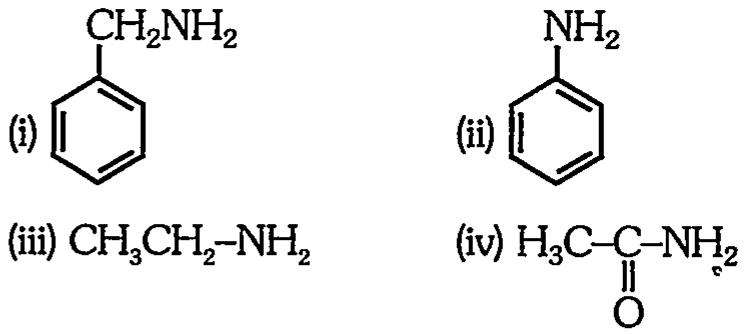
Previous-year questionIdentify the correct order of K_b (basic strength) for the compounds given below. [Re-AIPMT 2015]
- iv > iii > ii > i
- iii > i > ii > iv
- i > ii > iii > iv
- ii > iii > iv > i
Show answer
Answer: (B) iii > i > ii > iv
Explanation: Ethylamine (iii) is most basic because the +I effect of the ethyl group increases electron density on N. In benzylamine (i) the lone pair is not conjugated with the ring, but the phenyl group exerts a weak –I effect, so it is slightly less basic than ethylamine. In aniline (ii) the lone pair is delocalised into the ring, and in acetamide (iv) it is delocalised onto the C=O group, making amides almost non-basic. Order: iii > i > ii > iv.
Question 11
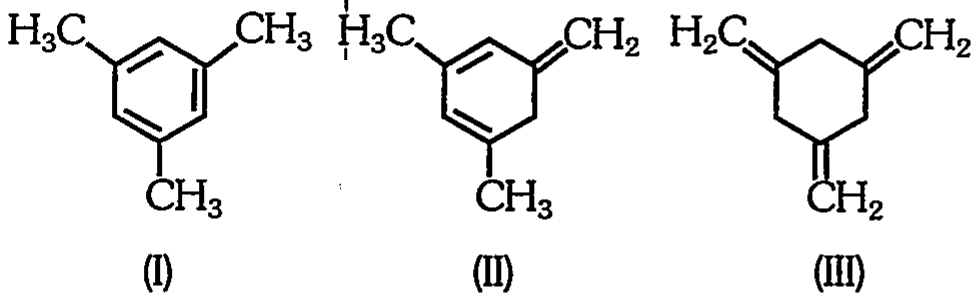
Previous-year questionFor the three compounds shown below, the enthalpies of hydrogenation will follow the order: [AIPMT 2015]
- III > II > I
- II > III > I
- II > I > III
- I > II > III
Show answer
Answer: (A) III > II > I
Explanation: Heat of hydrogenation is lower for a more stable (more delocalised) system. I (mesitylene) is aromatic and has the least heat of hydrogenation; II has one exocyclic and two ring double bonds in partial conjugation; III has three isolated exocyclic C=CH₂ groups with no conjugation and is least stable, so it releases the most heat. Order: III > II > I.
Question 12
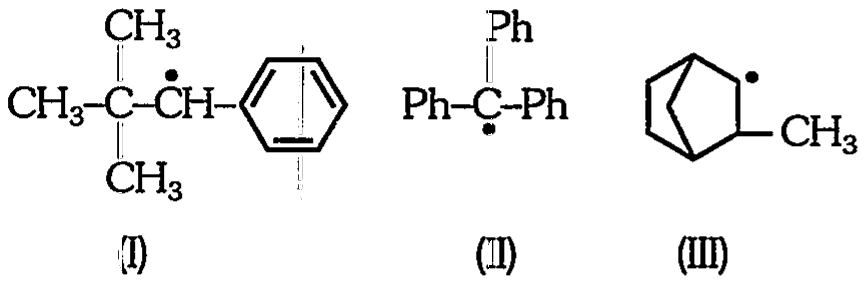
Previous-year questionConsider the free radicals given below. Hyperconjugation is possible in: [AIPMT 2015]
- II only
- III only
- I and III
- I only
Show answer
Answer: (B) III only
Explanation: Hyperconjugation requires at least one α-C–H bond (a C–H on the carbon next to the radical centre). In I the radical carbon is flanked by a quaternary carbon (no H) and a phenyl ring, and in II (Ph₃C•) all three neighbours are phenyl groups, so neither has α-hydrogens. In III the radical carbon is adjacent to ring carbons bearing hydrogens, so only III shows hyperconjugation.
Question 13
Previous-year questionA tertiary butyl carbocation is more stable than a secondary butyl carbocation because of which of the following? [NEET 2020]
- +R effect of the –CH₃ groups
- –R effect of the –CH₃ groups
- Hyperconjugation
- –I effect of the –CH₃ groups
Show answer
Answer: (C) Hyperconjugation
Explanation: The tert-butyl cation has nine α-hydrogens, whereas the sec-butyl cation has only five. Greater hyperconjugative delocalisation of these C–H σ electrons into the empty p orbital makes the tertiary cation the more stable one.
Question 14
Previous-year questionWhich of the following is correct with respect to the –I effect of the substituents (R = alkyl)? [NEET 2018]
- –NH₂ < –OR < –F
- –NR₂ < –OR < –F
- –NR₂ > –OR > –F
- –NH₂ > –OR > –F
Show answer
Answer: (A) –NH₂ < –OR < –F
Explanation: The inductive electron-withdrawing power runs parallel to electronegativity of the atom directly attached to the chain. Since F > O > N in electronegativity, the –I effect increases in the order –NH₂ < –OR < –F.
Question 15
Previous-year questionThe pair of electrons in the carbanion CH₃C≡C⁻ is present in which of the following orbitals? [NEET 2016]
- 2p
- sp³
- sp²
- sp
Show answer
Answer: (D) sp
Explanation: The negatively charged carbon of an acetylide ion is part of a triple bond, so it is sp hybridised. The lone pair occupies one of these sp hybrid orbitals, which is why terminal alkynes are appreciably acidic.
Want more Bond Fission and Electron Displacement in Organic Molecules Nomenclature (Trivial and IUPAC) Covalent bond fission - Homolytic and heterolytic – free radicals questions?
E-GYAN NIDHI has 181 questions on this topic and 63,000+ in total, all free: timed CBT tests, NEET marking and instant analysis.
Register free Free Sunday Mock TestMore topics in SOME BASIC PRINCIPLES OF ORGANIC CHEMISTRY
- Fundamental about Carbon, Classification and Nomenclature Tetravalency of carbon – Shapes of simple molecules MCQs
- Isomerism of Organic Compounds Isomerism - structural and stereoisomerism. MCQs
- Reagent and Reaction Intermediates Common types of organic reactions- Substitution, addition, elimination, and rearrangement. MCQs