Electromagnetic Induction – Self-Inductance: NEET MCQs with Answers
13 free questions on Electromagnetic Induction – Self-Inductance for NEET (UG), starting with previous-year NEET and AIPMT questions. Try each one, then tap Show answer for the answer and a short explanation.
Syllabus covered: Self-Inductance
Question 1
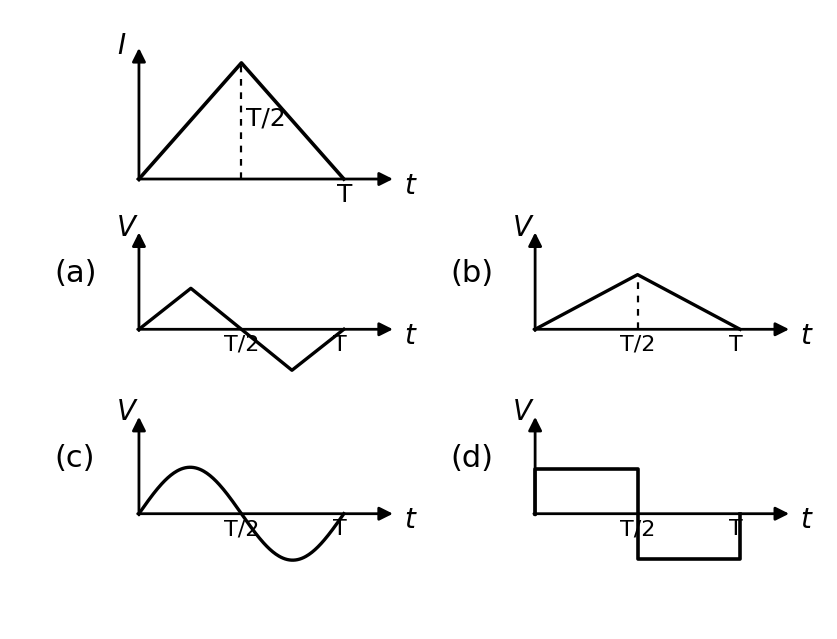
Previous-year questionThe current I in an inductance is varying with time according to the plot shown in the figure. Which one of the following is the correct variation of voltage with time in the coil? [AIPMT 2012]
- Graph (a)
- Graph (b)
- Graph (c)
- Graph (d)
Show answer
Answer: (D) Graph (d)
Explanation: The induced voltage is V = L(dI/dt), i.e. L times the slope of the current graph. From t = 0 to T/2 the current rises linearly, so the slope — and hence V — is a positive constant. From T/2 to T the current falls linearly at the same rate, so V is a negative constant of equal magnitude. The voltage is therefore a rectangular (square) waveform, which is graph (d).
Question 2
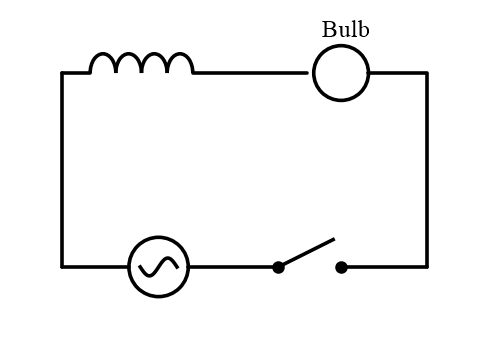
Previous-year questionA light bulb and an inductor coil are connected to an AC source through a key as shown in the figure. The key is closed and after some time an iron rod is inserted into the interior of the inductor. The glow of the light bulb [NEET (Oct.) 2020]
- decreases
- remains unchanged
- fluctuates
- increases
Show answer
Answer: (A) decreases
Explanation: Inserting an iron rod raises the relative permeability of the core, so the inductance L increases. The inductive reactance X_L = ωL therefore increases, the impedance of the circuit rises, and the current I = e/X_L falls. With less current through the bulb, its glow decreases.
Question 3
Previous-year questionThe magnetic potential energy stored in a certain inductor is 25 mJ, when the current in the inductor is 60 mA. This inductor is of inductance [NEET 2018]
- 0.138 H
- 138.88 H
- 13.89 H
- 1.389 H
Show answer
Answer: (C) 13.89 H
Explanation: From U = ½LI², L = 2U/I² = 2(25 × 10⁻³)/(60 × 10⁻³)² = 0.05/3.6 × 10⁻³ ≈ 13.89 H.
Question 4
Previous-year questionA long solenoid has 1000 turns. When a current of 4 A flows through it, the magnetic flux linked with each turn of the solenoid is 4 × 10⁻³ Wb. The self inductance of the solenoid is [NEET 2016]
- 4 H
- 3 H
- 2 H
- 1 H
Show answer
Answer: (D) 1 H
Explanation: L = Nϕ/I = (1000)(4 × 10⁻³)/4 = 1 H.
Question 5
The current in a coil of self-inductance 0.4 H is raised uniformly from zero to 5 A in 0.2 s. What are the magnitude of the back emf during this rise and the total work done against it?
- 5 V and 2.5 J
- 2.5 V and 5 J
- 10 V and 5 J
- 10 V and 10 J
Show answer
Answer: (C) 10 V and 5 J
Explanation: The back emf is L dI/dt = 0.4 × (5/0.2) = 10 V. The work done against it is ½LI² = ½ × 0.4 × 25 = 5 J, which is stored as magnetic potential energy. As a check, the average current is 2.5 A, so the work is 10 × 2.5 × 0.2 = 5 J.
Question 6
For an ideal air-cored coil of self-inductance L, the total flux linkage NΦ and the stored magnetic energy U are each plotted against the current I. Which description of the two graphs is correct?
- Both are parabolas through the origin
- NΦ against I is a parabola through the origin, and U against I is a straight line through the origin of slope L
- NΦ against I is a straight line through the origin of slope L, and U against I is a parabola through the origin
- Both are straight lines through the origin, with slopes L and L/2
Show answer
Answer: (C) NΦ against I is a straight line through the origin of slope L, and U against I is a parabola through the origin
Explanation: For an air-cored coil L is constant, so NΦ = LI is a straight line through the origin with slope L. The energy U = ½LI² varies as the square of the current, so its graph is a parabola. The slope of the U graph at any current is LI, which equals the flux linkage at that current.
Question 7
A branch of a circuit runs from point A through a 2 Ω resistor and then a 10 mH ideal inductor to point B. At a certain instant the current is 3 A from A to B and is decreasing at 500 A/s. The potential difference V_A − V_B at this instant is:
- 6 V
- −1 V
- 1 V
- 11 V
Show answer
Answer: (C) 1 V
Explanation: Moving along the current, the potential falls by iR = 6 V across the resistor. The inductor contributes L di/dt = 0.01 × (−500) = −5 V. Because the current is decreasing, the inductor's emf tries to maintain it and so acts as a rise along the current. Thus V_A − V_B = 6 − 5 = 1 V.
Doing well? Create a free account to take timed tests on this topic and see your weak areas.
Question 8
A self-induced emf of 6 V appears in inductor X when its current changes at 2 A/s, and in inductor Y when its current changes at 6 A/s. If both inductors store the same magnetic energy, what is the ratio of the current in Y to the current in X?
- 1/√3
- 1/3
- √3
- 3
Show answer
Answer: (C) √3
Explanation: From ε = L dI/dt, the inductances are 3 H for X and 1 H for Y. Equal energy requires ½L_X I_X² = ½L_Y I_Y², so (I_Y/I_X)² = L_X/L_Y = 3. The current ratio is therefore √3.
Question 9
Two ideal coils of self-inductance 9 mH and 3 mH have currents increasing at the same rate. At a certain instant, the power being supplied to the two coils is equal. At that instant, the ratio of the energy stored in the 9 mH coil to that in the 3 mH coil is:
- 1 : 1
- 1 : 9
- 1 : 3
- 3 : 1
Show answer
Answer: (C) 1 : 3
Explanation: With equal di/dt, the induced voltages are proportional to L, so V₁ : V₂ = 3 : 1. Equal power P = Vi then gives i₁ : i₂ = 1 : 3. The stored energy ½Li² is in the ratio 9 × 1² : 3 × 3² = 9 : 27 = 1 : 3.
Question 10
When a steady current of 0.2 A flows in a coil, the total flux linkage NΦ of the coil is 0.6 Wb. The additional energy stored in the coil's magnetic field when the current is raised to 0.4 A is:
- 0.12 J
- 0.24 J
- 0.06 J
- 0.18 J
Show answer
Answer: (D) 0.18 J
Explanation: Since NΦ = LI, the self-inductance is L = 0.6/0.2 = 3 H. The stored energy is ½LI², which is 0.06 J at 0.2 A and 0.24 J at 0.4 A. The additional energy is 0.24 − 0.06 = 0.18 J.
Question 11
The currents through two ideal inductors of 20 mH and 50 mH are increasing at the same rate. At the instant when energy is being supplied to both at the same rate, what is the ratio of the energy stored in the 20 mH inductor to that stored in the 50 mH inductor?
- 1 : 1
- 2 : 5
- 5 : 2
- 25 : 4
Show answer
Answer: (C) 5 : 2
Explanation: Power into an inductor is P = LI(dI/dt). With equal P and equal dI/dt, L₁I₁ = L₂I₂, so I₁/I₂ = 50/20 = 5/2. The stored energy ratio is (L₁I₁²)/(L₂I₂²) = (2/5) × (25/4) = 5/2.
Question 12
A long air-cored solenoid has 2000 turns per metre and carries a steady current of 5 A. How much magnetic energy is stored in the solenoid's interior, which has a volume of 5 × 10⁻⁴ m³? (Take μ₀ = 4π × 10⁻⁷ T m/A and neglect end effects)
- 63 mJ
- 31 mJ
- 16 mJ
- 6.3 mJ
Show answer
Answer: (B) 31 mJ
Explanation: Inside the solenoid, B = μ₀nI, so the energy density is B²/(2μ₀) = μ₀n²I²/2. This gives 2π × 10⁻⁷ × (2000 × 5)² = 20π ≈ 62.8 J/m³. Multiplying by the volume gives 62.8 × 5 × 10⁻⁴ ≈ 31 mJ.
Question 13
A coil L₁ (2 mH, resistance 4 Ω), a coil L₂ (3 mH, resistance 6 Ω) and a pure resistor of 12 Ω are connected in parallel across an ideal 6 V battery through a switch. The switch is closed at t = 0. What is the ratio of the largest to the smallest current drawn from the battery after closing?
- 12
- 2
- 6
- 5
Show answer
Answer: (C) 6
Explanation: Just after closing, the coils oppose any sudden rise of current and act as open circuits, so only the resistor conducts: 6/12 = 0.5 A. After a long time the coils behave as their resistances alone, giving 6/4 + 6/6 + 6/12 = 3 A. The current rises steadily between these limits, so the ratio is 3/0.5 = 6.
Want more Electromagnetic Induction – Self-Inductance questions?
E-GYAN NIDHI has 50 questions on this topic and 63,000+ in total, all free: timed CBT tests, NEET marking and instant analysis.
Register free Free Sunday Mock Test