Electromagnetic Induction – Magnetic Flux: NEET MCQs with Answers
15 free questions on Electromagnetic Induction – Magnetic Flux for NEET (UG), starting with previous-year NEET and AIPMT questions. Try each one, then tap Show answer for the answer and a short explanation.
Syllabus covered: Magnetic Flux, Electromagnetic Induction, Faraday's Law and Lenz's Law: Electromagnetic induction: Faraday's law. Induced emf and current: Lenz’s Law
Question 1
Previous-year questionAs a result of a change in the magnetic flux linked to the closed loop shown in the figure, an emf of V volt is induced in the loop. The work done (in joule) in taking a charge q coulomb once along the loop is [AIPMT 2005]
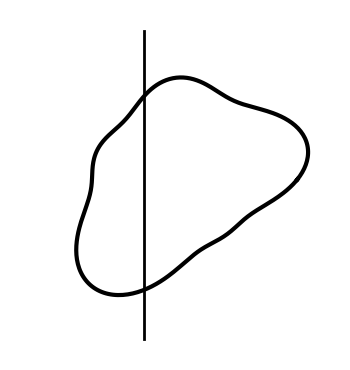
- qV
- zero
- 2qV
- qV/2
Show answer
Answer: (A) qV
Explanation: The induced emf is the work done per unit charge in carrying a charge once around the loop. Therefore the work done in taking a charge q around the loop once is simply W = qV joule.
Question 2
Previous-year questionAn 800-turn coil of effective area 0.05 m² is kept perpendicular to a magnetic field 5 × 10⁻⁵ T. When the plane of the coil is rotated by 90° around any of its coplanar axis in 0.1 s, the emf induced in the coil will be [NEET 2019]
- 2 V
- 0.2 V
- 2 × 10⁻³ V
- 0.02 V
Show answer
Answer: (D) 0.02 V
Explanation: The flux changes from NBA to zero: NΔΦ = 800 × 5 × 10⁻⁵ × 0.05 = 2 × 10⁻³ Wb. Dividing by 0.1 s gives e = 0.02 V.
Question 3
Two separate wire coils, a larger C₁ and a smaller C₂, lie flat in a horizontal plane in a uniform magnetic field directed vertically downwards, and the field strength rises at a steady rate. In case 1 each coil is closed on itself. In case 2 the coils are joined by crossed wires into one figure-of-eight loop, so that a current going one way round C₁ goes the other way round C₂. As seen from above, what are the directions of the induced currents?
- Case 1: both anticlockwise. Case 2: C₁ clockwise and C₂ anticlockwise.
- Case 1: both clockwise. Case 2: C₁ clockwise and C₂ anticlockwise.
- Case 1: both anticlockwise. Case 2: no current in either coil.
- Case 1: both anticlockwise. Case 2: C₁ anticlockwise and C₂ clockwise.
Show answer
Answer: (D) Case 1: both anticlockwise. Case 2: C₁ anticlockwise and C₂ clockwise.
Explanation: The rising downward flux induces currents that produce an upward field, so each separate coil carries an anticlockwise current as seen from above. In the figure-of-eight loop the two emfs oppose each other around the circuit, and the net emf is (A₁ − A₂) dB/dt. The larger coil wins and keeps its anticlockwise current, so the same current goes clockwise round C₂.
Question 4
A semicircular conducting loop of radius r and resistance R rotates steadily in its own plane at angular speed ω about an axis through O, the midpoint of its straight edge, perpendicular to that plane. A uniform magnetic field, perpendicular to the same plane, fills only the region on one side of a straight line through O. The induced current therefore varies periodically with time. If ω is increased with everything else unchanged, what happens to the current-time graph?
- The peak current increases and the period is unchanged.
- The peak current decreases and the period increases.
- The peak current increases and the period decreases.
- The peak current is unchanged and the period decreases.
Show answer
Answer: (C) The peak current increases and the period decreases.
Explanation: While the loop crosses the edge of the field, area enters or leaves at the rate ½r²ω. The emf is therefore ½Br²ω and the peak current is Br²ω/(2R), which is proportional to ω. The period of the graph is 2π/ω, which becomes shorter.
Question 5
A bar magnet falls vertically, north pole leading, along the axis of a fixed horizontal metal ring. Seen from above, what is the direction of the induced current in the ring first as the north pole nears the ring from above, and later as the south pole moves away below the ring?
- Anticlockwise at first, then clockwise
- Clockwise both times
- Clockwise at first, then anticlockwise
- Anticlockwise both times
Show answer
Answer: (A) Anticlockwise at first, then clockwise
Explanation: As the north pole approaches, the upper face of the ring must act as a north pole to repel it, which needs an anticlockwise current seen from above. As the south pole recedes below, the lower face must act as a north pole to attract it. A north lower face means a south upper face, which is a clockwise current seen from above. The current reverses, but the magnetic force on the magnet is upward both times.
Question 6
A flat coil lies in the plane of a page. Following the wire from its end P to its end Q takes one clockwise round the coil, as seen by the reader. End P is joined to plate A of a capacitor and end Q to plate B. The north pole of one bar magnet is moved towards the coil from the reader's side, while the south pole of a second bar magnet is moved towards the coil from behind the page, both along the coil's axis. While the magnets are moving:
- Plate B becomes positive and plate A negative
- The effects of the two magnets cancel and the plates stay uncharged
- Both plates acquire positive charge
- Plate A becomes positive and plate B negative
Show answer
Answer: (D) Plate A becomes positive and plate B negative
Explanation: Each magnet increases the flux directed into the page, since the field leaves the north pole and enters the south pole. By Lenz's law the induced current produces a field out of the page, which is anticlockwise as seen by the reader. This current runs through the coil from Q to P, so it delivers positive charge from P to plate A, and plate B becomes negative.
Question 7
The north pole of a bar magnet is pushed slowly into a coil connected to a centre-zero galvanometer. The magnet is then held at rest inside the coil for a few seconds, and finally pulled out rapidly. Which correctly describes the deflection in the three stages, in that order?
- Small one way; zero; large in the opposite direction
- Small one way; steady and of the same size; large in the same direction
- Small one way; zero; large in the same direction
- Large one way; zero; small in the opposite direction
Show answer
Answer: (A) Small one way; zero; large in the opposite direction
Explanation: The induced emf depends on the rate of change of flux, so slow motion gives a small deflection and rapid motion a large one. While the magnet is at rest the flux does not change, so there is no emf even though the flux through the coil is large. Pulling the magnet out makes the flux fall instead of rise, so the deflection reverses.
Doing well? Create a free account to take timed tests on this topic and see your weak areas.
Question 8
A light conducting rod rests across two smooth horizontal conducting rails that are joined at one end, so that the rod and rails form a closed rectangular circuit. A uniform vertical magnetic field directed downward is switched on and rises steadily from zero. Seen from above, what is the induced current, and which way does the rod begin to move?
- Anticlockwise; the rod moves towards the joined end of the rails
- Clockwise; the rod moves towards the joined end of the rails
- Anticlockwise; the rod moves away from the joined end of the rails
- Clockwise; the rod moves away from the joined end of the rails
Show answer
Answer: (A) Anticlockwise; the rod moves towards the joined end of the rails
Explanation: The downward flux through the circuit is rising, so by Lenz's law the induced current must produce an upward field inside it, which is an anticlockwise current seen from above. The magnetic force on the rod then acts so as to oppose the rise in flux. It does this by reducing the area of the circuit, so the rod is pushed towards the joined end.
Question 9
A flattened, narrow loop of flexible conducting wire lies in the plane of the page, in a uniform steady magnetic field directed out of the page. It is opened out into a circle of the same perimeter. Seen from above the page, what is the induced current during the change and after the circle has formed?
- No current at any stage, because the magnetic field does not change
- Anticlockwise during the change; zero afterwards
- Clockwise during the change, and it continues steadily afterwards
- Clockwise during the change; zero afterwards
Show answer
Answer: (D) Clockwise during the change; zero afterwards
Explanation: For a fixed perimeter a circle encloses the largest area, so the flux out of the page rises as the loop opens out. By Lenz's law the induced current sets up a field into the page inside the loop, which needs a clockwise current. Once the shape stops changing the flux is constant, so the emf and the current are zero. The flux can change through a change of area even when B is steady.
Question 10
A flexible conducting loop lies with its plane perpendicular to a uniform magnetic field. At a certain instant the field is 0.5 T and rising at 0.2 T/s, while the loop area is 0.04 m² and growing at 0.03 m²/s. The magnitude of the induced emf at that instant is:
- 7 mV
- 8 mV
- 23 mV
- 15 mV
Show answer
Answer: (C) 23 mV
Explanation: The flux is Φ = BA, and both factors change with time, so the product rule gives dΦ/dt = A(dB/dt) + B(dA/dt). This equals 0.04 × 0.2 + 0.5 × 0.03 = 0.008 + 0.015 = 0.023 Wb/s. Both terms increase the flux, so they add, and the emf is 23 mV.
Question 11
A fixed U-shaped wire lies in a plane perpendicular to a uniform 0.8 T magnetic field. The two free ends of the U are joined by a semicircular wire of radius 0.1 m that bulges outward, away from the U, in the same plane. This wire is then turned through 180° about the straight line joining the free ends, so that it lies inside the U, again in the same plane. If the total resistance of the loop is 2 Ω, what charge flows through it?
- 4π mC
- 2π mC
- Zero
- 8π mC
Show answer
Answer: (A) 4π mC
Explanation: The enclosed area changes from (A + πr²/2) to (A − πr²/2), where A is the area bounded by the U and the line joining its ends. The area therefore falls by πr² and the flux by Bπr² = 0.8 × π × 0.01 = 0.008π Wb. The charge is ΔΦ/R = 0.004π C = 4π mC.
Question 12
Three identical circular coils P, Q and R are coaxial, with Q midway between P and R. Coils P and R carry equal steady currents circulating in opposite senses when viewed from one end of the axis, while Q is a closed coil with no source. Keeping P and Q fixed, coil R is moved slowly away from Q along the axis. What happens in coil Q?
- An induced current flows only if P also moves.
- An induced current flows in the same sense as the current in R.
- No current is induced, because the currents in P and R are equal and opposite.
- An induced current flows in the same sense as the current in P.
Show answer
Answer: (B) An induced current flows in the same sense as the current in R.
Explanation: Initially the fluxes through Q from P and R are equal and opposite, so the net flux is zero. As R recedes, its flux through Q falls and the net flux grows in the direction of the field of P. By Lenz's law, Q's induced current opposes that growth, so it circulates opposite to P and therefore in the same sense as R. Equivalently, Q tries to attract the receding coil R, and parallel currents attract.
Question 13
A coil of 50 turns and area 0.02 m² lies with its plane perpendicular to a uniform 0.4 T magnetic field. It rotates about a diameter at a steady 10π rad/s. What is the average induced emf during the half rotation that reverses the coil from this position?
- 4 V
- Zero
- 4π V
- 8 V
Show answer
Answer: (D) 8 V
Explanation: A half rotation reverses the flux linkage from +NBA to −NBA, so the change is 2NBA = 2 × 50 × 0.4 × 0.02 = 0.8 Wb. The time taken is π/ω = 0.1 s, so the average emf is 0.8/0.1 = 8 V. This is 2/π of the peak value NBAω = 4π V.
Question 14
A fixed circular loop of area 2 × 10⁻³ m² lies in the plane of the page, in a uniform magnetic field directed into the page. The field rises steadily from 0 to 8 mT between t = 0 and t = 4 s, stays constant until t = 9 s, then falls steadily to 0 at t = 11 s. In which interval is the induced current clockwise as seen on the page, and what is the emf in that interval?
- 0 to 4 s; 4 μV
- 9 s to 11 s; 8 μV
- 0 to 4 s; 8 μV
- 9 s to 11 s; 4 μV
Show answer
Answer: (B) 9 s to 11 s; 8 μV
Explanation: A clockwise current produces a field into the page inside the loop, which is the induced response to a falling inward flux by Lenz's law. The flux falls only from 9 s to 11 s. The emf there is AΔB/Δt = (2 × 10⁻³ × 8 × 10⁻³)/2 = 8 × 10⁻⁶ V = 8 μV.
Question 15
A closed coil lies with its plane perpendicular to a uniform magnetic field. It is turned through 90° about a diameter, once in 0.1 s and, after being reset, once in 0.2 s. Which quantity has the same value in both turns?
- Total charge passing through the coil
- Average induced emf
- Average induced current
- Total heat produced in the coil
Show answer
Answer: (A) Total charge passing through the coil
Explanation: The flux change ΔΦ is the same in both turns. The charge is q = ΔΦ/R, which contains no time, so it is the same. Average emf and current vary as 1/Δt, and the heat for uniform current varies as (ΔΦ)²/(RΔt), so all three differ between the turns.
Want more Electromagnetic Induction – Magnetic Flux questions?
E-GYAN NIDHI has 98 questions on this topic and 63,000+ in total, all free: timed CBT tests, NEET marking and instant analysis.
Register free Free Sunday Mock Test