Alternating Current (AC) – AC Circuits: NEET MCQs with Answers
15 free questions on Alternating Current (AC) – AC Circuits for NEET (UG), starting with previous-year NEET and AIPMT questions. Try each one, then tap Show answer for the answer and a short explanation.
Syllabus covered: AC Circuits, Reactance, Impedance and Power: reactance and impedance: LCR series circuit, power in AC circuits, wattless current
Question 1
Previous-year questionIn a circuit, an inductance L and a capacitance C are connected as shown in the figure. A₁ and A₂ are ammeters. When key K is pressed to complete the circuit, then just after closing key K, the reading of current will be [AIPMT 1999]
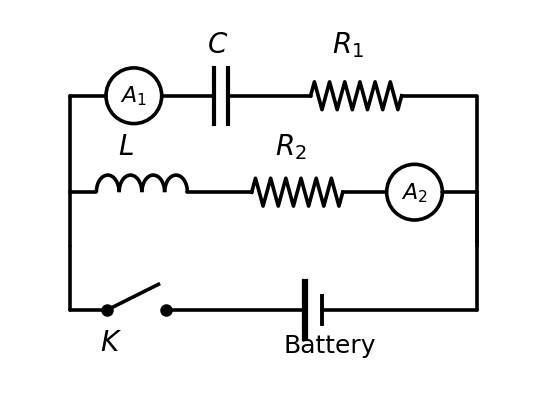
- zero in both A₁ and A₂
- maximum in both A₁ and A₂
- zero in A₁ and maximum in A₂
- maximum in A₁ and zero in A₂
Show answer
Answer: (D) maximum in A₁ and zero in A₂
Explanation: At the instant of closing, an uncharged capacitor behaves as a short circuit, so the current in the capacitor branch (A₁) is maximum. An inductor opposes any sudden change of current, so the current in the inductive branch (A₂) starts from zero. Hence the reading is maximum in A₁ and zero in A₂.
Question 2
A series R–C circuit and a series R–L circuit have the same resistance R, and each is driven at angular frequency ω by the same ac voltage. When the angular frequency is lowered to ω/2 at the same voltage, the current in the R–C circuit falls to 1/√2 of its earlier value, while the current in the R–L circuit rises to √2 times its earlier value. What is the ratio X_C : X_L of the two reactances at the original frequency ω?
- 2 : 1
- 1 : √2
- 1 : 4
- 1 : 2
Show answer
Answer: (D) 1 : 2
Explanation: At ω/2 the capacitive reactance doubles, and the current falling to 1/√2 of its value means the squared impedance doubles: R² + 4X_C² = 2(R² + X_C²), which gives X_C² = R²/2. The inductive reactance halves, and the current rising to √2 times its value means the squared impedance halves: R² + X_L²/4 = (R² + X_L²)/2, which gives X_L² = 2R². Then X_C²/X_L² = 1/4, so X_C : X_L = 1 : 2.
Question 3
A small bulb is connected in series with a coil of inductance 20 mH across an ac supply of rms voltage 120 V. The resistance of the bulb and the coil is negligible compared with the reactance of the coil. The supply frequency is raised from 60 Hz to 6 kHz at the same rms voltage. How do the rms current and the brightness of the bulb change?
- The current falls by 99% and the bulb becomes dimmer.
- The current does not change and the brightness stays the same.
- The current falls by 50% and the bulb becomes dimmer.
- The current rises by 99% and the bulb becomes brighter.
Show answer
Answer: (A) The current falls by 99% and the bulb becomes dimmer.
Explanation: With negligible resistance the current is I = V/(2πfL). At 60 Hz the reactance is 2π × 60 × 0.02 = 2.4π Ω, and at 6 kHz it is 240π Ω, so the reactance becomes 100 times larger. The current therefore falls to 1/100 of its value, a decrease of 99%. Since the reactance of a coil grows with frequency, the bulb becomes dimmer.
Question 4
A load receives a fixed power at a fixed voltage through a transmission line of constant resistance. The heat loss in the line is 900 W when the power factor of the load is 0.6. What will the line loss be if the power factor is raised to 0.9?
- 600 W
- 400 W
- 267 W
- 1350 W
Show answer
Answer: (B) 400 W
Explanation: From P = VI cos φ, with P and V fixed, the current varies as 1/cos φ. The line loss I²R therefore varies as 1/cos²φ. The new loss is 900 × (0.6/0.9)² = 900 × 4/9 = 400 W. This is why a low power factor is undesirable for transporting electric power.
Question 5
An AC load draws a current that lags the applied voltage. Which arrangement raises its power factor towards unity, and for what reason?
- A capacitor in parallel, because its leading wattless current cancels the lagging wattless current of the load
- An inductor in series, because it increases the phase angle between voltage and current
- An inductor in parallel, because its lagging wattless current adds to the lagging current of the load
- A capacitor in parallel, because it brings the power component of the current to zero
Show answer
Answer: (A) A capacitor in parallel, because its leading wattless current cancels the lagging wattless current of the load
Explanation: The load current has a power component in phase with the voltage and a lagging wattless component perpendicular to it. A capacitor of suitable value in parallel draws an equal leading wattless current, so the two cancel. The supply then provides only the power component, the phase angle tends to zero, and the power P = IpV is unchanged.
Question 6
A series AC circuit connected to a 220 V (rms) supply draws a current of 10 A (rms) with a power factor of 0.6, the current lagging the voltage. What are the wattless component of the current and the average power consumed?
- 6 A and 1760 W
- 8 A and 1320 W
- 8 A and 1760 W
- 6 A and 1320 W
Show answer
Answer: (B) 8 A and 1320 W
Explanation: The current can be resolved into a power component I cos φ in phase with the voltage and a wattless component I sin φ perpendicular to it. With cos φ = 0.6, sin φ = 0.8, so the wattless component is 10 × 0.8 = 8 A. Average power is VI cos φ = 220 × 10 × 0.6 = 1320 W, and only the power component contributes to it.
Question 7
An inductive load on an AC supply draws an rms line current of 10 A at a lagging power factor of 0.6. A capacitor is now connected in parallel with the load so that the power factor of the combination becomes 1, the supply voltage and the power used by the load remaining unchanged. What rms current does the capacitor draw, and what fraction of the original I²R loss in the supply line remains?
- 8 A; 0.36
- 6 A; 0.60
- 6 A; 0.36
- 8 A; 0.60
Show answer
Answer: (A) 8 A; 0.36
Explanation: Resolve the line current along and perpendicular to the voltage. The power component is 10 × 0.6 = 6 A and the wattless lagging component is √(10² − 6²) = 8 A. The capacitor must supply an equal leading wattless current of 8 A to cancel this, leaving a line current of only 6 A. The line loss varies as I², so the remaining fraction is (6/10)² = 0.36.
Doing well? Create a free account to take timed tests on this topic and see your weak areas.
Question 8
On a 120 V (rms) AC source, circuit element X alone draws 3 A (rms) lagging the voltage by π/2, while element Y alone, on the same source, draws 4 A (rms) in phase with the voltage. If X and Y are connected in series across this source, the average power consumed is
- 172.8 W
- 230.4 W
- 480 W
- 288 W
Show answer
Answer: (A) 172.8 W
Explanation: X is a pure inductor of reactance 120/3 = 40 Ω and Y is a resistor of 120/4 = 30 Ω. In series the impedance is √(40² + 30²) = 50 Ω, so the rms current is 2.4 A. Only the resistor consumes average power, which is (2.4)² × 30 = 172.8 W. This agrees with V I cos φ = 120 × 2.4 × 0.6.
Question 9
A device takes 1600 W from a 200 V (rms) ac supply, with its current lagging the voltage by an angle φ where tan φ = 3/4. A second device has twice the values of R, X_L and X_C of the first. What are R and X_L − X_C for the first device, and how does the second behave on the same supply?
- R = 12 Ω, X_L − X_C = 16 Ω; second takes 800 W at the same phase angle
- R = 16 Ω, X_L − X_C = 12 Ω; second takes 800 W at the same phase angle
- R = 16 Ω, X_L − X_C = 12 Ω; second takes 800 W at twice the phase angle
- R = 16 Ω, X_L − X_C = 12 Ω; second takes 3200 W at the same phase angle
Show answer
Answer: (B) R = 16 Ω, X_L − X_C = 12 Ω; second takes 800 W at the same phase angle
Explanation: Here cos φ = 0.8, so from P = VI cos φ the current is 1600/(200 × 0.8) = 10 A and Z = 20 Ω. Then R = Z cos φ = 16 Ω and X_L − X_C = R tan φ = 12 Ω. Doubling R, X_L and X_C doubles Z to 40 Ω and leaves tan φ unchanged, so the phase angle is the same. The current halves to 5 A, and P = 200 × 5 × 0.8 = 800 W.
Question 10
A 110 V, 55 W lamp, acting as a pure resistor, is to run at its rated values from a 220 V (rms), 50 Hz supply, using either an ideal series inductor or a series resistor. What reactance must the inductor have, and what power does the supply deliver in each arrangement?
- 440 Ω; 55 W with the inductor and 110 W with the resistor
- About 381 Ω; 110 W with the inductor and 55 W with the resistor
- 220 Ω; 110 W with the inductor and 110 W with the resistor
- About 381 Ω; 55 W with the inductor and 110 W with the resistor
Show answer
Answer: (D) About 381 Ω; 55 W with the inductor and 110 W with the resistor
Explanation: The lamp has R = 110²/55 = 220 Ω and needs a current of 0.5 A, so the total impedance must be 220/0.5 = 440 Ω. Then X = √(440² − 220²) ≈ 381 Ω. An ideal inductor takes no average power, so the supply gives only the lamp's 55 W. A 220 Ω series resistor would waste another 55 W, making 110 W in all. This is why a choke is preferred to a resistor for limiting ac.
Question 11
An ideal inductor carries an rms current of 2 A from a 200 V (rms), 50 Hz supply. Which set correctly gives the frequency at which the instantaneous power p = vi varies, the average power, and the largest magnitude of p?
- 100 Hz; average zero; largest magnitude 400 W
- 50 Hz; average 400 W; largest value 800 W
- 100 Hz; average 200 W; largest value 400 W
- 100 Hz; average zero; largest magnitude 800 W
Show answer
Answer: (A) 100 Hz; average zero; largest magnitude 400 W
Explanation: With v = V₀ sin ωt, the current lags by π/2, so i = −I₀ cos ωt and p = −(V₀I₀/2) sin 2ωt. Thus p varies at twice the supply frequency, 100 Hz, and averages to zero over a cycle. Its largest magnitude is V₀I₀/2 = V_rms I_rms = 200 × 2 = 400 W. Energy is stored in the inductor for one quarter cycle and returned to the source in the next.
Question 12
A lamp is connected in series with an air-filled parallel plate capacitor across an AC source of fixed rms voltage and frequency. Which single change will make the lamp glow more dimly?
- Sliding a dielectric slab between the plates
- Moving the plates closer together
- Raising the frequency of the source
- Reducing the overlapping area of the plates
Show answer
Answer: (D) Reducing the overlapping area of the plates
Explanation: The current in the circuit is limited by the capacitive reactance X_C = 1/(ωC). Reducing the overlapping area lowers C, so X_C rises, the current falls and the lamp dims. A dielectric slab or a smaller plate separation raises C, and a higher frequency raises ω, and each of these lowers X_C and brightens the lamp.
Question 13
A capacitor draws an rms current of 0.50 A from a 220 V, 50 Hz supply. A second capacitor of twice the capacitance is connected to a 110 V, 200 Hz supply. What rms current does it draw?
- 0.50 A
- 4.0 A
- 2.0 A
- 1.0 A
Show answer
Answer: (C) 2.0 A
Explanation: For a pure capacitor, I = V/X_C = 2πfCV, so the current is proportional to f × C × V. The frequency rises 4 times, the capacitance 2 times and the voltage falls to one-half. The current therefore becomes 4 × 2 × ½ = 4 times its earlier value, which is 2.0 A.
Question 14
A heater of purely resistive element 110 Ω is connected to a 220 V (rms) ac supply. The peak current through it and the maximum instantaneous power drawn by it are respectively nearly
- 2.83 A and 440 W
- 2.0 A and 440 W
- 2.83 A and 880 W
- 2.0 A and 880 W
Show answer
Answer: (C) 2.83 A and 880 W
Explanation: The rms current is 220/110 = 2 A, so the peak current is 2√2 ≈ 2.83 A. Instantaneous power in a resistor is i²R, which is greatest at peak current: 8 × 110 = 880 W. This is twice the average power of 440 W.
Question 15
A series R–C circuit carries an rms current I when driven at angular frequency ω. When the frequency is raised to 2ω at the same voltage, the rms current becomes √2 I. What is the power factor of the circuit at the original frequency ω?
- 1/√2
- √(2/3)
- 1/√3
- 1/2
Show answer
Answer: (C) 1/√3
Explanation: Doubling the frequency halves X_C, so the current condition gives R² + X_C² = 2(R² + X_C²/4). This simplifies to X_C²/2 = R², so X_C² = 2R². The impedance at ω is then √(R² + 2R²) = √3 R, and the power factor R/Z equals 1/√3.
Want more Alternating Current (AC) – AC Circuits questions?
E-GYAN NIDHI has 57 questions on this topic and 63,000+ in total, all free: timed CBT tests, NEET marking and instant analysis.
Register free Free Sunday Mock Test