Alternating Current (AC) – Resonance: NEET MCQs with Answers
8 free questions on Alternating Current (AC) – Resonance for NEET (UG), starting with previous-year NEET and AIPMT questions. Try each one, then tap Show answer for the answer and a short explanation.
Syllabus covered: Resonance: resonance
Question 1
Previous-year questionIn the given circuit, the readings of voltmeters V₁ and V₂ are 200 V each. The readings of the voltmeter V₃ and the ammeter A are respectively [AIPMT 2010]
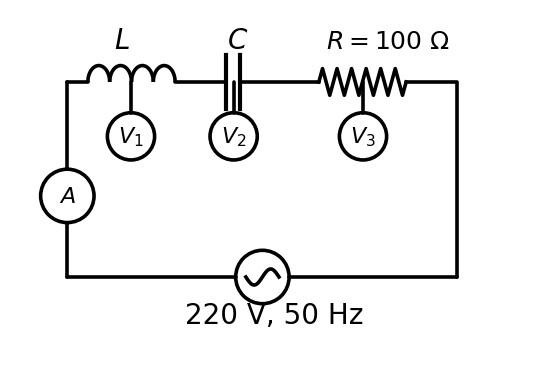
- 150 V, 2.2 A
- 220 V, 2.2 A
- 220 V, 2.0 A
- 100 V, 2.0 A
Show answer
Answer: (B) 220 V, 2.2 A
Explanation: Since V₁ = V₂, the voltages across L and C are equal and opposite, so they cancel — the circuit is at resonance. The whole source voltage then appears across R, giving V₃ = 220 V. The current is I = V/R = 220/100 = 2.2 A.
Question 2
A series LCR circuit on an AC source has X_L = 50 Ω and X_C = 80 Ω. Which single change brings the circuit closer to resonance?
- Connecting another capacitor in series with C
- Decreasing the frequency of the source
- Decreasing the inductance
- Increasing the frequency of the source
Show answer
Answer: (D) Increasing the frequency of the source
Explanation: Resonance needs X_L = X_C, and here X_C is the larger. A higher frequency raises X_L = ωL and lowers X_C = 1/(ωC), so the two approach each other. Less inductance lowers X_L, a capacitor in series lowers the net capacitance and raises X_C, and a lower frequency does both of the wrong things, so each of these moves the circuit further from resonance.
Question 3
The tuning circuit of a receiver has a fixed inductor and a variable capacitor. It is in resonance with a 500 kHz station when the capacitor is set at 360 pF. To what value must the capacitor be set to receive a 1500 kHz station?
- 40 pF
- 120 pF
- 1080 pF
- 3240 pF
Show answer
Answer: (A) 40 pF
Explanation: At resonance f = 1/(2π√(LC)), so with L fixed, C varies as 1/f². The frequency is raised three times, so the capacitance must become one-ninth. This gives 360/9 = 40 pF.
Question 4
Two radio receivers use series LCR tuning circuits with the same L and the same C, but with resistances R_A = 10 Ω and R_B = 40 Ω. Each is driven by the same signal voltage at resonance, and a second station broadcasts at a slightly different frequency. Which statement is correct?
- A carries four times the current of B at resonance, but A has the broader resonance curve.
- B carries four times the current of A at resonance, and B separates the two stations better.
- A and B carry equal currents at resonance, because they have the same resonant frequency.
- A carries four times the current of B at resonance, and A separates the two stations better.
Show answer
Answer: (D) A carries four times the current of B at resonance, and A separates the two stations better.
Explanation: Both circuits resonate at the same frequency because L and C are equal. At resonance the current equals V/R, so A carries four times the current of B. The quality factor is proportional to 1/R, so A has the sharper resonance curve and picks up much less of the neighbouring frequency.
Question 5
In a series LCR circuit the inductance is made four times and the resistance is halved, while the capacitance and the supply voltage are unchanged. How do the resonant frequency, the current at resonance and the quality factor change?
- Resonant frequency halves, current at resonance doubles, quality factor becomes eight times
- Resonant frequency halves, current at resonance doubles, quality factor becomes four times
- Resonant frequency halves, current at resonance halves, quality factor is unchanged
- Resonant frequency doubles, current at resonance doubles, quality factor becomes four times
Show answer
Answer: (B) Resonant frequency halves, current at resonance doubles, quality factor becomes four times
Explanation: The resonant frequency is 1/(2π√(LC)), so making L four times halves it. At resonance the current is V/R, so halving R doubles it. The quality factor is (1/R)√(L/C), which changes by 2 × 2 = 4 times; the new, lower resonant frequency must be used if Q is found from ω₀L/R.
Question 6
A series LCR circuit has R = 40 Ω, X_L = 80 Ω and X_C = 80 Ω, and is connected to a 100 V (rms) ac source. What are the rms voltage across the inductor alone and the rms voltage across the inductor and capacitor taken together?
- 100 V and 0 V
- 200 V and 0 V
- 200 V and 400 V
- 100 V and 200 V
Show answer
Answer: (B) 200 V and 0 V
Explanation: Since X_L = X_C the circuit is at resonance, so Z = R = 40 Ω and I = 100/40 = 2.5 A. The voltage across the inductor alone is IX_L = 2.5 × 80 = 200 V, which is twice the source voltage. The inductor and capacitor voltages are equal and 180° out of phase, so across the pair they cancel to 0 V.
Question 7
A series circuit has L = 0.2 H, C = 2 μF and R = 300 Ω, and is driven at ω = 1000 rad/s. Which extra capacitor, connected to the existing capacitor, brings the power factor to unity?
- 3 μF in series
- 3 μF in parallel
- 10/3 μF in series
- 5 μF in parallel
Show answer
Answer: (B) 3 μF in parallel
Explanation: Here X_L = ωL = 200 Ω and X_C = 1/(ωC) = 500 Ω, so the circuit is capacitive. Unity power factor needs X_C = 200 Ω, which requires a total capacitance of 1/(1000 × 200) = 5 μF. The capacitance must rise from 2 μF to 5 μF, and only a parallel connection increases it, so 3 μF is added in parallel.
Doing well? Create a free account to take timed tests on this topic and see your weak areas.
Question 8
A series circuit has R = 100 Ω, L = 0.1 H and C = 5 μF across an AC source of angular frequency 1000 rad/s. Without any other change, what capacitance must be added in parallel with C to make the power factor of the circuit unity?
- 5 μF
- 2.5 μF
- 10 μF
- 15 μF
Show answer
Answer: (A) 5 μF
Explanation: Unity power factor requires X_L = X_C, which is the resonance condition. Here X_L = ωL = 100 Ω, so the total capacitance needed is 1/(ω X_L) = 1/(1000 × 100) F = 10 μF. Capacitances in parallel add, so 10 μF − 5 μF = 5 μF must be added.
Want more Alternating Current (AC) – Resonance questions?
E-GYAN NIDHI has 14 questions on this topic and 63,000+ in total, all free: timed CBT tests, NEET marking and instant analysis.
Register free Free Sunday Mock Test