Work – Work done by a constant force and a variable force: NEET MCQs with Answers
15 free questions on Work – Work done by a constant force and a variable force for NEET (UG), starting with previous-year NEET and AIPMT questions. Try each one, then tap Show answer for the answer and a short explanation.
Syllabus covered: Work done by a constant force and a variable force
Question 1
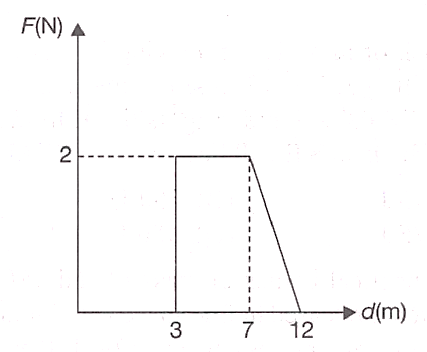
Previous-year questionForce F on a particle moving in a straight line varies with distance d as shown in the figure. The work done on the particle during its displacement of 12 m is: [CBSE AIPMT 2011]
- 21 J
- 26 J
- 13 J
- 18 J
Show answer
Answer: (C) 13 J
Explanation: Work done equals the area under the F–d graph. The force is zero from 0 to 3 m. From 3 m to 7 m it is constant at 2 N: area = 2 × 4 = 8 J. From 7 m to 12 m it falls linearly to zero: area = ½ × 5 × 2 = 5 J. Total work = 8 + 5 = 13 J.
Question 2
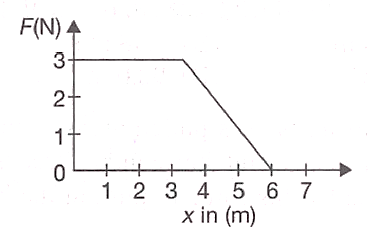
Previous-year questionA force F acting on an object varies with distance x as shown in the graph (F in N, x in m). The work done by the force in moving the object from x = 0 to x = 6 m is: [AIPMT 2005]
- 18.0 J
- 13.5 J
- 4.5 J
- 9.0 J
Show answer
Answer: (B) 13.5 J
Explanation: Work done equals the area under the F–x graph. Up to x = 3 m the force is constant at 3 N: area = 3 × 3 = 9 J. From x = 3 m to x = 6 m the force falls linearly to zero: area = ½ × 3 × 3 = 4.5 J. Total work = 9 + 4.5 = 13.5 J.
Question 3
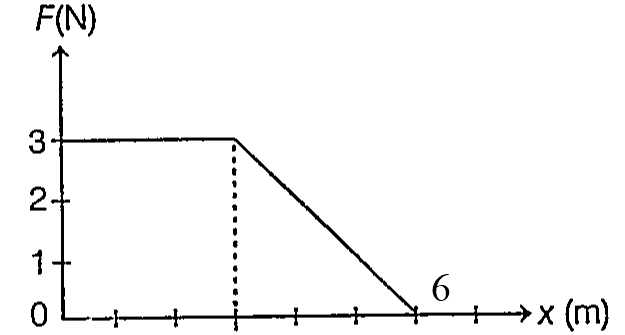
Previous-year questionThe graph shows the variation of a force F (in newton) acting on an object with the distance x (in metre). Determine the work done by this force in moving the object from x = 0 to x = 6 m. [AIPMT 2005]
- 4.5 J
- 13.5 J
- 9.0 J
- 18.0 J
Show answer
Answer: (B) 13.5 J
Explanation: Work = area under the F–x curve. Rectangle (x = 0 to 3 m, F = 3 N): W₁ = 3 × 3 = 9 J. Triangle (x = 3 m to 6 m, F falling from 3 N to 0): W₂ = ½ × 3 × 3 = 4.5 J. Total, W = 9 + 4.5 = 13.5 J.
Question 4
Previous-year questionA force F = 20 + 10y acts on a particle in the y-direction, where F is in newton and y in metre. The work done by this force in moving the particle from y = 0 to y = 1 m is [NEET 2019]
- 30 J
- 5 J
- 25 J
- 20 J
Show answer
Answer: (C) 25 J
Explanation: W = ∫₀¹ (20 + 10y) dy = 20 + 5 = 25 J.
Question 5
Previous-year questionA body that is constrained to move only along the y-direction experiences a force F = (−2î + 15ĵ + 6k̂) N. The work done by this force when the body is displaced through 10ĵ m along the Y-axis is [AIPMT 1994]
- 150 J
- 20 J
- 190 J
- 160 J
Show answer
Answer: (A) 150 J
Explanation: Only the force component along the displacement does work. W = F · s = (−2î + 15ĵ + 6k̂) · (10ĵ) = (−2)(0) + (15)(10) + (6)(0) = 150 J. The î and k̂ components are perpendicular to the motion and contribute zero work.
Question 6
Previous-year questionUnder the action of a 5 N force, a body traverses 10 m along a straight line. If the work done is 25 J, the angle between the force and the direction of motion is [AIPMT 1997]
- 60°
- 75°
- 30°
- 45°
Show answer
Answer: (A) 60°
Explanation: W = Fs cos θ 25 = 5 × 10 × cos θ cos θ = 25/50 = 0.5 θ = cos⁻¹(0.5) = 60°.
Question 7
Previous-year questionA force acts on a particle of mass 3 g such that its position varies with time as x = 3t − 4t² + t³, where x is in metre and t in second. The work done by the force during the first 4 s is [AIPMT 1998]
- 490 mJ
- 450 mJ
- 240 mJ
- 530 mJ
Show answer
Answer: (D) 530 mJ
Explanation: Velocity, v = dx/dt = 3 − 8t + 3t². At t = 0 : u = 3 m/s. At t = 4 s : v = 3 − 32 + 48 = 19 m/s. By the work–energy theorem, W = ½m(v² − u²) = ½ × 3 × 10⁻³ × (361 − 9) = ½ × 3 × 10⁻³ × 352 = 0.528 J ≈ 530 mJ.
Doing well? Create a free account to take timed tests on this topic and see your weak areas.
Question 8
Previous-year questionA constant force acting on a body of mass 3 kg produces a displacement s (in metre) governed by s = t²/3, where t is in second. Determine the work done by this force during the first 2 s. [AIPMT 2006]
- 5/19 J
- 3/8 J
- 8/3 J
- 19/5 J
Show answer
Answer: (C) 8/3 J
Explanation: Acceleration, a = d²s/dt² = d/dt (2t/3) = 2/3 m/s². Force, F = ma = 3 × 2/3 = 2 N. Displacement in 2 s, s = (2)²/3 = 4/3 m. W = F × s = 2 × 4/3 = 8/3 J.
Question 9
Previous-year questionA uniform force of (3î + ĵ) N acts on a particle of mass 2 kg, as a result of which the particle shifts from the position (2î + k̂) m to the position (4î + 3ĵ − k̂) m. The work done by the force on the particle is [NEET 2013]
- 9 J
- 6 J
- 13 J
- 15 J
Show answer
Answer: (A) 9 J
Explanation: Displacement, s = (4î + 3ĵ − k̂) − (2î + 0ĵ + k̂) = 2î + 3ĵ − 2k̂. W = F · s = (3)(2) + (1)(3) + (0)(−2) = 6 + 3 = 9 J. The mass of 2 kg is redundant data — work depends only on the force and the displacement, not on the mass.
Question 10
Previous-year questionA constant force (4î + 3ĵ) N is applied to a particle which travels from the point (−2î + 5ĵ) to the point (4ĵ + 3k̂). Find the work done by this force. [NEET 2016]
- 8 J
- 11 J
- 5 J
- 2 J
Show answer
Answer: (C) 5 J
Explanation: Displacement, Δs = r₂ − r₁ = (0î + 4ĵ + 3k̂) − (−2î + 5ĵ + 0k̂) = 2î − ĵ + 3k̂. W = F · Δs = (4)(2) + (3)(−1) + (0)(3) = 8 − 3 = 5 J. The k̂-component of displacement contributes nothing because the force has no k̂-component.
Question 11
Previous-year questionConsider a raindrop of mass 1 g falling from rest from a height of 1 km. It hits the ground with a speed of 50 m/s. Taking g = 10 m/s², the work done by the (i) gravitational force and the (ii) resistive force of air is: [NEET 2016]
- (i) 1.25 J, (ii) −8.25 J
- (i) 100 J, (ii) 8.75 J
- (i) 10 J, (ii) −8.75 J
- (i) −10 J, (ii) −8.25 J
Show answer
Answer: (C) (i) 10 J, (ii) −8.75 J
Explanation: (i) W_gravity = mgh = 0.001×10×1000 = 10 J. (ii) KE at ground = ½(0.001)(50²) = 1.25 J, so 10 + W_air = 1.25 ⇒ W_air = −8.75 J.
Question 12
Previous-year questionTwo spherical bodies of mass M and 5M and radii R and 2R are released in free space with initial separation between their centres equal to 12R. If they attract each other due to gravitational force only, then the distance covered by the smaller body before collision is: [AIPMT 2015]
- 7.5R
- 1.5R
- 2.5R
- 4.5R
Show answer
Answer: (A) 7.5R
Explanation: They collide when centre-separation = 3R, so the centres approach by 9R. Since M·d₁ = 5M·d₂ and d₁ + d₂ = 9R, the smaller body moves d₁ = 7.5R.
Question 13
Previous-year questionA block of mass 10 kg, moving in the x-direction with a constant speed of 10 m/s, is subjected to a retarding force F = 0.1x J/m during its travel from x = 20 m to x = 30 m. Its final kinetic energy is: [AIPMT 2014]
- 275 J
- 250 J
- 475 J
- 450 J
Show answer
Answer: (C) 475 J
Explanation: Initial KE = 500 J. Work = −∫₂₀³⁰ 0.1x dx = −0.1(450 − 200) = −25 J. Final KE = 500 − 25 = 475 J.
Question 14
Previous-year questionA person of mass 60 kg is inside a lift of mass 940 kg and presses the button on the control panel. The lift starts moving upwards with an acceleration 1.0 m/s². If g = 10 m/s², the tension in the supporting cable is: [CBSE AIPMT 2011]
- 9680 N
- 11000 N
- 1200 N
- 8600 N
Show answer
Answer: (B) 11000 N
Explanation: Total mass = 1000 kg. T − Mg = Ma ⇒ T = M(g + a) = 1000(10 + 1) = 11000 N.
Question 15
Previous-year questionA plate of mass m, length b and breadth a, is initially lying on a horizontal floor with its length parallel to the floor and its breadth perpendicular to the floor. The work done to erect it on its breadth is: [CBSE AIPMT 2010]
- mg·a/2
- mg(a + b)/2
- mg(b − a)/2
- mg(b + a)/2
Show answer
Answer: (C) mg(b − a)/2
Explanation: The centre of mass rises from a/2 to b/2, so W = mg(b − a)/2.
Want more Work – Work done by a constant force and a variable force questions?
E-GYAN NIDHI has 149 questions on this topic and 63,000+ in total, all free: timed CBT tests, NEET marking and instant analysis.
Register free Free Sunday Mock Test