Motion in Vertical Circle: NEET MCQs with Answers
15 free questions on Motion in Vertical Circle for NEET (UG), starting with previous-year NEET and AIPMT questions. Try each one, then tap Show answer for the answer and a short explanation.
Question 1
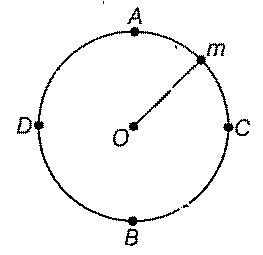
Previous-year questionA stone attached to one end of a string is rotated in a vertical circle. If the string breaks at the position of maximum tension, it will break at [AIPMT 2000]
- A
- B
- C
- D
Show answer
Answer: (B) B
Explanation: Take a point on the circle at angle θ from the lowest position. Along the string, T − mg cos θ = mv²/l, so T = mg cos θ + mv²/l. Both terms are largest at the lowest point: cos θ = +1 there, and the speed is greatest there because the stone has lost the most potential energy. In the figure A is the top, B the bottom, and C and D are at the level of the centre O. The tension is therefore maximum at B, so the string breaks at B.
Question 2
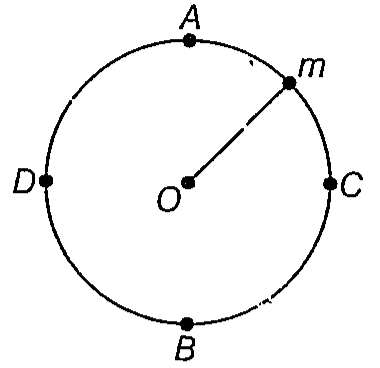
Previous-year questionAs shown in the figure, a mass is performing vertical circular motion. If the average velocity of the particle is increased, at which point will the string break? [AIPMT 2000]
- A
- B
- C
- D
Show answer
Answer: (B) B
Explanation: At the lowest point B the equation of motion is T_B = mv²/R + mg, whereas at the side points C and D, T = mv²/R, and at the top A, T_A = mv²/R − mg. Thus T_B is the largest tension. Increasing the speed raises every tension, but B remains the maximum, so the string breaks at B.
Question 3
Previous-year questionA stone tied to a string of length l is whirled in a vertical circle about the other end of the string. At the instant when the stone is at its lowest position it has speed u. The magnitude of the change in its velocity as it reaches the position where the string is horizontal is (g being the acceleration due to gravity) [AIPMT 2004]
- √(2(u² − gl))
- √(u² − gl)
- u − √(u² − 2gl)
- √(2gl)
Show answer
Answer: (A) √(2(u² − gl))
Explanation: Energy conservation between the lowest point and the horizontal position (a rise of l): ½mu² = ½mu′² + mgl ⟹ u′² = u² − 2gl. The velocity at the lowest point is horizontal while that at the horizontal position is vertical, so the two are mutually perpendicular. |Δv| = √(u² + u′²) = √(u² + u² − 2gl) = √(2(u² − gl)).
Question 4
Previous-year questionA mass m attached to a thin wire is whirled in a vertical circle. The wire is most likely to break when [NEET (National) 2019]
- the wire is horizontal
- the mass is at the lowest point
- it is inclined at an angle of 60° from the vertical
- the mass is at the highest point
Show answer
Answer: (B) the mass is at the lowest point
Explanation: At an angular position θ measured from the lowest point, T = mg cos θ + mv²/l. Both terms are largest at the lowest point: cos θ = 1 there, and by conservation of energy the speed v is also maximum there. Hence the tension peaks at the lowest point and the wire is most likely to snap there.
Question 5
Previous-year questionA point mass m is made to move in a vertical circle of radius r with the help of a string. If the velocity of the mass at the lowest point is √(7gr), the tension in the string at that lowest point is [NEET (Oct.) 2020]
- 6mg
- 7mg
- 8mg
- 1mg
Show answer
Answer: (C) 8mg
Explanation: At the lowest point the net upward force provides the centripetal force: T − mg = mv²/r T = mg + m(7gr)/r = mg + 7mg = 8mg. (Note that √(7gr) > √(5gr), so the mass does complete the full vertical circle.)
Question 6
A 20 g bullet moving horizontally with speed v strikes head-on a 2 kg bob at rest at the lower end of a light rigid rod of length 0.9 m, pivoted at its upper end. The bullet rebounds along its path with a speed of 50 m s⁻¹. The least value of v for which the bob completes a full vertical circle is (g = 10 m s⁻²)
- 450 m s⁻¹
- 650 m s⁻¹
- 550 m s⁻¹
- 600 m s⁻¹
Show answer
Answer: (C) 550 m s⁻¹
Explanation: A rigid rod can push as well as pull, so the bob need only reach the top with zero speed: V² = 4gl = 36, which gives V = 6 m s⁻¹. Momentum conservation with the rebound taken as negative gives 0.02v = 0.02(–50) + 2(6) = 11. Hence v = 550 m s⁻¹.
Question 7
A thin smooth tube is bent into a quarter of a circle and fixed in a vertical plane, with its upper end A directly above the centre of the circle and its lower end C level with the centre. A ball slightly narrower than the tube is placed at A and given a tiny push, so that it slides down through the tube to C. During this motion the ball
- stays in contact with the outer wall (farther from the centre) all the way
- stays in contact with the inner wall (nearer the centre) all the way
- touches the inner wall at first and the outer wall later
- touches the outer wall at first and the inner wall later
Show answer
Answer: (C) touches the inner wall at first and the outer wall later
Explanation: At angle θ from the vertical the required centripetal force is mv²/R = 2mg(1 – cos θ), while gravity supplies mg cos θ towards the centre. Near A the speed is small, gravity supplies more than is needed, and the inner wall must push outward on the ball. Beyond cos θ = 2/3 more force is needed than gravity gives, so the outer wall must push inward.
Doing well? Create a free account to take timed tests on this topic and see your weak areas.
Question 8
A particle on a light string moves in a vertical circle of radius R with just enough speed to complete the circle, the string only just going slack at the highest point. P is a point on the circle where the radius makes an angle of 120° with the upward vertical through the centre. The speed of the particle at P is
- √(2gR)
- 2√(gR)
- √(5gR)
- √(3gR)
Show answer
Answer: (B) 2√(gR)
Explanation: At the highest point the critical condition gives v² = gR. The point P lies R + R cos 60° = 3R/2 below the top. Energy conservation gives v_P² = gR + 2g(3R/2) = 4gR, so v_P = 2√(gR).
Question 9
A ball of mass 0.5 kg hangs from a light string. It is pulled aside until the string makes an angle θ with the vertical, where cos θ = 0.6, and is released from rest. The greatest tension in the string during the swing is (g = 10 m s⁻²)
- 3 N
- 10 N
- 9 N
- 5 N
Show answer
Answer: (C) 9 N
Explanation: The tension is greatest at the lowest point, where the speed is greatest. The ball falls l(1 – cos θ) = 0.4l, so v² = 0.8gl. Then T = mg + mv²/l = 1.8mg = 9 N.
Question 10
A ball of mass 0.5 kg tied to a light string of length 1 m moves in a vertical circle, with a speed of 8 m s⁻¹ at the lowest point. The tensions in the string when the ball is at the lowest point, at the level of the centre and at the highest point are respectively (g = 10 m s⁻²)
- 32 N, 32 N and 32 N
- 27 N, 42 N and 57 N
- 37 N, 32 N and 7 N
- 37 N, 22 N and 7 N
Show answer
Answer: (D) 37 N, 22 N and 7 N
Explanation: At the lowest point T = mg + mv²/l = 5 + 32 = 37 N. At the level of the centre v² = 64 – 2gl = 44, and the weight has no component along the string, so T = 0.5(44) = 22 N. At the top v² = 64 – 4gl = 24, and the weight helps, so T = 12 – 5 = 7 N.
Question 11
A small ball is placed at the top of a fixed smooth sphere and given a very slight push, so that it slides down the surface. The angle between the vertical and the line from the centre of the sphere to the ball, at the instant the ball loses contact, is
- sin⁻¹(1/3)
- cos⁻¹(1/3)
- 60°
- cos⁻¹(2/3)
Show answer
Answer: (D) cos⁻¹(2/3)
Explanation: After turning through θ the ball has fallen R(1 – cos θ), so v² = 2gR(1 – cos θ). Contact is lost when the normal reaction becomes zero, which means mg cos θ = mv²/R. Substituting gives cos θ = 2(1 – cos θ), so cos θ = 2/3.
Question 12
A bob hangs from a fixed point by a light string of length 0.9 m, and the string snaps when its tension reaches 1.5 times the weight of the bob. The bob is released from rest with the string taut and horizontal. The speed of the bob at the instant the string snaps is (g = 10 m s⁻²)
- 3 m s⁻¹
- 1.5 m s⁻¹
- 6 m s⁻¹
- 4.2 m s⁻¹
Show answer
Answer: (A) 3 m s⁻¹
Explanation: When the string makes an angle θ with the vertical, the bob has fallen l cos θ, so v² = 2gl cos θ. The radial equation T − mg cos θ = mv²/l then gives T = 3mg cos θ. Setting T = 1.5mg gives cos θ = 0.5, so v² = 2 × 10 × 0.9 × 0.5 = 9 and v = 3 m s⁻¹.
Question 13
A thin smooth tube is bent into a quarter of a vertical circle with centre O. Its upper end A is vertically above O and its lower end C is at the level of O. A small ball that just fits inside the tube is placed at A, given a tiny push and slides down to C. Which statement about the wall of the tube that the ball presses on is correct?
- It presses on the wall farther from O all the way from A to C
- It presses first on the wall farther from O and then on the wall nearer to O, the change occurring where the radius to the ball makes an angle cos⁻¹(1/3) with the vertical
- It presses first on the wall nearer to O and then on the wall farther from O, the change occurring where the radius to the ball makes an angle cos⁻¹(2/3) with the vertical
- It presses on the wall nearer to O all the way from A to C
Show answer
Answer: (C) It presses first on the wall nearer to O and then on the wall farther from O, the change occurring where the radius to the ball makes an angle cos⁻¹(2/3) with the vertical
Explanation: At angle θ from the vertical, energy conservation gives v² = 2gR(1 − cos θ). If N is the outward push of the tube on the ball, mg cos θ − N = mv²/R, so N = mg(3 cos θ − 2). N is positive for cos θ > 2/3, when the ball rests on the nearer wall, and negative beyond that, when the farther wall must supply the extra inward force. Unlike a ball on a sphere, the ball cannot lose contact, because the tube can push from either side.
Question 14
A bob of mass 0.5 kg tied to a light string of length 0.5 m moves in a vertical circle. Its speed at the lowest point is 6 m/s. The magnitude of the change in its momentum between the lowest point and the highest point is (g = 10 m/s²)
- 5 kg m/s
- 10 kg m/s
- 3.6 kg m/s
- 1 kg m/s
Show answer
Answer: (A) 5 kg m/s
Explanation: Energy conservation gives v² = u² − 4gL = 36 − 20 = 16, so the speed at the top is 4 m/s, and the string stays taut there because v² exceeds gL. The velocities at the bottom and top are opposite in direction, so the change in velocity has magnitude 6 + 4 = 10 m/s. The change in momentum is 0.5 × 10 = 5 kg m/s.
Question 15
A 200 g particle tied to a light string 0.4 m long moves in a vertical circle, with just enough speed to complete the circle. The tension in the string at the instant the string is horizontal is (g = 10 m/s²):
- 12 N
- 4 N
- 6 N
- 2 N
Show answer
Answer: (C) 6 N
Explanation: Just completing the circle means the tension is zero at the top, so v_top² = gl. Falling through a height l to the horizontal position raises this to v² = gl + 2gl = 3gl. With the string horizontal, gravity is tangential and the tension alone supplies the centripetal force, so T = mv²/l = 3mg. This gives T = 3 × 0.2 × 10 = 6 N, independent of the string's length.
Want more Motion in Vertical Circle questions?
E-GYAN NIDHI has 53 questions on this topic and 63,000+ in total, all free: timed CBT tests, NEET marking and instant analysis.
Register free Free Sunday Mock Test