Work Energy Theorem and Conservation of Energy – The potential energy of spring conservation of mechanical: NEET MCQs with Answers
15 free questions on Work Energy Theorem and Conservation of Energy – The potential energy of spring conservation of mechanical for NEET (UG), starting with previous-year NEET and AIPMT questions. Try each one, then tap Show answer for the answer and a short explanation.
Syllabus covered: The potential energy of spring conservation of mechanical energy, conservative and non- conservative forces
Question 1
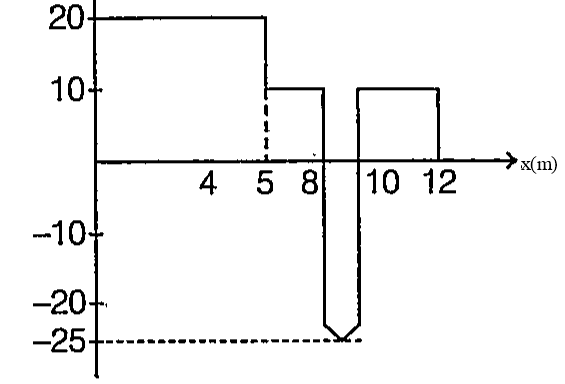
Previous-year questionAn object of mass 500 g, initially at rest, is acted upon by a variable force whose x-component varies with x as shown in the graph. The velocities of the object at x = 8 m and x = 12 m would respectively be (nearly) [NEET (Odisha) 2019]
- 18 m/s and 24.4 m/s
- 23 m/s and 24.4 m/s
- 23 m/s and 20.6 m/s
- 18 m/s and 20.6 m/s
Show answer
Answer: (C) 23 m/s and 20.6 m/s
Explanation: Work is the algebraic area under the F–x curve, and by the work–energy theorem W = ΔKE = ½mv². Up to x = 8 m: W = (20 × 5) + (10 × 3) = 130 J. Then ½ × 0.5 × v² = 130, so v² = 520 and v = 22.8 ≈ 23 m/s. From x = 8 m to x = 10 m the force is negative. This area is a rectangle (20 × 2 = 40 J) plus a triangle on it (½ × 2 × 5 = 5 J), so it contributes −45 J. From x = 10 m to x = 12 m the area is 10 × 2 = +20 J. Up to x = 12 m: W = 130 − 45 + 20 = 105 J. Then ½ × 0.5 × v² = 105, so v² = 420 and v ≈ 20.5 m/s, which is nearest to 20.6 m/s.
Question 2
Previous-year questionA drop of rain water of mass 1 g falls from a height of 1 km and hits the ground with a speed of 50 m/s. Taking g = 10 m/s², the work done by (i) the gravitational force and (ii) the resistive force of air are [NEET 2017]
- (i) 1.25 J (ii) –8.25 J
- (i) 100 J (ii) 8.75 J
- (i) 10 J (ii) –8.75 J
- (i) –10 J (ii) –8.25 J
Show answer
Answer: (C) (i) 10 J (ii) –8.75 J
Explanation: W_gravity = mgh = 10⁻³ × 10 × 1000 = 10 J. The kinetic energy gained is ½ × 10⁻³ × 2500 = 1.25 J, so the air resistance does 1.25 – 10 = –8.75 J of work.
Question 3
Previous-year questionA particle of mass 10 g moves along a circle of radius 6.4 cm with a constant tangential acceleration. If the kinetic energy of the particle becomes 8 × 10⁻⁴ J by the end of the second revolution after the motion begins, the magnitude of that acceleration is [NEET 2016]
- 0.1 m/s²
- 0.15 m/s²
- 0.18 m/s²
- 0.2 m/s²
Show answer
Answer: (A) 0.1 m/s²
Explanation: From ½mv² = 8 × 10⁻⁴ J, v² = 0.16 m²/s². The distance covered in two revolutions is s = 2(2πr) = 0.804 m, and v² = 2a_t s gives a_t = 0.16/1.608 ≈ 0.1 m/s².
Question 4
Previous-year questionA block of mass 10 kg moving in the x-direction with a constant speed of 10 m/s is subjected to a retarding force F = 0.1x J/m during its travel from x = 20 m to x = 30 m. Its final kinetic energy will be [AIPMT 2015]
- 450 J
- 275 J
- 250 J
- 475 J
Show answer
Answer: (D) 475 J
Explanation: Work done against the retarding force = ∫₂₀³⁰ 0.1x dx = 0.05(900 – 400) = 25 J. Initial KE = ½ × 10 × 100 = 500 J, so the final kinetic energy is 500 – 25 = 475 J.
Question 5
Previous-year questionA ball thrown vertically downward from a height of 20 m with initial velocity v₀ loses 50% of its energy on colliding with the ground and rebounds to the same height. The value of v₀ is (g = 10 m/s²) [AIPMT 2015]
- 20 m/s
- 28 m/s
- 10 m/s
- 14 m/s
Show answer
Answer: (A) 20 m/s
Explanation: Energy at the ground = ½mv₀² + mg(20). Half of it takes the ball back to 20 m: ½[½v₀² + 200] = 200, giving v₀² = 400 and v₀ = 20 m/s.
Question 6
Previous-year questionA bullet of mass 10 g leaves a rifle with an initial velocity of 1000 m/s and strikes the earth at the same level with a velocity of 500 m/s. The work done in overcoming the resistance of air will be [AIPMT 1989]
- 375 J
- 3750 J
- 5000 J
- 500 J
Show answer
Answer: (B) 3750 J
Explanation: Since the bullet returns to the same level, gravity does zero net work; the entire loss of kinetic energy goes into overcoming air resistance. W = ½m(u² − v²) = ½ × 0.01 × [(1000)² − (500)²] = 0.005 × (10⁶ − 2.5 × 10⁵) = 0.005 × 7.5 × 10⁵ = 3750 J.
Question 7
Previous-year questionA rubber ball is dropped from a height of 5 m onto a planet whose gravitational acceleration is unknown. It bounces back to a height of 1.8 m. The factor by which the ball's velocity is reduced on bouncing is [AIPMT 1998]
- 16/25
- 2/5
- 3/5
- 9/25
Show answer
Answer: (B) 2/5
Explanation: For free fall and rebound, v = √(2gh), so v ∝ √h — the unknown value of g cancels out. v₂/v₁ = √(1.8/5) = √0.36 = 0.6 The question asks by what factor the velocity is lost, i.e. the fractional loss: Δv/v₁ = 1 − v₂/v₁ = 1 − 0.6 = 0.4 = 2/5.
Doing well? Create a free account to take timed tests on this topic and see your weak areas.
Question 8
Previous-year questionA child is swinging on a swing. The minimum and maximum heights of the swing above the earth's surface are 0.75 m and 2 m respectively. The maximum velocity of the swing is [AIPMT 2001]
- 5 m/s
- 10 m/s
- 15 m/s
- 20 m/s
Show answer
Answer: (A) 5 m/s
Explanation: Speed is maximum at the lowest point. By conservation of energy between the highest and lowest points: ½mv²ₘₐₓ = mg(H₂ − H₁) = mg(2 − 0.75) v²ₘₐₓ = 2 × 10 × 1.25 = 25 vₘₐₓ = 5 m/s.
Question 9
Previous-year questionA 2 kg block is slid up an inclined plane of height 10 m by performing 300 J of work. Taking g = 10 m/s², the work done against friction is [AIPMT 2006]
- 200 J
- 100 J
- zero
- 1000 J
Show answer
Answer: (B) 100 J
Explanation: Work done against gravity = mgh = 2 × 10 × 10 = 200 J. Total work supplied = work against gravity + work against friction 300 = 200 + W_friction ⟹ W_friction = 100 J.
Question 10
Previous-year questionA vertical spring of force constant k is fixed on a table. A ball of mass m held at a height h above the free upper end of the spring is dropped onto it, compressing the spring by a distance d. The net work done in the process is [AIPMT 2007]
- mg(h + d) − ½kd²
- mg(h − d) − ½kd²
- mg(h − d) + ½kd²
- mg(h + d) + ½kd²
Show answer
Answer: (A) mg(h + d) − ½kd²
Explanation: The ball descends a total distance (h + d), so gravity does positive work mg(h + d). The spring force opposes the compression and does negative work equal to the energy stored, −½kd². Net work = mg(h + d) − ½kd². (Since the ball starts and ends at rest, this net work is in fact zero, which is the equation used to find d.)
Question 11
Previous-year questionA shell of mass 200 g is fired from a gun of mass 4 kg by an explosion that liberates 1.05 kJ of energy. The initial velocity of the shell is [AIPMT 2008]
- 100 m/s
- 80 m/s
- 40 m/s
- 120 m/s
Show answer
Answer: (A) 100 m/s
Explanation: Momentum conservation gives 0.2v = 4v′, so v′ = 0.05v. Energy released: ½(0.2)v² + ½(4)(0.05v)² = 1050 J, i.e. 0.105v² = 1050, so v² = 10⁴ and v = 100 m/s.
Question 12
Previous-year questionA block of mass M is attached to the lower end of a vertical spring of force constant k that hangs from a ceiling. The block is released from rest with the spring initially unstretched. The maximum extension produced in the spring will be [AIPMT 2009]
- Mg/k
- 2Mg/k
- 4Mg/k
- Mg/2k
Show answer
Answer: (B) 2Mg/k
Explanation: At the point of maximum extension x the block is momentarily at rest, so the total change in kinetic energy is zero. Energy conservation: Mgx = ½kx² ⟹ x = 2Mg/k. Note that Mg/k is the static equilibrium extension; because the block is released suddenly it overshoots to exactly twice that value.
Question 13
Previous-year questionA body of mass 1 kg is thrown upwards with a velocity of 20 m/s. It momentarily comes to rest after rising to a height of 18 m. Taking g = 10 m/s², the energy lost to air friction is [AIPMT 2009]
- 20 J
- 30 J
- 40 J
- 10 J
Show answer
Answer: (A) 20 J
Explanation: Initial kinetic energy = ½ × 1 × (20)² = 200 J. Potential energy gained = mgh = 1 × 10 × 18 = 180 J. Energy dissipated against air friction = 200 − 180 = 20 J.
Question 14
Previous-year questionA pulley system requires a force of 250 N to raise a 75 kg mass. To lift the mass through 3 m, the rope must be pulled through 12 m. The efficiency of the system is [AIPMT 2011]
- 50%
- 75%
- 33%
- 90%
Show answer
Answer: (B) 75%
Explanation: Useful output work = mgh = 75 × 10 × 3 = 2250 J. Input work = F × s = 250 × 12 = 3000 J. Efficiency = (output/input) × 100 = (2250/3000) × 100 = 75%.
Question 15
Previous-year questionThe potential energy of a system increases when work is done [AIPMT 2011]
- by the system against a conservative force
- by the system against a non-conservative force
- upon the system by a conservative force
- upon the system by a non-conservative force
Show answer
Answer: (A) by the system against a conservative force
Explanation: For conservative forces, ΔU = −W_conservative. When the system does work against a conservative force (as in lifting a body against gravity), W_conservative is negative, so ΔU is positive and the potential energy rises. Non-conservative forces such as friction do not have an associated potential energy function, which rules out the other options.
Want more Work Energy Theorem and Conservation of Energy – The potential energy of spring conservation of mechanical questions?
E-GYAN NIDHI has 204 questions on this topic and 63,000+ in total, all free: timed CBT tests, NEET marking and instant analysis.
Register free Free Sunday Mock Test