Newton's Laws of Motion – Force and inertia: NEET MCQs with Answers
15 free questions on Newton's Laws of Motion – Force and inertia for NEET (UG), starting with previous-year NEET and AIPMT questions. Try each one, then tap Show answer for the answer and a short explanation.
Syllabus covered: Force and inertia, Newton’s First law of motion; Momentum, Newton’s Second Law of motion, Impulses; Newton’s Third Law of motion.
Question 1
Previous-year questionBlocks A (mass 3m) and B (mass m) are connected by an inextensible string; the system hangs from a spring. Just after the string is cut, the magnitudes of the accelerations of A and B are [NEET 2017]
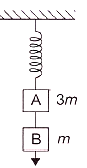
- g/3, g
- g, g/3
- g/3, g/3
- g, g
Show answer
Answer: (A) g/3, g
Explanation: The spring force stays 4mg; for A: 4mg − 3mg = 3m·a_A ⇒ a_A = g/3 (up); for B: mg = m·a_B ⇒ a_B = g (down).
Question 2
Previous-year questionA body, under the action of a force F = 6î − 8ĵ + 10k̂ (N), acquires an acceleration of 1 m/s². The mass of this body must be [AIPMT 2009]
- 10√2 kg
- 2√10 kg
- 10 kg
- 20 kg
Show answer
Answer: (A) 10√2 kg
Explanation: Magnitude of the force = √(6² + 8² + 10²) = √200 = 10√2 N. From F = ma, m = 10√2/1 = 10√2 kg.
Question 3
Previous-year questionA 600 kg rocket is set for a vertical firing. If the exhaust speed is 1000 m s⁻¹, the mass of the gas ejected per second to supply the thrust needed to overcome the weight of the rocket is [AIPMT 1990]
- 117.6 kg s⁻¹
- 58.6 kg s⁻¹
- 6 kg s⁻¹
- 76.4 kg s⁻¹
Show answer
Answer: (C) 6 kg s⁻¹
Explanation: Here the thrust is required only to balance the weight — the rocket is just supported, not accelerated: F = mg = 600 × 10 = 6000 N Using F = v_r(−dm/dt): −dm/dt = mg/v_r = 6000/1000 = 6 kg s⁻¹. (Taking g = 9.8 m s⁻² instead would give 5.88 kg s⁻¹, still closest to 6 kg s⁻¹.)
Question 4
Previous-year questionPhysical independence of force is a consequence of [AIPMT 1991]
- the third law of motion
- the second law of motion
- the first law of motion
- all of these
Show answer
Answer: (C) the first law of motion
Explanation: Newton's first law states that a body continues in its state of rest or of uniform motion in a straight line unless it is acted upon by an external force. It therefore establishes force as the independent physical agency that changes a body's state of motion — this is what is meant by the 'physical independence' of force. The second law provides the quantitative measure of force (F = ma) and the third law describes forces as mutual interactions, but it is the first law that establishes the very concept of force independently.
Question 5
Previous-year questionA satellite in force-free space sweeps up stationary interplanetary dust at a rate (dM/dt) = αv, where M is the mass and v the velocity of the satellite and α is a constant. The acceleration of the satellite is [AIPMT 1994]
- −2αv²/M
- −αv²/M
- −αv²/(2M)
- −αv²
Show answer
Answer: (B) −αv²/M
Explanation: In force-free space no external force acts, so the momentum of the satellite changes only because it is accreting mass. The retarding force on the satellite is F = −v (dM/dt) = −v(αv) = −αv² Hence the acceleration is a = F/M = −αv²/M. The negative sign shows the satellite decelerates as it sweeps up the stationary dust.
Question 6
Previous-year questionIf the force on a rocket moving with a velocity of 300 m/s is 345 N, then the rate of combustion of the fuel is [AIPMT 1995]
- 0.55 kg/s
- 0.75 kg/s
- 1.15 kg/s
- 2.25 kg/s
Show answer
Answer: (C) 1.15 kg/s
Explanation: Using the thrust relation F = v_r(−dm/dt), where the negative sign only indicates that the thrust acts opposite to the direction of the escaping gases: −dm/dt = F/v_r = 345/300 = 1.15 kg/s.
Question 7
Previous-year questionA force of 10 N applied on a body produces in it an acceleration of 1 m/s². The mass of the body is [AIPMT 1996]
- 5 kg
- 10 kg
- 15 kg
- 20 kg
Show answer
Answer: (B) 10 kg
Explanation: From Newton's second law, F = ma: m = F/a = 10/1 = 10 kg.
Doing well? Create a free account to take timed tests on this topic and see your weak areas.
Question 8
Previous-year questionA 5000 kg rocket is set for vertical firing. The exhaust speed is 800 m s⁻¹. To give an initial upward acceleration of 20 m/s², the amount of gas ejected per second to supply the needed thrust will be (take g = 10 m s⁻²) [AIPMT 1998]
- 127.5 kg s⁻¹
- 187.5 kg s⁻¹
- 185.5 kg s⁻¹
- 137.5 kg s⁻¹
Show answer
Answer: (B) 187.5 kg s⁻¹
Explanation: The thrust must both support the rocket's weight and provide the upward acceleration: F_thrust − mg = ma F_thrust = m(g + a) = 5000(10 + 20) = 150000 N Since F_thrust = v_r(−dm/dt): −dm/dt = m(g + a)/v_r = 150000/800 = 187.5 kg s⁻¹. Forgetting the weight term would give 5000 × 20/800 = 125 kg s⁻¹, close to the distractor 127.5.
Question 9
Previous-year questionThe force on a rocket moving with a velocity of 300 m/s is 210 N. The rate of combustion of the fuel of the rocket is [AIPMT 1999]
- 0.7 kg/s
- 1.4 kg/s
- 0.07 kg/s
- 10.7 kg/s
Show answer
Answer: (A) 0.7 kg/s
Explanation: The thrust on a rocket is F = v_r(−dm/dt) where v_r is the exhaust velocity relative to the rocket and (−dm/dt) the rate of combustion of fuel. Rearranging: −dm/dt = F/v_r = 210/300 = 0.7 kg/s.
Question 10
Previous-year questionA player takes 0.1 s in catching a ball of mass 150 g moving with a velocity of 20 m/s. The force imparted by the ball on the hands of the player is [AIPMT 2001]
- 0.3 N
- 3 N
- 30 N
- 300 N
Show answer
Answer: (C) 30 N
Explanation: Force is the rate of change of momentum: F = Δp/Δt = m(v − u)/Δt Here m = 150 g = 0.15 kg, u = 20 m/s, v = 0 (the ball is brought to rest) and Δt = 0.1 s: F = 0.15 × (20 − 0)/0.1 = 3/0.1 = 30 N. This is why a player draws his hands back while catching — increasing Δt reduces the force for the same change in momentum.
Question 11
Previous-year questionAn object of mass 3 kg is at rest. If a force F = (6t²î + 4tĵ) N is applied to the object, then the velocity of the object at t = 3 s is [AIPMT 2002]
- 18î + 3ĵ
- 18î + 6ĵ
- 3î + 18ĵ
- 18î + 4ĵ
Show answer
Answer: (B) 18î + 6ĵ
Explanation: Since the force varies with time, we integrate rather than use v = u + at. From F = m dv/dt: dv = (1/3)(6t²î + 4tĵ) dt Integrating from t = 0 (where v = 0) to t = 3 s: v = (1/3)∫₀³ (6t²î + 4tĵ) dt = (1/3)[2t³î + 2t²ĵ]₀³ = (1/3)[2(27)î + 2(9)ĵ] = (1/3)(54î + 18ĵ) = 18î + 6ĵ m s⁻¹.
Question 12
Previous-year questionA block of mass m is placed on a smooth wedge of inclination θ. The whole system is accelerated horizontally so that the block does not slip on the wedge. The force exerted by the wedge on the block (g is the acceleration due to gravity) will be [AIPMT 2004]
- mg cos θ
- mg/cos θ
- mg
- mg sin θ/cos θ
Show answer
Answer: (B) mg/cos θ
Explanation: Work in the frame of the accelerating wedge, where a pseudo force ma acts on the block horizontally, directed opposite to the acceleration. For the block not to slip, the components along the incline must balance: mg sin θ = ma cos θ ⇒ a = g tan θ The wedge pushes on the block through the normal reaction R, perpendicular to the incline. Resolving perpendicular to the incline: R = mg cos θ + ma sin θ = mg cos θ + m(g tan θ) sin θ = mg cos θ + mg sin²θ/cos θ = (mg/cos θ)(cos²θ + sin²θ) = mg/cos θ = mg sec θ.
Question 13
Previous-year questionA body, under the action of a force F = 6î − 8ĵ + 10k̂, acquires an acceleration of 1 m s⁻². The mass of this body must be [AIPMT 2009]
- 2√10 kg
- 10 kg
- 20 kg
- 10√2 kg
Show answer
Answer: (D) 10√2 kg
Explanation: First find the magnitude of the force: |F| = √(6² + (−8)² + 10²) = √(36 + 64 + 100) = √200 = 10√2 N From Newton's second law, F = ma: m = |F|/a = 10√2/1 = 10√2 kg ≈ 14.1 kg. Since the acceleration is a scalar 1 m s⁻² here, only the magnitude of the force is needed.
Question 14
Previous-year questionA balloon of mass m is descending with an acceleration a, where a < g. How much mass should be removed from it so that it starts moving up with the same acceleration a? [AIPMT 2014]
- 2ma/(g + a)
- 2ma/(g − a)
- ma/(g + a)
- ma/(g − a)
Show answer
Answer: (A) 2ma/(g + a)
Explanation: While descending, with B the (constant) buoyant force: mg − B = ma ⇒ B = m(g − a) …(i) Let m′ be the new mass after removing some ballast. The volume — and hence the buoyant force B — is unchanged. Moving up with acceleration a: B − m′g = m′a ⇒ B = m′(g + a) …(ii) Equating (i) and (ii): m(g − a) = m′(g + a) ⇒ m′ = m(g − a)/(g + a) Mass removed: Δm = m − m′ = m[1 − (g − a)/(g + a)] = m[(g + a − g + a)/(g + a)] = 2ma/(g + a).
Question 15
Previous-year questionA particle moving with velocity v is acted upon by three forces which are represented, in magnitude and direction, by the three sides PQ, QR and RP of a triangle PQR taken in order. The velocity of the particle will [NEET (National) 2019] △ The original question carries a diagram; the arrangement it shows is described in full in the wording above, so no figure is needed to solve it.
- decrease
- remain constant
- change according to the smallest force QR
- increase
Show answer
Answer: (B) remain constant
Explanation: When three vectors are represented by the three sides of a triangle taken in order, they form a closed figure and their vector sum is zero: F_net = F_PQ + F_QR + F_RP = 0 By Newton's second law, F_net = ma = m(dv/dt) = 0 dv/dt = 0, so v = constant. With zero net force the particle is in equilibrium, and its velocity — both magnitude and direction — remains unchanged.
Want more Newton's Laws of Motion – Force and inertia questions?
E-GYAN NIDHI has 333 questions on this topic and 63,000+ in total, all free: timed CBT tests, NEET marking and instant analysis.
Register free Free Sunday Mock TestMore topics in LAWS OF MOTION
- Friction – Static and Kinetic friction MCQs
- Dynamics of Circular Motion – Dynamics of uniform circular motion MCQs
- Impulse and Conservation of Momentum – Law of conservation of linear momentum and its applications MCQs
- Equilibrium of a Particle and Common Forces in Mechanics – Equilibrium of concurrent forces MCQs