Impulse and Conservation of Momentum – Law of conservation of linear momentum and its applications: NEET MCQs with Answers
15 free questions on Impulse and Conservation of Momentum – Law of conservation of linear momentum and its applications for NEET (UG), starting with previous-year NEET and AIPMT questions. Try each one, then tap Show answer for the answer and a short explanation.
Syllabus covered: Law of conservation of linear momentum and its applications.
Question 1
Previous-year questionA particle of mass 4M kg at rest splits into two particles of mass M and 3M. The ratio of the kinetic energies of mass M and 3M would be: [NEET 2022]
- 1 : 4
- 1 : 1
- 1 : 3
- 3 : 1
Show answer
Answer: (D) 3 : 1
Explanation: Both fragments carry momenta of equal magnitude p because the parent was at rest. Writing kinetic energy as E = p²/2m shows that energy is inversely proportional to mass, so E_M : E_3M = (1/M) : (1/3M) = 3 : 1. The lighter fragment therefore takes three-quarters of the released energy — the same reason a bullet, not the gun, carries most of the energy.
Question 2
Previous-year questionA body of mass 5 kg explodes at rest into three fragments with masses in the ratio 1 : 1 : 3. The fragments with equal masses fly off in mutually perpendicular directions with a speed of 21 m/s. The velocity of the heaviest fragment, in m/s, will be [AIPMT 1989]
- 3√2
- 7√2
- √2
- 5√2
Show answer
Answer: (B) 7√2
Explanation: With masses in the ratio 1 : 1 : 3 and a total of 5 kg, the fragments are 1 kg, 1 kg and 3 kg. Momentum of each of the two equal fragments: p₁ = p₂ = 1 × 21 = 21 kg m s⁻¹ Since these are mutually perpendicular, their resultant is p = √(p₁² + p₂²) = √(21² + 21²) = 21√2 kg m s⁻¹ The body was initially at rest, so the heaviest fragment must carry an equal and opposite momentum: 3v = 21√2 ⇒ v = 7√2 m/s.
Question 3
Previous-year questionA particle of mass m is moving with a uniform velocity v₁. It is given an impulse such that its velocity becomes v₂. The impulse is equal to [AIPMT 1990]
- m[|v₂| − |v₁|]
- ½m(v₂² − v₁²)
- m(v₁ + v₂)
- m(v₂ − v₁)
Show answer
Answer: (D) m(v₂ − v₁)
Explanation: Impulse equals the change in linear momentum: I = mv₂ − mv₁ = m(v₂ − v₁). This is a vector difference of the velocities, not a difference of their magnitudes, and an expression like ½m(v₂² − v₁²) has the dimensions of energy.
Question 4
Previous-year questionA man fires a bullet of mass 200 g at a speed of 5 m/s. The gun is of one kg mass. By what velocity does the gun rebound backwards? [AIPMT 1996]
- 1 m/s
- 0.01 m/s
- 0.1 m/s
- 10 m/s
Show answer
Answer: (A) 1 m/s
Explanation: The gun and bullet are initially at rest, so the total momentum is zero and must remain zero. m_gun v_gun = m_bullet v_bullet (1)v = (0.2)(5) v = 1 m/s. The gun recoils at 1 m/s in the direction opposite to the bullet. Its much larger mass is what keeps the recoil speed small compared with the bullet's.
Question 5
Previous-year questionA bullet is fired from a gun. The force on the bullet is given by F = 600 − 2 × 10⁵ t, where F is in newton and t in second. The force on the bullet becomes zero as soon as it leaves the barrel. What is the average impulse imparted to the bullet? [AIPMT 1998]
- 8 N-s
- zero
- 0.9 N-s
- 1.8 N-s
Show answer
Answer: (C) 0.9 N-s
Explanation: First find the time for which the force acts, i.e. when F = 0: 600 − 2 × 10⁵ t = 0 ⇒ t = 600/(2 × 10⁵) = 3 × 10⁻³ s Impulse is the time integral of the force: I = ∫₀^(3×10⁻³) (600 − 2 × 10⁵ t) dt = [600t − 10⁵ t²]₀^(3×10⁻³) = 600(3 × 10⁻³) − 10⁵(3 × 10⁻³)² = 1.8 − 10⁵(9 × 10⁻⁶) = 1.8 − 0.9 = 0.9 N-s. Equivalently, the force falls linearly from 600 N to 0, so its mean value is 300 N, and 300 × 3 × 10⁻³ = 0.9 N-s. ✔
Question 6
Previous-year questionA particle of mass 1 kg is thrown vertically upwards with a speed of 100 m/s. After 5 s it explodes into two parts. One part of mass 400 g comes back with a speed of 25 m/s. What is the speed of the other part just after the explosion? [AIPMT 2000]
- 100 m/s upwards
- 600 m/s upwards
- 100 m/s downwards
- 300 m/s upwards
Show answer
Answer: (A) 100 m/s upwards
Explanation: Just before the explosion the velocity is v = 100 − 10 × 5 = 50 m/s upwards. Momentum conservation with the 0.4 kg piece moving down at 25 m/s gives 1 × 50 = 0.4(−25) + 0.6v₂, so 0.6v₂ = 60 and v₂ = 100 m/s upwards.
Question 7
Previous-year questionIf a cricketer catches a ball of mass 150 g moving with a velocity of 20 m/s, then he experiences a force of (time taken to complete the catch is 0.1 s) [AIPMT 2001]
- 300 N
- 30 N
- 3 N
- 0.3 N
Show answer
Answer: (B) 30 N
Explanation: Force is the rate of change of momentum: F = m(v − u)/Δt = 0.15 × (0 − 20)/0.1 = −30 N The magnitude of the force experienced is 30 N; the negative sign simply shows that it opposes the ball's motion, i.e. the ball does work against the cricketer's hands.
Doing well? Create a free account to take timed tests on this topic and see your weak areas.
Question 8
Previous-year questionAn explosion blows a rock into three parts. Two parts go off at right angles to each other: a 1 kg first part moving with a velocity of 12 m s⁻¹ and a 2 kg second part moving with a velocity of 8 m s⁻¹. If the third part flies off with a velocity of 4 m s⁻¹, its mass would be [AIPMT 2009]
- 5 kg
- 7 kg
- 17 kg
- 3 kg
Show answer
Answer: (A) 5 kg
Explanation: Since the rock was initially at rest, the vector sum of the momenta of the three fragments must be zero. Momentum of the first part = 1 × 12 = 12 kg m s⁻¹ Momentum of the second part = 2 × 8 = 16 kg m s⁻¹ These are perpendicular, so their resultant is √(12² + 16²) = √(144 + 256) = 20 kg m s⁻¹ The third part must have momentum of the same magnitude, directed oppositely: 4 × M = 20 ⇒ M = 5 kg.
Question 9
Previous-year questionA man of 50 kg mass is standing in a gravity-free space at a height of 10 m above the floor. He throws a stone of 0.5 kg mass downwards with a speed of 2 m s⁻¹. When the stone reaches the floor, the distance of the man above the floor will be [AIPMT 2010]
- 9.9 m
- 10.1 m
- 10 m
- 20 m
Show answer
Answer: (B) 10.1 m
Explanation: In gravity-free space the total momentum is conserved and stays zero. When the man throws the stone downwards, he recoils upwards: 50 v = 0.5 × 2 ⇒ v = 0.02 m s⁻¹ upwards The stone travels the 10 m to the floor at a constant 2 m s⁻¹ (no gravity to accelerate it): t = 10/2 = 5 s In this time the man drifts upwards through d = 0.02 × 5 = 0.1 m Hence his distance above the floor becomes 10 + 0.1 = 10.1 m.
Question 10
Previous-year questionA body of mass M hits a rigid wall normally with velocity v and bounces back with the same velocity. The impulse experienced by the body is [AIPMT 2011]
- Mv
- 1.5 Mv
- 2 Mv
- zero
Show answer
Answer: (C) 2 Mv
Explanation: Impulse equals the change in linear momentum. Taking the initial direction as positive: Initial momentum = +Mv Final momentum = −Mv (the body rebounds) Impulse = final − initial = (−Mv) − (Mv) = −2Mv The magnitude of the impulse experienced by the body is therefore 2Mv.
Question 11
Previous-year questionAn explosion breaks a rock into three parts in a horizontal plane. Two of them go off at right angles to each other. The first part, of mass 1 kg, moves with a speed of 12 m s⁻¹ and the second part, of mass 2 kg, moves with a speed of 8 m s⁻¹. If the third part flies off with a speed of 4 m s⁻¹, then its mass is [NEET 2013]
- 3 kg
- 5 kg
- 7 kg
- 17 kg
Show answer
Answer: (B) 5 kg
Explanation: The rock was initially at rest, so the total momentum after the explosion must also be zero. Momentum of the first part: p₁ = 1 × 12 = 12 kg m s⁻¹ Momentum of the second part: p₂ = 2 × 8 = 16 kg m s⁻¹ Since these two are at right angles, their resultant is p = √(p₁² + p₂²) = √(144 + 256) = √400 = 20 kg m s⁻¹ The third part must carry an equal and opposite momentum of 20 kg m s⁻¹: m₃ = p₃/v₃ = 20/4 = 5 kg.
Question 12
Previous-year questionA bullet of mass 10 g moving horizontally with a velocity of 400 m/s strikes a wooden block of mass 2 kg which is suspended by a light inextensible string of length 5 m. As a result, the centre of gravity of the block is found to rise through a vertical distance of 10 cm. The speed of the bullet after it emerges horizontally from the block will be [NEET 2016]
- 100 m/s
- 80 m/s
- 120 m/s
- 160 m/s
Show answer
Answer: (C) 120 m/s
Explanation: The block rises 0.1 m, so its speed just after impact is v = √(2gh) = √(2 × 10 × 0.1) = √2 m/s. Momentum conservation gives 0.01 × 400 = 2√2 + 0.01v′, so 0.01v′ = 4 − 2.83 = 1.17 and v′ ≈ 120 m/s.
Question 13
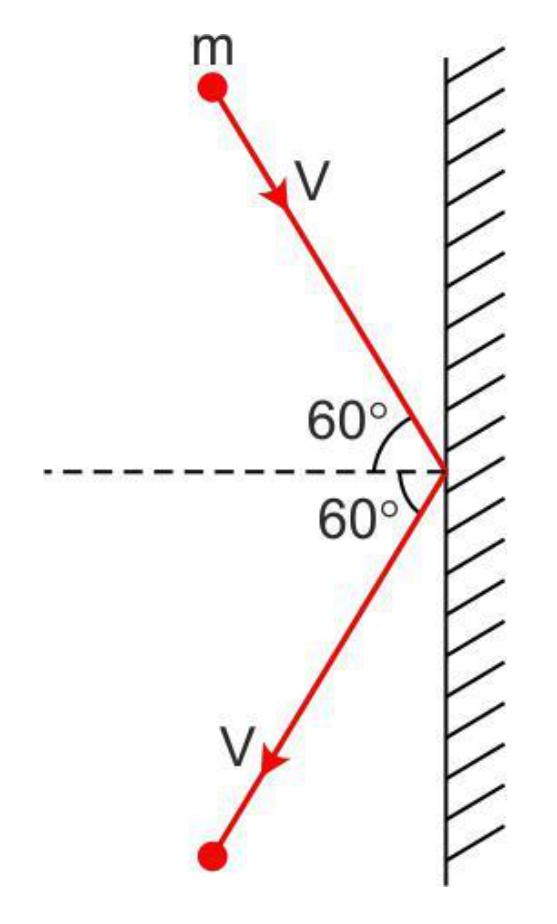
Previous-year questionA rigid ball of mass m strikes a rigid wall at an angle of 60° with the normal to the wall and is reflected without any loss of speed. The magnitude of the impulse imparted by the wall on the ball will be [NEET 2016] △ The original question carries a diagram; the arrangement it shows is described in full in the wording above, so no figure is needed to solve it.
- mv
- 2mv
- mv/2
- mv/3
Show answer
Answer: (A) mv
Explanation: Only the velocity component along the normal reverses. With the ball striking at 60° to the normal, that component is v cos 60° = v/2, so the impulse is J = 2m(v/2) = mv.
Question 14
Previous-year questionAn object flying in air with velocity (20î + 25ĵ − 12k̂) suddenly breaks into two pieces whose masses are in the ratio 1 : 5. The smaller mass flies off with a velocity (100î + 35ĵ + 8k̂). The velocity of the larger piece will be [Odisha NEET 2019]
- 4î + 23ĵ − 16k̂
- −100î − 35ĵ − 8k̂
- 20î + 15ĵ − 80k̂
- −20î − 15ĵ − 80k̂
Show answer
Answer: (A) 4î + 23ĵ − 16k̂
Explanation: Let the masses be m and 5m, so the total mass is 6m. By conservation of linear momentum: 6m v = m v₁ + 5m v₂ 6(20î + 25ĵ − 12k̂) = (100î + 35ĵ + 8k̂) + 5v₂ 120î + 150ĵ − 72k̂ − 100î − 35ĵ − 8k̂ = 5v₂ 20î + 115ĵ − 80k̂ = 5v₂ v₂ = 4î + 23ĵ − 16k̂.
Question 15
Every second, N small balls, each of mass m, strike a wall normally with speed u and bounce straight back with the same speed. What average force do they exert on the wall?
- Nmu
- Nmu/2
- 2Nmu
- 4Nmu
Show answer
Answer: (C) 2Nmu
Explanation: Each ball's momentum changes from mu towards the wall to mu away from it, a change of 2mu. N balls strike per second, so the momentum change per second is 2Nmu. By the third law this is the average force on the wall.
Want more Impulse and Conservation of Momentum – Law of conservation of linear momentum and its applications questions?
E-GYAN NIDHI has 117 questions on this topic and 63,000+ in total, all free: timed CBT tests, NEET marking and instant analysis.
Register free Free Sunday Mock Test