Friction – Static and Kinetic friction: NEET MCQs with Answers
15 free questions on Friction – Static and Kinetic friction for NEET (UG), starting with previous-year NEET and AIPMT questions. Try each one, then tap Show answer for the answer and a short explanation.
Syllabus covered: Static and Kinetic friction, laws of friction, rolling friction
Question 1
Previous-year questionA block of mass m is in contact with a cart C as shown; μ is the coefficient of static friction between them. The acceleration α of the cart that will prevent the block from falling satisfies [AIPMT 2010]
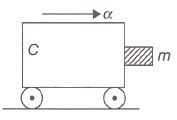
- α < g/μ
- α > mg/μ
- α > g/(μm)
- α ≥ g/μ
Show answer
Answer: (D) α ≥ g/μ
Explanation: The cart pushes the block with a normal force N = mα. The limiting friction μN = μmα must be at least the weight mg, so α ≥ g/μ.
Question 2
Previous-year questionThe coefficient of static friction μ_s between a block A of mass 2 kg and the table on which it rests is 0.2. Block A is connected by a string, passing over a smooth pulley at the edge of the table, to a hanging block B. What would be the maximum mass value of block B so that the two blocks do not move? The string and the pulley are assumed to be smooth and massless (g = 10 m/s²). [AIPMT 2004]
△ The original question carries a diagram; the arrangement it shows is described in full in the wording above, so no figure is needed to solve it.
△ The original question carries a diagram; the arrangement it shows is described in full in the wording above, so no figure is needed to solve it.
- 2.0 kg
- 4.0 kg
- 0.2 kg
- 0.4 kg
Show answer
Answer: (D) 0.4 kg
Explanation: For the hanging block B to be in equilibrium, the tension must support its weight: T = Mg …(i) For block A to stay at rest, that same tension must not exceed the limiting static friction on A: T ≤ f_s = μ_s N = μ_s mg …(ii) At the maximum value, combining (i) and (ii): Mg = μ_s mg M = μ_s m = 0.2 × 2 = 0.4 kg. Note that g cancels entirely, so the answer does not depend on its value.
Question 3
Previous-year questionA block B is pushed momentarily along a horizontal surface with an initial velocity v. If μ is the coefficient of sliding friction between B and the surface, block B will come to rest after a time [AIPMT 2007]
△ The original question carries a diagram; the arrangement it shows is described in full in the wording above, so no figure is needed to solve it.
△ The original question carries a diagram; the arrangement it shows is described in full in the wording above, so no figure is needed to solve it.
- v/(gμ)
- gμ/v
- g/v
- v/g
Show answer
Answer: (A) v/(gμ)
Explanation: After the initial push no driving force acts, so the only horizontal force is friction, which decelerates the block: μmg = ma ⇒ a = μg Using v = u + at with final velocity zero, u = v and a = −μg: 0 = v − μgt t = v/(μg). A quick dimensional check confirms this: velocity divided by acceleration gives time. ✔
Question 4
Previous-year questionA block of mass m is held in contact with the vertical rear face of a cart C, which is accelerating horizontally with acceleration α. The coefficient of static friction between the block and the cart is μ. The acceleration α of the cart that will prevent the block from falling satisfies [AIPMT 2010]
△ The original question carries a diagram; the arrangement it shows is described in full in the wording above, so no figure is needed to solve it.
△ The original question carries a diagram; the arrangement it shows is described in full in the wording above, so no figure is needed to solve it.
- α > mg/μ
- α > g/(μm)
- α ≥ g/μ
- α < g/μ
Show answer
Answer: (C) α ≥ g/μ
Explanation: As the cart accelerates, it presses on the block, providing a normal reaction N = mα This normal force is horizontal, so the block is held up only by the vertical frictional force between it and the cart. For the block not to slide down: f ≥ mg Since the frictional force cannot exceed its limiting value μN: μN ≥ mg μ(mα) ≥ mg α ≥ g/μ. The mass cancels, so the required acceleration does not depend on how heavy the block is.
Question 5
Previous-year questionA trolley of mass 10 kg rests on a horizontal surface and is connected by a light string, passing over a pulley at the edge, to a block of mass 2 kg hanging vertically. The coefficient of kinetic friction between the trolley and the surface is 0.05. Calculate the acceleration of the block and trolley system. (Take g = 10 m/s², the mass of the string is negligible and no other friction exists.) [NEET (Oct.) 2020]
△ The original question carries a diagram; the arrangement it shows is described in full in the wording above, so no figure is needed to solve it.
△ The original question carries a diagram; the arrangement it shows is described in full in the wording above, so no figure is needed to solve it.
- 1.25 m/s²
- 1.50 m/s²
- 1.66 m/s²
- 1.00 m/s²
Show answer
Answer: (A) 1.25 m/s²
Explanation: For the trolley (mass 10 kg) moving horizontally, with the frictional force μN = μ(10)g opposing it: T − μ(10)g = 10a T − 0.05 × 10 × 10 = 10a T − 5 = 10a …(i) For the hanging block (mass 2 kg): 2g − T = 2a 20 − T = 2a …(ii) Adding (i) and (ii) to eliminate T: 15 = 12a a = 15/12 = 1.25 m/s².
Question 6
Previous-year questionStarting from rest, a body slides down a 45° inclined plane in twice the time it takes to slide down the same distance in the absence of friction. The coefficient of friction between the body and the inclined plane is [AIPMT 1988]
- 0.80
- 0.75
- 0.25
- 0.33
Show answer
Answer: (B) 0.75
Explanation: Without friction the acceleration is g sin θ, so the time is t₂ = √(2s/(g sin θ)) With friction it is g(sin θ − μ cos θ), giving t₁ = √(2s/(g(sin θ − μ cos θ))) Given t₁ = 2t₂, squaring gives t₁² = 4t₂²: 2s/(g(sin θ − μ cos θ)) = 4 × 2s/(g sin θ) sin θ = 4 sin θ − 4μ cos θ 4μ cos θ = 3 sin θ μ = (3/4) tan θ = (3/4) tan 45° = 0.75. The general result for this class of problem is μ = tan θ(1 − 1/n²), where n is the factor by which the time increases; here n = 2 gives tan 45°(1 − ¼) = 0.75. ✔
Question 7
Previous-year questionA heavy uniform chain lies on a horizontal table top. If the coefficient of friction between the chain and the table surface is 0.25, then the maximum percentage of the length of the chain that can hang over one edge of the table is [AIPMT 1991]
- 20%
- 25%
- 35%
- 15%
Show answer
Answer: (A) 20%
Explanation: Let a length x of the chain of total length L hang over the edge. At the maximum overhang, the weight of the hanging part equals the limiting friction on the rest: x = μ(L − x). This gives x = μL/(1 + μ) = 0.25L/1.25 = 0.2L, which is 20% of the length.
Doing well? Create a free account to take timed tests on this topic and see your weak areas.
Question 8
Previous-year questionConsider a car moving along a straight horizontal road with a speed of 72 km/h. If the coefficient of static friction between the tyres and the road is 0.5, the shortest distance in which the car can be stopped is (take g = 10 m/s²) [AIPMT 1992]
- 30 m
- 40 m
- 72 m
- 20 m
Show answer
Answer: (B) 40 m
Explanation: Convert the speed: 72 km/h = 72 × 5/18 = 20 m/s. The retardation available is provided entirely by friction: a = −μg = −0.5 × 10 = −5 m/s² Using v² = u² + 2as with the final velocity zero: s = (0 − u²)/(2a) = −(20)²/(2 × −5) = 400/10 = 40 m. The mass of the car is irrelevant, since it cancels between the frictional force and the inertia.
Question 9
Previous-year questionA block has been placed on an inclined plane with slope angle θ, and the block slides down the plane at constant speed. The coefficient of kinetic friction is equal to [AIPMT 1993]
- sin θ
- cos θ
- g
- tan θ
Show answer
Answer: (D) tan θ
Explanation: Sliding at constant speed means zero acceleration, so the forces along the incline balance exactly: mg sin θ = f = μN Perpendicular to the incline: N = mg cos θ Substituting: mg sin θ = μ mg cos θ μ = sin θ/cos θ = tan θ. This particular angle is called the angle of repose — the largest slope on which a body can rest without sliding.
Question 10
Previous-year questionA block of mass 10 kg is placed on a rough horizontal surface having a coefficient of friction μ = 0.5. If a horizontal force of 100 N is applied on it, then the acceleration of the block will be (take g = 10 m/s²) [AIPMT 2002]
- 15 m/s²
- 10 m/s²
- 5 m/s²
- 0.5 m/s²
Show answer
Answer: (C) 5 m/s²
Explanation: Applying Newton's second law along the direction of motion: F − f = ma, where f = μN = μmg 100 − (0.5)(10)(10) = 10a 100 − 50 = 10a 50 = 10a a = 5 m/s².
Question 11
Previous-year questionWhich one of the following statements is incorrect? [NEET 2018]
- Frictional force opposes the relative motion
- The limiting value of static friction is directly proportional to the normal reaction
- Rolling friction is smaller than sliding friction
- The coefficient of sliding friction has the dimensions of length
Show answer
Answer: (D) The coefficient of sliding friction has the dimensions of length
Explanation: The coefficient of sliding friction is the ratio of the frictional force to the normal reaction, so it is a dimensionless number and has no dimensions of length. The other statements are true: friction opposes relative motion, limiting static friction is proportional to the normal reaction, and rolling friction is smaller than sliding friction.
Question 12
Previous-year questionA body of mass m is kept on a rough horizontal surface whose coefficient of friction is μ. A horizontal force is applied on the body but it does not move. If F is the resultant of the normal reaction and the frictional force acting on the object, then [NEET (Odisha) 2019]
- |F| = mg + μmg
- |F| = μmg
- |F| ≤ mg√(1 + μ²)
- |F| = mg
Show answer
Answer: (C) |F| ≤ mg√(1 + μ²)
Explanation: The two contact forces acting on the body are the normal reaction N = mg (vertical) and the static frictional force f (horizontal). Being perpendicular, their resultant has magnitude |F| = √(N² + f²) = √((mg)² + f²) Since the body does not move, the friction is static and can take any value up to its limiting value: f ≤ μN = μmg Substituting the maximum value gives the upper bound: |F| ≤ √((mg)² + (μmg)²) = mg√(1 + μ²) The inequality is essential — the equality holds only when the body is on the verge of slipping.
Question 13
Previous-year questionCalculate the maximum acceleration of a moving car so that a body lying on the floor of the car remains stationary. The coefficient of static friction between the body and the floor is 0.15 (take g = 10 m s⁻²). [NEET 2023]
- 150 m s⁻²
- 1.5 m s⁻²
- 50 m s⁻²
- 1.2 m s⁻²
Show answer
Answer: (B) 1.5 m s⁻²
Explanation: The only horizontal force available to accelerate the body along with the car is static friction. The body will not slip so long as the required force does not exceed the limiting friction: ma ≤ μ_s N = μ_s mg a ≤ μ_s g a_max = 0.15 × 10 = 1.5 m s⁻². The mass cancels, so the result is independent of how heavy the body is.
Question 14
Previous-year questionA football player is moving southward and suddenly turns eastward with the same speed to avoid an opponent. The force that acts on the player while turning is [NEET 2023]
- along northward
- along north-east
- along south-west
- along eastward
Show answer
Answer: (B) along north-east
Explanation: By Newton's second law the force is directed along the change in momentum, Δp = p_final − p_initial. Taking east along î and north along ĵ, with speed v: p_initial = −mvĵ (southward) p_final = +mvî (eastward) Δp = mvî − (−mvĵ) = mvî + mvĵ This resultant points equally towards the east and the north, i.e. along the north-east direction. An equivalent way to see it: to destroy the southward motion the force must act northward, and to create the eastward motion it must act eastward — the combination is north-east.
Question 15
An 80 kg block rests on a rough horizontal table. A light horizontal string runs from the block to a knot O. From O, one string goes up to a fixed support making 60° with the horizontal and another carries a hanging weight W. The largest static friction the table can provide on the block is 300 N. What is the largest W for which the system stays at rest?
- 600 N
- 300 N
- About 173 N
- About 520 N
Show answer
Answer: (D) About 520 N
Explanation: At O, the horizontal string tension T₁ balances T₂ cos 60°, and W balances T₂ sin 60°, so W = T₁ tan 60°. The block stays at rest as long as T₁ does not exceed 300 N. Hence the largest W = 300√3 ≈ 520 N.
Want more Friction – Static and Kinetic friction questions?
E-GYAN NIDHI has 227 questions on this topic and 63,000+ in total, all free: timed CBT tests, NEET marking and instant analysis.
Register free Free Sunday Mock TestMore topics in LAWS OF MOTION
- Newton's Laws of Motion – Force and inertia MCQs
- Dynamics of Circular Motion – Dynamics of uniform circular motion MCQs
- Impulse and Conservation of Momentum – Law of conservation of linear momentum and its applications MCQs
- Equilibrium of a Particle and Common Forces in Mechanics – Equilibrium of concurrent forces MCQs