Motion in a Plane – Vectors: NEET MCQs with Answers
15 free questions on Motion in a Plane – Vectors for NEET (UG), starting with previous-year NEET and AIPMT questions. Try each one, then tap Show answer for the answer and a short explanation.
Syllabus covered: Vectors: Scalars and vectors, Addition and subtraction, scalar and vector products, Unit Vector, Resolution of a Vector.
Question 1
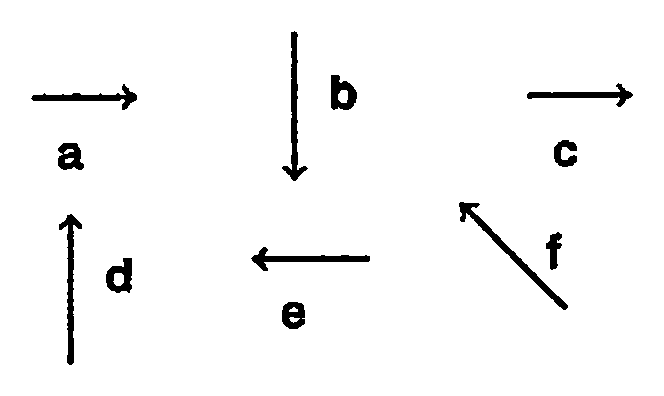
Previous-year questionSix vectors a, b, c, d, e and f have the magnitudes and directions indicated in the figure below. Which one of the following statements is true? [AIPMT 2010]
- b + c = f
- d + c = f
- d + e = f
- b + e = f
Show answer
Answer: (C) d + e = f
Explanation: Vectors are added by the triangle law: if two vectors are placed head to tail, the single vector drawn from the free tail to the free head is their resultant. Reading the figure, d is directed vertically upwards and e is directed horizontally to the left. Placing the tail of e at the head of d, the closing side of the triangle runs upwards and to the left — which is exactly the vector f, both in magnitude and in direction. Hence d + e = f. The other combinations fail: b and c, d and c, and b and e each produce a resultant whose direction does not match that of f, so none of those statements is correct.
Question 2
Previous-year questionIf F = 2î + ĵ − k̂ and r = 3î + 2ĵ − 2k̂, then the scalar and vector products of F and r have magnitudes respectively as: [Re-NEET 2022]
- 5, √3
- 4, √5
- 10, √2
- 10, 2
Show answer
Answer: (C) 10, √2
Explanation: The scalar product is F·r = (2)(3) + (1)(2) + (−1)(−2) = 6 + 2 + 2 = 10. For the vector product, the î term is (1)(−2) − (−1)(2) = 0, the ĵ term is −[(2)(−2) − (−1)(3)] = 1, and the k̂ term is (2)(2) − (1)(3) = 1. So F × r = ĵ + k̂, of magnitude √2. The pair is therefore 10 and √2.
Question 3
Previous-year questionTwo adjacent sides of a parallelogram are represented by the two vectors 3î + 4ĵ + 5k̂ and î − ĵ − k̂. The area of the parallelogram is: [NEET 2021]
- √74
- √94
- √104
- √114
Show answer
Answer: (D) √114
Explanation: When two adjacent SIDES are given, the area is the full magnitude of their cross product, with no factor of a half. The cross product is î[(4)(−1) − (5)(−1)] − ĵ[(3)(−1) − (5)(1)] + k̂[(3)(−1) − (4)(1)] = î + 8ĵ − 7k̂. Its magnitude is √(1 + 64 + 49) = √114.
Question 4
Previous-year questionThe angle between A and B is θ. The value of the triple product A · (B × A) is [AIPMT 1989]
- A²B
- zero
- A²B sin θ
- A²B cos θ
Show answer
Answer: (B) zero
Explanation: In a scalar triple product the positions of the dot and the cross may be interchanged: A · (B × A) = (A × B) · A Alternatively, note that B × A is by definition perpendicular to both B and A. Since the result of the cross product is perpendicular to A, its dot product with A must be zero: A · (B × A) = 0 More formally, A · (B × A) = (A × A) · B, and since A × A = 0, the whole expression vanishes. In general, a scalar triple product is zero whenever any two of its three vectors are the same (or coplanar).
Question 5
Previous-year questionThe resultant of A × 0 will be equal to [AIPMT 1992]
- zero
- A
- zero vector
- unit vector
Show answer
Answer: (C) zero vector
Explanation: The cross product of any vector with the null vector is itself a null vector, A × 0 = 0. A cross product is always a vector, so the result is the zero vector and not the scalar zero.
Question 6
Previous-year questionWhich one of the following is not a vector quantity? [AIPMT 1995]
- Speed
- Velocity
- Torque
- Displacement
Show answer
Answer: (A) Speed
Explanation: A vector quantity must possess both magnitude and direction and must obey the laws of vector addition. Speed is the magnitude of velocity; it tells us only how fast an object moves and gives no information about the direction of motion, so it is a scalar. Velocity (rate of change of displacement), torque (τ = r × F, the cross product of two vectors) and displacement (the shortest directed path from initial to final position) all have direction associated with them and are therefore vectors.
Question 7
Previous-year questionIf a unit vector is represented by 0.5î + 0.8ĵ + ck̂, then the value of c is [AIPMT 1999]
- 1
- √0.11
- √0.01
- 0.39
Show answer
Answer: (B) √0.11
Explanation: A unit vector has magnitude 1, so (0.5)² + (0.8)² + c² = 1. Thus 0.25 + 0.64 + c² = 1, giving c² = 0.11 and c = √0.11.
Doing well? Create a free account to take timed tests on this topic and see your weak areas.
Question 8
Previous-year questionThe vector sum of two forces is perpendicular to their vector difference. In that case, the forces [AIPMT 2003]
- are not equal to each other in magnitude
- cannot be predicted
- are equal to each other
- are equal to each other in magnitude
Show answer
Answer: (D) are equal to each other in magnitude
Explanation: Perpendicular sum and difference give (A + B)·(A − B) = 0, so A² − B² = 0 and |A| = |B|. The forces must be equal in magnitude, but their directions may differ, so they need not be equal as vectors.
Question 9
Previous-year questionIf |A × B| = √3 (A · B), then the value of |A + B| is [AIPMT 2004]
- (A² + B² + AB)^½
- (A² + B² + AB/√3)^½
- A + B
- (A² + B² + √3 AB)^½
Show answer
Answer: (A) (A² + B² + AB)^½
Explanation: AB sin θ = √3 AB cos θ gives tan θ = √3, so θ = 60°. Then |A + B| = √(A² + B² + 2AB cos 60°) = (A² + B² + AB)^½.
Question 10
Previous-year questionIf the vector 2î + 3ĵ + 8k̂ is perpendicular to the vector 4ĵ − 4î + αk̂, then the value of α is [AIPMT 2005]
- −1
- 1/2
- −1/2
- 1
Show answer
Answer: (C) −1/2
Explanation: Two vectors are perpendicular when their scalar (dot) product vanishes. Let a = 2î + 3ĵ + 8k̂ and b = −4î + 4ĵ + αk̂. a · b = (2)(−4) + (3)(4) + (8)(α) = −8 + 12 + 8α = 4 + 8α Setting a · b = 0: 4 + 8α = 0 ⇒ 8α = −4 ⇒ α = −1/2.
Question 11
Previous-year questionTwo vectors A and B are such that |A + B| = |A − B|. The angle between the two vectors is [AIPMT 2006, 1996, 1991]
- 45°
- 90°
- 60°
- 5°
Show answer
Answer: (B) 90°
Explanation: Squaring both sides of the given condition: |A + B|² = |A − B|² |A|² + |B|² + 2A · B = |A|² + |B|² − 2A · B 4A · B = 0 |A||B| cos θ = 0 Since neither vector is null, cos θ = 0 ⇒ θ = π/2 = 90°. Useful companion results: if |A + B| = |A| + |B| then cos θ = 1 (θ = 0°), and if |A + B| = ||A| − |B|| then cos θ = −1 (θ = 180°).
Question 12
Previous-year questionA and B are two vectors and θ is the angle between them. If |A × B| = √3 (A · B), then the value of θ is [AIPMT 2007]
- 60°
- 45°
- 30°
- 90°
Show answer
Answer: (A) 60°
Explanation: By definition, |A × B| = AB sin θ and A · B = AB cos θ. Substituting into the given condition: AB sin θ = √3 AB cos θ Dividing both sides by AB cos θ: tan θ = √3 θ = 60°. This is a standard result worth remembering: the cross product exceeds the dot product by a factor √3 precisely at 60°, and the two are equal at 45°.
Question 13
Previous-year questionIf the magnitude of the sum of two vectors is equal to the magnitude of the difference of the two vectors, the angle between these vectors is [NEET 2016, AIPMT 1991]
- 90°
- 45°
- 180°
- 0°
Show answer
Answer: (A) 90°
Explanation: Let the two vectors be P and Q with an angle φ between them. |P + Q|² = P² + Q² + 2PQ cos φ |P − Q|² = P² + Q² − 2PQ cos φ Equating the two, since |P + Q| = |P − Q|: P² + Q² + 2PQ cos φ = P² + Q² − 2PQ cos φ 4PQ cos φ = 0 Since P ≠ 0 and Q ≠ 0, cos φ = 0 ⇒ φ = π/2 = 90°. The two vectors are therefore perpendicular — geometrically, the diagonals of the parallelogram they form are equal, which makes it a rectangle.
Question 14
Previous-year questionA body moving at 30 m/s towards East has, after 10 s, a velocity of 40 m/s towards North. The average acceleration of the body is [AIPMT 2011]
- 1 m/s²
- 7 m/s²
- √7 m/s²
- 5 m/s²
Show answer
Answer: (D) 5 m/s²
Explanation: |Δv| = √(30² + 40²) = 50 m/s (perpendicular); a = 50/10 = 5 m/s².
Question 15
Previous-year questionA particle's position coordinates (x, y) are (2 m, 3 m) at t = 0, (6 m, 7 m) at t = 2 s and (13 m, 14 m) at t = 5 s. The average velocity vector from t = 0 to 5 s is [CBSE AIPMT 2014]
- (1/5)(13î + 14ĵ)
- (7/3)(î + ĵ)
- 2(î − ĵ)
- (11/5)(î + ĵ)
Show answer
Answer: (D) (11/5)(î + ĵ)
Explanation: Displacement = (13−2)î + (14−3)ĵ = 11î + 11ĵ; average velocity = displacement/time = (11/5)(î + ĵ).
Want more Motion in a Plane – Vectors questions?
E-GYAN NIDHI has 335 questions on this topic and 63,000+ in total, all free: timed CBT tests, NEET marking and instant analysis.
Register free Free Sunday Mock TestMore topics in KINEMATICS
- Motion in a Straight Line – Terms Related to Motion MCQs
- Motion in a Straight Line – Kinematics Equations of Uniformly and Non-uniformly MCQs
- Motion in a Straight Line – Graphs Related to Motion MCQs
- Motion in a Straight Line – Relative Motion in One Dimension MCQs
- Motion in a Plane and Projectile Motion MCQs
- Motion in a Plane – Relative Velocity in Two Dimensions MCQs
- Motion in a Plane – Uniform Circular Motion MCQs