Motion in a Plane and Projectile Motion: NEET MCQs with Answers
15 free questions on Motion in a Plane and Projectile Motion for NEET (UG), starting with previous-year NEET and AIPMT questions. Try each one, then tap Show answer for the answer and a short explanation.
Question 1
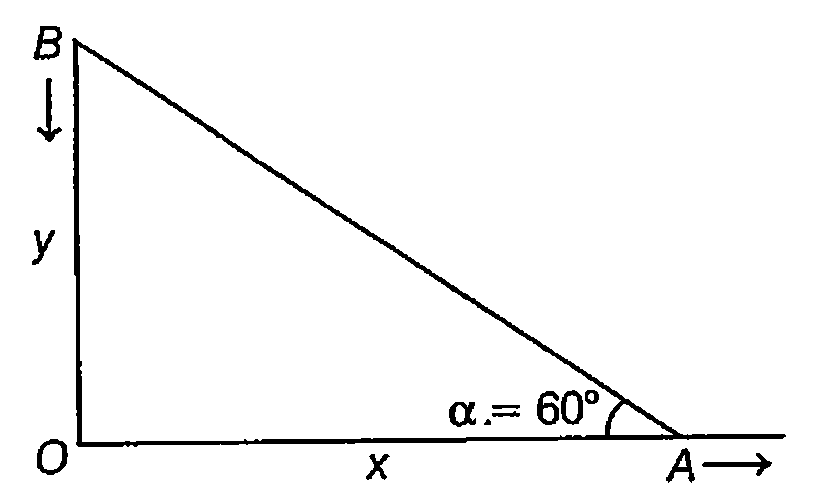
Previous-year questionTwo particles A and B are connected by a rigid rod AB. The rod slides along two perpendicular rails as shown in the figure below. The velocity of A to the right is 10 m/s. What is the velocity of B when the angle α = 60°? [AIPMT 1998]
- 9.8 m/s
- 10 m/s
- 5.8 m/s
- 17.3 m/s
Show answer
Answer: (C) 5.8 m/s
Explanation: Let O be the corner of the rails, with OA = x along the horizontal rail and OB = y along the vertical rail. The rod has a fixed length L, so x² + y² = L². Differentiating with respect to time: 2x(dx/dt) + 2y(dy/dt) = 0, so the speed of B is v_B = (x/y) v_A. In the figure α is the angle at A between the rod and the horizontal rail, so tan α = y/x and x/y = cot α. Therefore v_B = v_A cot α = 10 × cot 60° = 10/√3 = 5.8 m/s, with B moving down the vertical rail. Check: a rigid rod cannot stretch, so the velocity components of its two ends along the rod must be equal: v_A cos 60° = v_B sin 60°, which again gives v_B = 5.8 m/s.
Question 2
Previous-year questionA ball is projected from point A with velocity 20 m/s at an angle 60° to the horizontal. At the highest point B of its path, its velocity v is: [NEET(UG) 2023 (Manipur)]
- 20
- 10√3
- Zero
- 10
Show answer
Answer: (D) 10
Explanation: At the highest point, only the horizontal component of velocity survives: v = u cosθ = 20 cos60° = 20 × 0.5 = 10 m/s.
Question 3
Previous-year questionA cricket ball is thrown by a player at a speed of 20 m/s in a direction 30° above the horizontal. The maximum height attained by the ball is (g=10 m/s²): [Re-NEET(UG) 2022]
- 5 m
- 10 m
- 20 m
- 25 m
Show answer
Answer: (A) 5 m
Explanation: H = u²sin²θ/2g = (400×0.25)/20 = 100/20 = 5 m.
Question 4
Previous-year questionIf a ball is thrown from some height at an angle with the horizontal, for maximum horizontal range, the angle of projection should be: [NEET(UG) 2021 (Paper-2)]
- Zero
- 45°
- >45°
Show answer
Answer: (D)
Explanation: When projecting from an elevated point (not ground level), the optimum angle for maximum range is somewhat less than 45° (unlike level-ground projection, where 45° is exactly optimum).
Question 5
Previous-year questionA particle's coordinates are x=5t−2t² and y=10t (metres, seconds). The acceleration of the particle at t=2s is: [NEET(UG) 2019 Odisha]
- 5 m/s²
- −4 m/s²
- −8 m/s²
- 0
Show answer
Answer: (B) −4 m/s²
Explanation: aₓ = d²x/dt² = −4 (constant). a_y = d²y/dt² = 0. The only (constant) acceleration is −4 m/s² along x.
Question 6
Previous-year questionIf a body A of mass M is thrown with velocity v at an angle of 30° to the horizontal and another body B of the same mass is thrown with the same speed at an angle of 60° to the horizontal, the ratio of the horizontal range of A to that of B will be [AIPMT 1992]
- 1 : 3
- 1 : 1
- 1 : √3
- √3 : 1
Show answer
Answer: (B) 1 : 1
Explanation: The horizontal range of a projectile is R = v² sin 2θ/g, and it is independent of the mass. For A (θ = 30°): R_A = v² sin 60°/g For B (θ = 60°): R_B = v² sin 120°/g Since sin 120° = sin(180° − 120°) = sin 60°, the two are identical: R_A/R_B = sin 60°/sin 120° = 0.866/0.866 = 1 Hence R_A : R_B = 1 : 1. This is the general rule for complementary angles of projection — 30° and 60° add up to 90°. The equal masses are irrelevant to the result.
Question 7
Previous-year questionTwo particles are projected with the same initial velocity at angles of 30° and 60° with the horizontal. Then [AIPMT 2000]
- their heights will be equal
- their ranges will be equal
- their times of flight will be equal
- their ranges will be different
Show answer
Answer: (B) their ranges will be equal
Explanation: 30° and 60° are complementary, and R = u² sin 2θ/g gives sin 60° = sin 120°, so the ranges are equal. Heights differ (H ∝ sin²θ gives 1 : 3) and times of flight differ (T ∝ sin θ gives 1 : √3).
Doing well? Create a free account to take timed tests on this topic and see your weak areas.
Question 8
Previous-year questionA man is slipping down a frictionless inclined plane and a bag falls down freely from the same height. Taking v_m as the velocity of the man and v_B as the velocity of the bag on reaching the ground, the two are related as [AIPMT 2000]
- v_B > v_m
- v_B < v_m
- v_B = v_m
- v_B and v_m cannot be related
Show answer
Answer: (C) v_B = v_m
Explanation: For the bag in free fall, v_B² = 0 + 2gh, so v_B = √(2gh). For the man on the smooth (frictionless) incline of inclination θ, the acceleration along the plane is g sin θ and the distance travelled along the plane is x = h/sin θ. Hence v_m² = 0 + 2(g sin θ)(h/sin θ) = 2gh, so v_m = √(2gh). Therefore v_B = v_m. The result follows more directly from conservation of energy: on a frictionless surface the entire loss of potential energy mgh converts into kinetic energy ½mv², whatever the shape of the path, so only the vertical drop h matters.
Question 9
Previous-year questionA particle moves in a plane with constant acceleration in a direction different from that of its initial velocity. The path of the particle is [AIPMT 2005]
- an ellipse
- a parabola
- an arc of a circle
- a straight line
Show answer
Answer: (B) a parabola
Explanation: Resolve the motion along and perpendicular to the constant acceleration a, with θ the angle between the initial velocity v and a. Perpendicular to a: x = (v sin θ)t, so t = x/(v sin θ) Along a: y = (v cos θ)t + ½at² Substituting for t: y = (v cos θ)x/(v sin θ) + ½a·x²/(v² sin²θ) y = x/tan θ + [a/(2v² sin²θ)]x² This has the form y = Ax² + Bx, which is the equation of a parabola. Ordinary projectile motion near the earth's surface is exactly this situation, with a = g. Had the acceleration been along the initial velocity, the path would have been a straight line.
Question 10
Previous-year questionFor angles of projection of a projectile at angles (45° − θ) and (45° + θ), the horizontal ranges described by the projectile are in the ratio of [AIPMT 2006]
- 1 : 1
- 2 : 3
- 1 : 2
- 2 : 1
Show answer
Answer: (A) 1 : 1
Explanation: The two given angles are complementary, since (45° − θ) + (45° + θ) = 90°, and complementary angles of projection always give the same horizontal range. Proving it directly, with R = u² sin 2α/g: For α = 45° − θ: R₁ = u² sin(90° − 2θ)/g = u² cos 2θ/g For α = 45° + θ: R₂ = u² sin(90° + 2θ)/g = u² cos 2θ/g Hence R₁ = R₂, i.e. R₁ : R₂ = 1 : 1. The maximum heights and times of flight of the two projectiles are, however, quite different.
Question 11
Previous-year questionA particle starting from the origin (0, 0) moves in a straight line in the (x, y) plane. Its coordinates at a later time are (√3, 3). The path of the particle makes with the X-axis an angle of [AIPMT 2007]
- 30°
- 45°
- 60°
- 0°
Show answer
Answer: (C) 60°
Explanation: Since the particle moves along a straight line through the origin, the angle θ that its path makes with the X-axis is given by the slope of that line: tan θ = (y₂ − y₁)/(x₂ − x₁) = (3 − 0)/(√3 − 0) = 3/√3 = √3 θ = 60°. A quick check: 3/√3 = √3 ≈ 1.732, and tan 60° = 1.732 ✔
Question 12
Previous-year questionA particle has an initial velocity of (3î + 4ĵ) and an acceleration of (0.4î + 0.3ĵ). Its speed after 10 s is [AIPMT 2010]
- 7 unit
- 7√2 unit
- 8.5 unit
- 10 unit
Show answer
Answer: (B) 7√2 unit
Explanation: Using v = u + at: v = (3î + 4ĵ) + (0.4î + 0.3ĵ)(10) = (3î + 4ĵ) + (4î + 3ĵ) = 7î + 7ĵ Speed = |v| = √(7² + 7²) = √98 = 7√2 units ≈ 9.9 units. Note that the answer is the magnitude of the resultant, not the sum of the components (7 + 7 = 14 would be wrong).
Question 13
Previous-year questionA particle moves in the XY-plane according to the rule x = a sin ωt and y = a cos ωt. The particle follows [AIPMT 2010]
- an elliptical path
- a circular path
- a parabolic path
- a straight line path inclined equally to the X- and Y-axes
Show answer
Answer: (B) a circular path
Explanation: Eliminate the time by squaring and adding the two coordinates: x² + y² = a² sin²ωt + a² cos²ωt = a²(sin²ωt + cos²ωt) = a² So x² + y² = a², which is the equation of a circle centred at the origin (0, 0) with radius a. Had the two amplitudes been different, the same elimination would have produced an ellipse instead.
Question 14
Previous-year questionThe speed of a projectile at its maximum height is half of its initial speed. The angle of projection is [AIPMT 2010]
- 60°
- 15°
- 30°
- 45°
Show answer
Answer: (A) 60°
Explanation: At the highest point of the trajectory the vertical component of velocity is zero, so the speed there is just the horizontal component, u cos θ, which stays constant throughout the flight. Given that this equals half the initial speed: u cos θ = u/2 cos θ = 1/2 θ = 60°. (For comparison, if the speed at the top were u/√2 the angle would be 45°.)
Question 15
Previous-year questionA body is moving with a velocity of 30 m/s towards East. After 10 s its velocity becomes 40 m/s towards North. The average acceleration of the body is [AIPMT 2011]
- 1 m/s²
- 7 m/s²
- √7 m/s²
- 5 m/s²
Show answer
Answer: (D) 5 m/s²
Explanation: Average acceleration is the change in the velocity vector divided by the time, so directions matter. Taking East along î and North along ĵ: u = 30î m/s and v = 40ĵ m/s Δv = v − u = 40ĵ − 30î |Δv| = √(30² + 40²) = √2500 = 50 m/s a_av = |Δv|/Δt = 50/10 = 5 m/s². Subtracting the magnitudes (40 − 30 = 10) would be wrong, since the two velocities are at right angles.
Want more Motion in a Plane and Projectile Motion questions?
E-GYAN NIDHI has 305 questions on this topic and 63,000+ in total, all free: timed CBT tests, NEET marking and instant analysis.
Register free Free Sunday Mock TestMore topics in KINEMATICS
- Motion in a Straight Line – Terms Related to Motion MCQs
- Motion in a Straight Line – Kinematics Equations of Uniformly and Non-uniformly MCQs
- Motion in a Straight Line – Graphs Related to Motion MCQs
- Motion in a Straight Line – Relative Motion in One Dimension MCQs
- Motion in a Plane – Vectors MCQs
- Motion in a Plane – Relative Velocity in Two Dimensions MCQs
- Motion in a Plane – Uniform Circular Motion MCQs