Magnetic Dipole, Bar Magnet and Magnetic Field – Current loop as a magnetic dipole and its magnetic dipole: NEET MCQs with Answers
12 free questions on Magnetic Dipole, Bar Magnet and Magnetic Field – Current loop as a magnetic dipole and its magnetic dipole for NEET (UG), starting with previous-year NEET and AIPMT questions. Try each one, then tap Show answer for the answer and a short explanation.
Syllabus covered: Current loop as a magnetic dipole and its magnetic dipole moment, Bar magnet as an equivalent solenoid, magnetic field lines; Magnetic field due to a magnetic dipole (bar magnet) along its axis and perpendicular to its axis. , dia- and ferromagnetic substances with examples, effect of temperature on magnetic properties.
Question 1
Previous-year questionTwo identical bar magnets are fixed with their centres a distance d apart. A stationary charge Q is placed at P in the gap between the two magnets, at a distance D from the centre O as shown in the figure. The force on the charge Q is [AIPMT 2010]
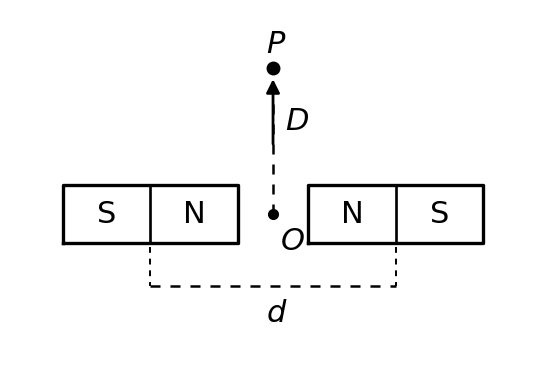
- zero
- directed along OP
- directed along PO
- directed perpendicular to the plane of the paper
Show answer
Answer: (A) zero
Explanation: A magnetic field exerts a force F = qv × B only on a moving charge. Since the charge Q is stationary (v = 0), the magnetic force is zero regardless of the field produced by the magnets at P.
Question 2
Previous-year questionA charged particle carrying charge q is moving in a circle of radius R with uniform speed v. The associated magnetic moment μ is given by [AIPMT 2007]
- qvR/2
- qvR²
- qvR²/2
- qvR
Show answer
Answer: (A) qvR/2
Explanation: The revolving charge is equivalent to a current i = q/T = qv/2πR. The magnetic moment is μ = iA = (qv/2πR)(πR²) = qvR/2.
Question 3
Previous-year questionA wire of length L metre carrying a current of I ampere is bent in the form of a circle. Its magnetic moment is [NEET (Oct.) 2020]
- (IL²/4) A m²
- (IπL²/4) A m²
- (2IL²/π) A m²
- (IL²/4π) A m²
Show answer
Answer: (D) (IL²/4π) A m²
Explanation: For a circle, L = 2πR gives R = L/2π. The enclosed area is A = πR² = π(L/2π)² = L²/4π. Hence M = IA = IL²/4π A m².
Question 4
Previous-year questionAn iron bar of length L has a magnetic moment M. It is bent at the middle of its length in such a way that the two arms make an angle of 60° with each other. The magnetic moment of this new magnet is [NEET 2024]
- M
- M/2
- 2M
- M/√3
Show answer
Answer: (B) M/2
Explanation: The original moment is M = mL, where m is the pole strength. After bending, the two arms each have length L/2 and enclose 60°, so the triangle formed by the two arms is equilateral — the separation between the poles becomes L/2. The new moment is therefore M′ = m(L/2) = M/2. Note that pole strength is unchanged by bending; only the pole separation matters.
Question 5
The far field of a bar magnet can be written down from that of an electric dipole by a set of replacements. Which one of these correspondences between electrostatics and magnetism is NOT correct?
- Constant ε₀ corresponds to constant μ₀
- Torque p × E corresponds to torque m × B
- Energy −p · E corresponds to energy −m · B
- Dipole moment p corresponds to magnetic moment m
Show answer
Answer: (A) Constant ε₀ corresponds to constant μ₀
Explanation: The correct replacement is 1/ε₀ to μ₀, not ε₀ to μ₀. Thus the axial field 2p/(4πε₀r³) of a short electric dipole becomes μ₀(2m)/(4πr³) for a short bar magnet. The moment, torque and energy expressions carry over directly with E replaced by B and p by m.
Question 6
Four field patterns are described in words as candidates for a static magnetic field. Which one is possible?
- Closed circles in empty space, with no current crossing the area enclosed by any circle
- Straight lines running radially outward from a long current-carrying wire, in a plane perpendicular to the wire
- Closed circles lying wholly within the windings of a toroid, each enclosing a region crossed by current
- Straight lines that pass through a finite solenoid and continue straight beyond both ends, never curving back
Show answer
Answer: (C) Closed circles lying wholly within the windings of a toroid, each enclosing a region crossed by current
Explanation: Magnetic field lines cannot radiate from a source, since the net flux through any closed surface must be zero; around a wire they circle the conductor. A closed loop of a static magnetic field line must enclose a region through which a current passes, which rules out loops around empty space and is satisfied inside a toroid. Lines at the ends of a finite solenoid must curve out and close on themselves, or Ampere's law would be violated.
Question 7
Two identical-looking iron bars X and Y are given, and exactly one of them is magnetised. One end of X is lowered first onto an end of Y and then onto the middle of Y. The pull on X is found to be the same in both positions. What can be concluded?
- Y is the magnet, because the field of a bar magnet is uniform along its length
- Nothing can be concluded unless a third piece of magnetic material is used
- Y is the magnet, because a magnet pulls equally at its ends and at its middle
- X is the magnet, because its pole attracts the unmagnetised bar equally at any point along it
Show answer
Answer: (D) X is the magnet, because its pole attracts the unmagnetised bar equally at any point along it
Explanation: The magnetic field of a bar magnet is strongest at its ends and weakest in its central region. If Y were the magnet, X would feel practically no force at the middle of Y. Since the pull does not change from the end to the middle of Y, Y must be the unmagnetised bar and X must be the magnet.
Doing well? Create a free account to take timed tests on this topic and see your weak areas.
Question 8
Compare a bar magnet of magnetic moment m with an electric dipole of moment p. How are the magnetic field at the centre of the magnet and the electric field at the midpoint between the two charges of the dipole directed?
- The magnetic field is along m and the electric field is along p.
- The magnetic field is opposite to m and the electric field is along p.
- The magnetic field is opposite to m and the electric field is opposite to p.
- The magnetic field is along m and the electric field is opposite to p.
Show answer
Answer: (D) The magnetic field is along m and the electric field is opposite to p.
Explanation: Magnetic field lines are continuous closed loops, so inside the magnet they run from the south pole to the north pole, which is the direction of m. Electric field lines start on the positive charge and end on the negative charge. Between the charges they therefore run from + to −, opposite to p, which points from − to +.
Question 9
A wire is wound into a coil of 3 turns, each of radius r, and carries a current I. The same wire is unwound and bent into a single circular loop carrying the same current. The ratio of the magnetic moment of the single loop to that of the 3-turn coil is:
- 9
- 3
- 1
- 1/3
Show answer
Answer: (B) 3
Explanation: The wire length is 3(2πr), so the single loop has radius 3r. Its magnetic moment is Iπ(3r)² = 9Iπr². The 3-turn coil has a moment of 3Iπr². The ratio is therefore 3.
Question 10
Two concentric coplanar circular loops have radii R and 2R. The inner loop carries a current I. What current must flow in the outer loop so that the pair has zero net magnetic dipole moment?
- I, in the opposite sense to the inner loop
- I/4, in the opposite sense to the inner loop
- I/4, in the same sense as the inner loop
- I/2, in the opposite sense to the inner loop
Show answer
Answer: (B) I/4, in the opposite sense to the inner loop
Explanation: The inner moment is IπR² and the outer moment is I′π(2R)² = 4I′πR². Setting the magnitudes equal gives I′ = I/4. The two moments must point in opposite directions to cancel, so the currents must circulate in opposite senses.
Question 11
The electron in a Bohr hydrogen atom moves from the orbit n = 1 to the orbit n = 2. What happens to its orbital magnetic moment m, its orbital angular momentum L, and the ratio m/L?
- m and L both become four times as large; m/L stays equal to e/(2mₑ)
- m and L both double; m/L doubles
- m and L both double; m/L stays equal to e/(2mₑ)
- m doubles, L stays the same; m/L doubles
Show answer
Answer: (C) m and L both double; m/L stays equal to e/(2mₑ)
Explanation: Bohr's condition gives L = nh/2π, so L is proportional to n. The orbital moment is m = evr/2 = (e/2mₑ)L, which equals n times the Bohr magneton eh/(4πmₑ). So m and L both double. Their ratio e/(2mₑ) depends only on the electron's charge and mass, not on the orbit.
Question 12
An electron (charge 1.6 × 10⁻¹⁹ C) moves at 2.2 × 10⁶ m/s in a circular orbit of radius 0.53 × 10⁻¹⁰ m. What is the magnetic dipole moment of this orbiting electron?
- 1.9 × 10⁻²³ A m²
- 4.7 × 10⁻²⁴ A m²
- 9.3 × 10⁻²⁴ A m²
- 9.3 × 10⁻²² A m²
Show answer
Answer: (C) 9.3 × 10⁻²⁴ A m²
Explanation: The orbiting electron is a current loop with I = e/T = ev/(2πr). Its moment is m = I × πr² = evr/2. Substituting gives m = (1.6 × 10⁻¹⁹ × 2.2 × 10⁶ × 0.53 × 10⁻¹⁰)/2 ≈ 9.3 × 10⁻²⁴ A m², which is close to the Bohr magneton.
Want more Magnetic Dipole, Bar Magnet and Magnetic Field – Current loop as a magnetic dipole and its magnetic dipole questions?
E-GYAN NIDHI has 57 questions on this topic and 63,000+ in total, all free: timed CBT tests, NEET marking and instant analysis.
Register free Free Sunday Mock TestMore topics in MAGNETIC EFFECTS OF CURRENT AND MAGNETISM
- Biot Savart's Law and Ampere's Circuital Law – Biot MCQs
- Force and Torque on Current Carrying Conductor – Force on a current-carrying conductor in a uniform magnetic MCQs
- Magnetic Force on Charged Particle in Electric and Magnetic Fields – Force on a moving charge in uniform magnetic and electric MCQs
- Moving Coil Galvanometer MCQs
- Magnetic Dipole in Uniform Magnetic Field – Torque on a magnetic dipole in a uniform magnetic field MCQs
- Magnetic Materials and its Properties – Para MCQs