Biot Savart's Law and Ampere's Circuital Law – Biot: NEET MCQs with Answers
15 free questions on Biot Savart's Law and Ampere's Circuital Law – Biot for NEET (UG), starting with previous-year NEET and AIPMT questions. Try each one, then tap Show answer for the answer and a short explanation.
Syllabus covered: Biot - Savart law and its application to current carrying circular loop. Ampere's law and its applications to infinitely long current carrying straight wire and solenoid.
Question 1
Previous-year questionA long wire carrying a current I has three parts. The current comes in along the line y = −R, z = 0, travelling in the −X direction from very far away to the point (0, −R, 0). It then follows a semicircle of radius R, centred at the origin O and lying in the YZ-plane, through the point (0, 0, R) to the point (0, R, 0). It then leaves along the line y = R, z = 0, travelling in the +X direction to a very large distance. The magnetic field at the point O is [AIPMT 2015]
- B = (μ₀/4π)(I/R)(πî + 2k̂)
- B = −(μ₀/4π)(I/R)(πî − 2k̂)
- B = −(μ₀/4π)(I/R)(πî + 2k̂)
- B = (μ₀/4π)(I/R)(πî − 2k̂)
Show answer
Answer: (C) B = −(μ₀/4π)(I/R)(πî + 2k̂)
Explanation: Use dB̄ = (μ₀I/4π)(dl̄ × r̂)/r², with r̄ drawn from the current element to O. The semicircle gives a field of magnitude μ₀I/4R, that is, (μ₀/4π)(πI/R). At the point (0, 0, R) the current runs along +Y and r̄ points along −Z, so dl̄ × r̄ points along −X, and B̄(arc) = −(μ₀/4π)(πI/R)î. Each straight part is a semi-infinite wire with O at perpendicular distance R from its end, so each gives a field of magnitude μ₀I/4πR. For the part at y = −R, the current is along −X and r̄ has a component along +Y, so the field is along −Z. For the part at y = +R, the current is along +X and r̄ has a component along −Y, so the field is again along −Z. Together they give −2(μ₀I/4πR)k̂. Adding, B̄ = −(μ₀/4π)(I/R)(πî + 2k̂).
Question 2
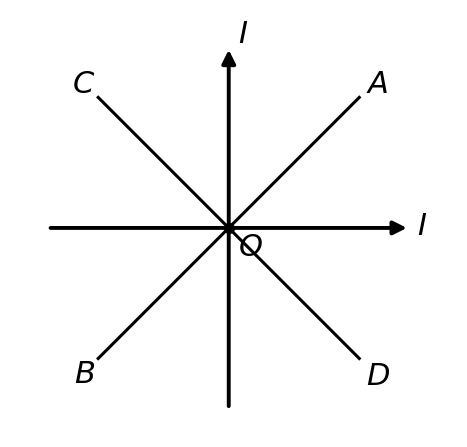
Previous-year questionTwo equal electric currents flow perpendicular to each other as shown in the figure. AB and CD are mutually perpendicular and are placed symmetrically with respect to the currents. Along which line do we expect the resultant magnetic field to be zero? [AIPMT 1996]
- On AB
- On CD
- On both AB and CD
- On both OD and BO
Show answer
Answer: (A) On AB
Explanation: Applying the right-hand grip rule at any point on AB, the field due to one current points out of the page while that due to the other points into the page, and because the point is equidistant from both wires the magnitudes are equal — so they cancel. Along CD both fields point the same way and add, giving a non-zero resultant. Hence the field vanishes only on AB.
Question 3
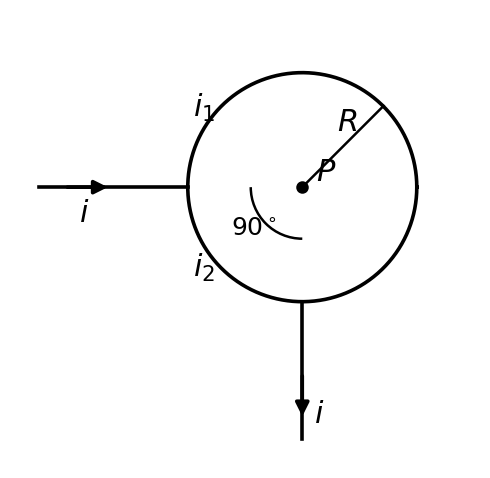
Previous-year questionA straight conductor carrying a current i divides into two branches which form a circular loop of radius R, as shown in the figure. The resultant magnetic field at the centre P of the loop is [NEET (Odisha) 2019]
- zero
- 3μ₀i/32R, directed outward
- 3μ₀i/32R, directed inward
- μ₀i/2R, directed inward
Show answer
Answer: (A) zero
Explanation: The two arcs subtend 270° and 90° at P and carry currents i₁ and i₂. Since the wire is uniform, resistance is proportional to arc length, so R₁/R₂ = 270/90 = 3. Being in parallel, i₁R₁ = i₂R₂, giving i₂ = 3i₁. The fields are B₁ = (μ₀i₁/2R)(270/360) inward and B₂ = (μ₀i₂/2R)(90/360) outward. Substituting i₂ = 3i₁ makes the two contributions equal and opposite, so the resultant field at P is zero. (In general, the field at the centre of such a split loop is always zero.)
Question 4
Previous-year questionA long solenoid of 50 cm length having 100 turns carries a current of 2.5 A. The magnetic field at the centre of the solenoid is (μ₀ = 4π × 10⁻⁷ T m A⁻¹) [NEET 2020]
- 3.14 × 10⁻⁴ T
- 6.28 × 10⁻⁵ T
- 3.14 × 10⁻⁵ T
- 6.28 × 10⁻⁴ T
Show answer
Answer: (D) 6.28 × 10⁻⁴ T
Explanation: Turn density n = 100/0.5 = 200 per metre, so B = μ₀nI = (4π × 10⁻⁷)(200)(2.5) = 6.28 × 10⁻⁴ T.
Question 5
Previous-year questionA long straight wire of radius a carries a steady current I. The current is uniformly distributed over its cross-section. The ratio of the magnetic fields B and B′, at radial distances a/2 and 2a respectively from the axis of the wire, is [NEET 2016]
- 1/4
- 1/2
- 1
- 4
Show answer
Answer: (C) 1
Explanation: Inside, B = μ₀Ir/2πa², so at r = a/2 it is μ₀I/4πa. Outside, B′ = μ₀I/2πr, so at r = 2a it is also μ₀I/4πa. The two are equal and the ratio is 1.
Question 6
Previous-year questionTwo identical long conducting wires AOB and COD are placed at right angles to each other, with one above the other, such that O is their common point. The wires carry I₁ and I₂ currents respectively. Point P is lying at distance d from O along a direction perpendicular to the plane containing the wires. The magnetic field at the point P will be [AIPMT 2014]
- (μ₀/2πd)(I₁/I₂)
- (μ₀/2πd)(I₁ + I₂)
- (μ₀/2πd)(I₁² − I₂²)
- (μ₀/2πd)(I₁² + I₂²)^(1/2)
Show answer
Answer: (D) (μ₀/2πd)(I₁² + I₂²)^(1/2)
Explanation: Each wire produces μ₀I/2πd at P, and because the wires are mutually perpendicular the two field vectors at P are also perpendicular. Adding them at right angles gives B = (μ₀/2πd)√(I₁² + I₂²).
Question 7
Previous-year questionTesla is the SI unit of [AIPMT 1988]
- magnetic flux
- magnetic field
- magnetic induction
- magnetic moment
Show answer
Answer: (C) magnetic induction
Explanation: The tesla is the SI unit of magnetic induction (magnetic flux density) B. One tesla is the induction at a point where a charge of one coulomb moving at right angles to the field with a speed of 1 m s⁻¹ experiences a force of 1 N, i.e. 1 T = 1 N A⁻¹ m⁻¹. Magnetic flux is measured in weber and magnetic moment in A m².
Doing well? Create a free account to take timed tests on this topic and see your weak areas.
Question 8
Previous-year questionThe magnetic induction at a point P situated 4 cm from a long current-carrying wire is 10⁻³ T. The field of induction at a distance 12 cm from the same current will be [AIPMT 1990]
- 3.33 × 10⁻⁴ T
- 1.11 × 10⁻⁴ T
- 3 × 10⁻³ T
- 9 × 10⁻³ T
Show answer
Answer: (A) 3.33 × 10⁻⁴ T
Explanation: Since B ∝ 1/r, increasing the distance from 4 cm to 12 cm — a factor of 3 — reduces the field to one-third of its value: B′ = 10⁻³/3 = 3.33 × 10⁻⁴ T.
Question 9
Previous-year questionThe magnetic field at a distance r from a long wire carrying a current i is 0.4 T. The magnetic field at a distance 2r is [AIPMT 1992]
- 0.2 T
- 0.8 T
- 0.1 T
- 1.6 T
Show answer
Answer: (A) 0.2 T
Explanation: For a long straight wire, B = μ₀i/2πr, so B ∝ 1/r. Doubling the distance halves the field: B′ = 0.4/2 = 0.2 T.
Question 10
Previous-year questionA straight wire of diameter 0.5 mm carrying a current of 1 A is replaced by another wire of 1 mm diameter carrying the same current. The strength of the magnetic field far away from the wire is [AIPMT 1995]
- twice the earlier value
- the same as the earlier value
- one-half of the earlier value
- one-quarter of the earlier value
Show answer
Answer: (B) the same as the earlier value
Explanation: For points outside the wire, B = μ₀i/2πr depends only on the current and on the distance from the wire — not on its diameter. Since both the current and the distance are unchanged, the field far away remains the same.
Question 11
Previous-year questionAt what distance from a long straight wire carrying a current of 12 A will the magnetic field be equal to 3 × 10⁻⁵ Wb/m²? [AIPMT 1995]
- 8 × 10⁻² m
- 12 × 10⁻² m
- 18 × 10⁻² m
- 24 × 10⁻² m
Show answer
Answer: (A) 8 × 10⁻² m
Explanation: For an infinitely long straight wire, B = μ₀i/2πr, so r = μ₀i/2πB = (2 × 10⁻⁷ × 12)/(3 × 10⁻⁵) = 2.4 × 10⁻⁶/3 × 10⁻⁵ = 8 × 10⁻² m.
Question 12
Previous-year questionThe magnetic field dB produced by a small current element dl, situated at a distance r and carrying a current i, is given by [AIPMT 1996]
- dB = (μ₀/4π) i (dl × r)/r
- dB = (μ₀/4π) i² (dl × r)/r²
- dB = (μ₀/4π) i² (dl × r)/r
- dB = (μ₀/4π) i (dl × r)/r³
Show answer
Answer: (D) dB = (μ₀/4π) i (dl × r)/r³
Explanation: The Biot–Savart law states dB ∝ i, dB ∝ dl, dB ∝ sin θ and dB ∝ 1/r². Combining these, dB = (μ₀/4π) i dl sin θ / r², whose vector form is dB = (μ₀/4π) i (dl × r)/r³ — the extra power of r in the denominator accounts for r being a vector of magnitude r rather than a unit vector.
Question 13
Previous-year questionA coil of one turn is made from a wire of a certain length, and then a coil of two turns is made from the same length of wire. If the same current is passed in both cases, the ratio of the magnetic inductions at their centres will be [AIPMT 1998]
- 2 : 1
- 1 : 4
- 4 : 1
- 1 : 2
Show answer
Answer: (B) 1 : 4
Explanation: For fixed wire length L, the radius of an N-turn coil is r = L/2πN. Since B = μ₀NI/2r = μ₀N²I×π/L, we get B ∝ N². Therefore B₁/B₂ = 1²/2² = 1/4, i.e. 1 : 4.
Question 14
Previous-year questionIf a long hollow copper pipe carries a current along its length, then a magnetic field is produced [AIPMT 1999]
- inside the pipe only
- outside the pipe only
- both inside and outside the pipe
- nowhere
Show answer
Answer: (B) outside the pipe only
Explanation: Applying Ampere's law to a circular loop drawn inside the hollow region, the enclosed current is zero, so B(2πr) = μ₀ × 0 and B = 0 inside. Outside, the whole current behaves as though concentrated on the axis, giving B = μ₀i/2πr. Hence the field exists only outside the pipe.
Question 15
Previous-year questionA circular coil of radius 0.1 m having 1000 turns carries a current of 0.1 A. The magnetic field at the centre of the coil is [AIPMT 1999]
- 0.2 T
- 2 × 10⁻⁴ T
- 6.28 × 10⁻⁴ T
- 9.8 × 10⁻⁴ T
Show answer
Answer: (C) 6.28 × 10⁻⁴ T
Explanation: B = μ₀NI/2r = (4π × 10⁻⁷ × 1000 × 0.1)/(2 × 0.1) = 2π × 10⁻⁴ = 6.28 × 10⁻⁴ T.
Want more Biot Savart's Law and Ampere's Circuital Law – Biot questions?
E-GYAN NIDHI has 118 questions on this topic and 63,000+ in total, all free: timed CBT tests, NEET marking and instant analysis.
Register free Free Sunday Mock TestMore topics in MAGNETIC EFFECTS OF CURRENT AND MAGNETISM
- Force and Torque on Current Carrying Conductor – Force on a current-carrying conductor in a uniform magnetic MCQs
- Magnetic Dipole, Bar Magnet and Magnetic Field – Current loop as a magnetic dipole and its magnetic dipole MCQs
- Magnetic Force on Charged Particle in Electric and Magnetic Fields – Force on a moving charge in uniform magnetic and electric MCQs
- Moving Coil Galvanometer MCQs
- Magnetic Dipole in Uniform Magnetic Field – Torque on a magnetic dipole in a uniform magnetic field MCQs
- Magnetic Materials and its Properties – Para MCQs