Force and Torque on Current Carrying Conductor – Force on a current-carrying conductor in a uniform magnetic: NEET MCQs with Answers
15 free questions on Force and Torque on Current Carrying Conductor – Force on a current-carrying conductor in a uniform magnetic for NEET (UG), starting with previous-year NEET and AIPMT questions. Try each one, then tap Show answer for the answer and a short explanation.
Syllabus covered: Force on a current-carrying conductor in a uniform magnetic field. The force between two parallel currents carrying conductors-definition of ampere. Torque experienced by a current loop in a uniform magnetic field
Question 1
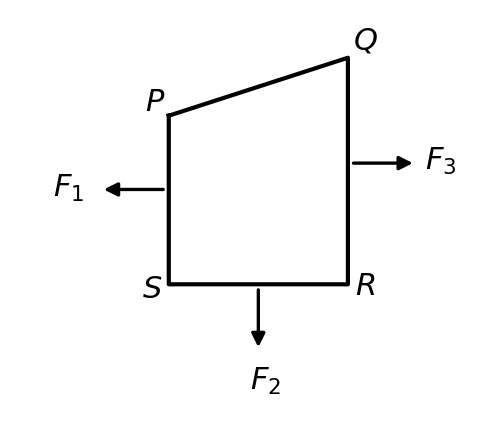
Previous-year questionA closed loop PQRS carrying a current is placed in a uniform magnetic field. If the magnetic forces on the segments PS, SR and RQ are F₁, F₂ and F₃ respectively, and these lie in the plane of the paper along the directions shown in the figure, then the force on the segment QP is [AIPMT 2008]
- F₃ − F₁ − F₂
- √[(F₃ − F₁)² + F₂²]
- √[(F₃ − F₁)² − F₂²]
- F₃ − F₁ + F₂
Show answer
Answer: (B) √[(F₃ − F₁)² + F₂²]
Explanation: Since the net force on a closed loop in a uniform field is zero, F_QP must balance the vector sum of F₁, F₂ and F₃. F₁ and F₃ are oppositely directed along the horizontal, giving a resultant (F₃ − F₁); F₂ acts vertically. These two are perpendicular, so |F_QP| = √[(F₃ − F₁)² + F₂²].
Question 2
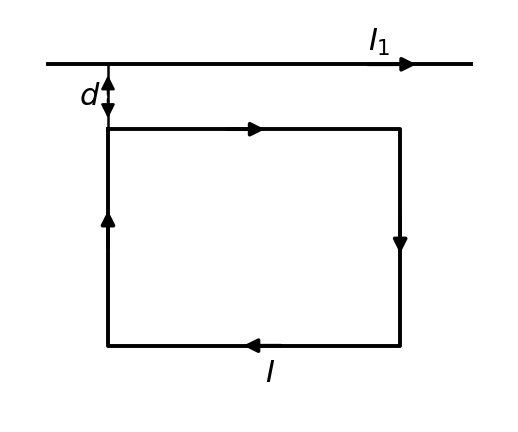
Previous-year questionA square loop carrying a steady current I is placed in a horizontal plane near a long straight conductor carrying a steady current I₁ at a distance d from the conductor as shown in the figure. The loop will experience [AIPMT 2011]
- a net repulsive force away from the conductor
- a net torque acting upward perpendicular to the horizontal plane
- a net torque acting downward normal to the horizontal plane
- a net attractive force towards the conductor
Show answer
Answer: (D) a net attractive force towards the conductor
Explanation: The side of the loop nearest the conductor carries current in the same direction as I₁ and is therefore attracted, while the far side carries it in the opposite direction and is repelled. Since the magnetic force per unit length falls off as 1/d, the attraction on the nearer side exceeds the repulsion on the farther side. The two remaining sides give equal and opposite forces. The net result is an attractive force towards the conductor, and since the loop is coplanar with the wire there is no net torque.
Question 3
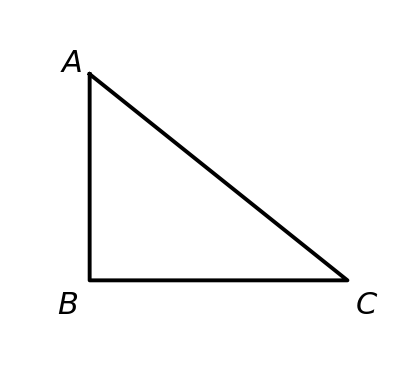
Previous-year questionA current-carrying closed loop in the form of a right-angled isosceles triangle ABC is placed in a uniform magnetic field acting along AB. If the magnetic force on the arm BC is F, the force on the arm AC is [AIPMT 2011]
- −F
- F
- √2 F
- −√2 F
Show answer
Answer: (A) −F
Explanation: For any closed loop in a uniform magnetic field the net force is zero, so F_AB + F_BC + F_CA = 0. The arm AB lies along B, so F_AB = I(L × B) = 0. This leaves F_BC + F_CA = 0, i.e. F_CA = −F_BC = −F.
Question 4
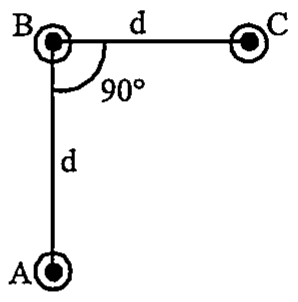
Previous-year questionAn arrangement of three parallel straight wires placed perpendicular to the plane of the paper, carrying the same current 'I' along the same direction, is shown in the figure. The magnitude of force per unit length on the middle wire 'B' is given by [NEET 2017]
- 2μ₀i²/πd
- √2μ₀i²/πd
- μ₀i²/√2πd
- μ₀i²/2πd
Show answer
Answer: (C) μ₀i²/√2πd
Explanation: Wires A and C are each a distance d from B and mutually at right angles as seen from B, so the two forces on B are equal in magnitude μ₀i²/2πd and perpendicular to one another. Their resultant is √2 × μ₀i²/2πd = μ₀i²/√2πd.
Question 5
Previous-year questionA metallic rod of mass per unit length 0.5 kg m⁻¹ is lying horizontally on a smooth inclined plane which makes an angle of 30° with the horizontal. The rod is not allowed to slide down by flowing a current through it when a magnetic field of induction 0.25 T is acting on it in the vertical direction. The current flowing in the rod to keep it stationary is [NEET 2018]
- 7.14 A
- 5.98 A
- 11.32 A
- 14.76 A
Show answer
Answer: (C) 11.32 A
Explanation: With B vertical and the current horizontal along the rod, the magnetic force BIℓ is horizontal. Balancing components along the incline, mg sinθ = BIℓ cosθ, so I = (m/ℓ)g tanθ/B = (0.5)(9.8)(tan 30°)/0.25 ≈ 11.32 A.
Question 6
Previous-year questionA 250-turn rectangular coil of length 2.1 cm and width 1.25 cm carries a current of 85 μA and is subjected to a magnetic field of strength 0.85 T. Work done for rotating the coil by 180° against the torque is [NEET 2017]
- 4.55 μJ
- 2.3 μJ
- 1.15 μJ
- 9.1 μJ
Show answer
Answer: (D) 9.1 μJ
Explanation: The work to turn a dipole from θ = 0 to θ = 180° is W = 2mB = 2NIAB, with A = 0.021 × 0.0125 = 2.625 × 10⁻⁴ m². This gives W = 2(250)(85 × 10⁻⁶)(2.625 × 10⁻⁴)(0.85) ≈ 9.5 × 10⁻⁶ J, and 9.1 μJ, the official NEET answer, is the nearest listed value.
Question 7
Previous-year questionA current-carrying coil is placed in a uniform magnetic field. The coil will orient itself so that its plane becomes [AIPMT 1988]
- inclined at 45° to the magnetic field
- inclined at any arbitrary angle to the magnetic field
- parallel to the magnetic field
- perpendicular to the magnetic field
Show answer
Answer: (D) perpendicular to the magnetic field
Explanation: The coil turns until the torque τ = MB sin θ vanishes with the system in its lowest energy state, i.e. until M is parallel to B. Since M is normal to the plane of the coil, the plane of the coil ends up perpendicular to the field.
Doing well? Create a free account to take timed tests on this topic and see your weak areas.
Question 8
Previous-year questionA straight wire of length 0.5 m carrying a current of 1.2 A is placed in a uniform magnetic field of induction 2 T. If the magnetic field is perpendicular to the length of the wire, the force on the wire is [AIPMT 1992]
- 2.4 N
- 1.2 N
- 3.0 N
- 2.0 N
Show answer
Answer: (B) 1.2 N
Explanation: F = ilB sin θ with θ = 90°, so F = 1.2 × 0.5 × 2 = 1.2 N. This is the maximum possible force for these values, since the wire is perpendicular to the field.
Question 9
Previous-year questionTwo long parallel wires are 1 m apart and each carries a current of 1 A. The force of attraction per unit length between the two wires is [AIPMT 1998]
- 2 × 10⁻⁷ N/m
- 2 × 10⁻⁸ N/m
- 5 × 10⁻⁸ N/m
- 10⁻⁷ N/m
Show answer
Answer: (A) 2 × 10⁻⁷ N/m
Explanation: F/l = μ₀i₁i₂/2πr = (2 × 10⁻⁷ × 1 × 1)/1 = 2 × 10⁻⁷ N/m. This is precisely the situation used in the earlier SI definition of the ampere. Since the currents are in the same direction, the force is attractive.
Question 10
Previous-year questionA current i flows in a coil of area A having N turns. The magnetic moment M of the coil is equal to [AIPMT 2001]
- NiA
- Ni/A
- Ni/√A
- N²Ai
Show answer
Answer: (A) NiA
Explanation: The magnetic dipole moment of a plane current loop of N turns is the product of the number of turns, the current and the area enclosed: M = NiA. Its direction is along the normal to the plane of the coil, given by the right-hand rule.
Question 11
Previous-year questionA coil in the shape of an equilateral triangle of side l is suspended between the pole pieces of a permanent magnet such that B lies in the plane of the coil. If a current i in the triangle produces a torque τ on it, the side l of the triangle is [AIPMT 2005]
- (2/√3)(τ/Bi)^½
- (2/√3)(τ/Bi)
- 2(τ/√3 Bi)^½
- (1/√3)(τ/Bi)
Show answer
Answer: (C) 2(τ/√3 Bi)^½
Explanation: With B in the plane of the coil, M is perpendicular to B, so θ = 90° and τ = MB = iAB. The area of an equilateral triangle is A = (√3/4)l², so τ = i(√3/4)l²B. Solving, l² = 4τ/(√3 Bi), giving l = 2(τ/√3 Bi)^½.
Question 12
Previous-year questionA square current-carrying loop is suspended in a uniform magnetic field acting in the plane of the loop. If the force on one arm of the loop is F, the net force on the remaining three arms of the loop is [AIPMT 2010]
- 3F
- −F
- −3F
- F
Show answer
Answer: (B) −F
Explanation: The net force on any closed current loop placed in a uniform magnetic field is zero. Therefore the force on the remaining three arms must be equal and opposite to the force on the fourth arm, i.e. −F.
Question 13
Previous-year questionA closely wound solenoid of 2000 turns and cross-sectional area 1.5 × 10⁻⁴ m² carries a current of 2.0 A. It is suspended through its centre and perpendicular to its length, allowing it to turn in a horizontal plane in a uniform magnetic field of 5 × 10⁻² tesla making an angle of 30° with the axis of the solenoid. The torque on the solenoid will be [AIPMT 2010]
- 3 × 10⁻³ N m
- 1.5 × 10⁻³ N m
- 1.5 × 10⁻² N m
- 3 × 10⁻² N m
Show answer
Answer: (C) 1.5 × 10⁻² N m
Explanation: The magnetic moment of the solenoid is M = NIA. Hence τ = MB sin θ = NIAB sin θ = 2000 × 2 × 1.5 × 10⁻⁴ × 5 × 10⁻² × sin 30° = 0.6 × 5 × 10⁻² × 0.5 = 1.5 × 10⁻² N m.
Question 14
Previous-year questionA current loop placed in a magnetic field [NEET 2013]
- experiences a torque whether the field is uniform or non-uniform in all orientations
- can be in equilibrium in one orientation
- can be in equilibrium in two orientations, both of which are unstable
- can be in equilibrium in two orientations, one stable while the other is unstable
Show answer
Answer: (D) can be in equilibrium in two orientations, one stable while the other is unstable
Explanation: The torque τ = M × B vanishes when M is parallel to B (θ = 0°, potential energy U = −MB, a minimum — stable equilibrium) and when M is antiparallel to B (θ = 180°, U = +MB, a maximum — unstable equilibrium). Hence there are two equilibrium orientations, one stable and the other unstable.
Question 15
Previous-year questionA rectangular coil of length 0.12 m and width 0.1 m having 50 turns of wire is suspended vertically in a uniform magnetic field of strength 0.2 Wb/m². The coil carries a current of 2 A. If the plane of the coil is inclined at an angle of 30° to the direction of the field, the torque required to keep the coil in stable equilibrium will be [AIPMT 2015]
- 0.15 N m
- 0.20 N m
- 0.24 N m
- 0.12 N m
Show answer
Answer: (B) 0.20 N m
Explanation: The area is A = 0.12 × 0.1 = 0.012 m². If the plane makes 30° with B, the normal (and hence M) makes 60° with B. Therefore τ = NIAB sin θ = 50 × 2 × 0.012 × 0.2 × sin 60° = 0.24 × 0.866 = 0.20 N m.
Want more Force and Torque on Current Carrying Conductor – Force on a current-carrying conductor in a uniform magnetic questions?
E-GYAN NIDHI has 60 questions on this topic and 63,000+ in total, all free: timed CBT tests, NEET marking and instant analysis.
Register free Free Sunday Mock TestMore topics in MAGNETIC EFFECTS OF CURRENT AND MAGNETISM
- Biot Savart's Law and Ampere's Circuital Law – Biot MCQs
- Magnetic Dipole, Bar Magnet and Magnetic Field – Current loop as a magnetic dipole and its magnetic dipole MCQs
- Magnetic Force on Charged Particle in Electric and Magnetic Fields – Force on a moving charge in uniform magnetic and electric MCQs
- Moving Coil Galvanometer MCQs
- Magnetic Dipole in Uniform Magnetic Field – Torque on a magnetic dipole in a uniform magnetic field MCQs
- Magnetic Materials and its Properties – Para MCQs