CARBOXYLIC Acids General methods of preparation, properties, reactions, and uses. Acidic strength and factors affecting it,: NEET MCQs with Answers
15 free questions on CARBOXYLIC Acids General methods of preparation, properties, reactions, and uses. Acidic strength and factors affecting it, for NEET (UG), starting with previous-year NEET and AIPMT questions. Try each one, then tap Show answer for the answer and a short explanation.
Question 1
Previous-year questionThe major product formed when benzene-1,2-dicarboxylic acid is heated strongly with NH₃ is [NEET 2019]
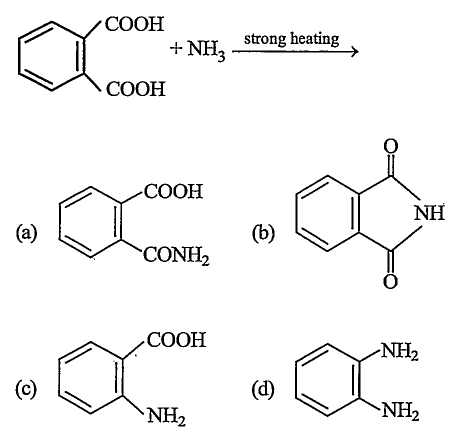
- 2-Carbamoylbenzoic acid
- Phthalimide
- 2-Aminobenzoic acid
- Benzene-1,2-diamine
Show answer
Answer: (B) Phthalimide
Explanation: Strong heating first dehydrates the diacid to phthalic anhydride; ammonia then opens it to the ammonium salt of the amic acid, which cyclises with loss of water to give the cyclic imide, phthalimide.
Question 2
Previous-year questionCarboxylic acids have higher boiling points than aldehydes, ketones and even alcohols of comparable molecular mass. This is due to their [NEET 2018]
- formation of intramolecular H-bonding
- formation of carboxylate ion
- formation of intermolecular H-bonding
- more extensive association via van der Waals forces
Show answer
Answer: (C) formation of intermolecular H-bonding
Explanation: Two molecules of a carboxylic acid associate through a pair of intermolecular hydrogen bonds to form a stable cyclic dimer, so much more energy is needed to separate them than for alcohols, which form only single hydrogen bonds.
Question 3
A substituent X placed at the para position of benzoic acid makes the acid stronger than benzoic acid itself, so that its pKa falls. X can be:
- –OCH₃
- –CH₃
- –CN
- –NH₂
Show answer
Answer: (C) –CN
Explanation: An acid becomes stronger when its conjugate base is stabilised. The cyano group withdraws electrons by –I and –R effects, spreading the negative charge of the carboxylate and lowering the pKa. Amino, methyl and methoxy groups at the para position release electrons, destabilise the carboxylate and raise the pKa.
Question 4
At equal concentrations, which of the following acids is the most ionised in water?
- CH₃CHClCOOH
- CH₃CCl₂COOH
- ClCH₂CH₂COOH
- CH₃CHClCH₂COOH
Show answer
Answer: (B) CH₃CCl₂COOH
Explanation: The degree of ionisation is greatest for the strongest acid. The –I effect of chlorine stabilises the carboxylate ion, and the effect is larger when there are more chlorine atoms and when they are closer to –COOH. 2,2-Dichloropropanoic acid has two chlorines on the α-carbon, so it ionises most.
Question 5
For para-substituted benzoic acids, p-X–C₆H₄–COOH, which substituent X gives the lowest pKₐ?
- –NH₂
- –CN
- –OCH₃
- –CH₃
Show answer
Answer: (B) –CN
Explanation: A lower pKₐ means a stronger acid, which needs a more stabilised carboxylate ion. The cyano group withdraws electrons by –I and –M effects and disperses the negative charge. The methyl, methoxy and amino groups donate electrons, destabilise the carboxylate and raise the pKₐ.
Question 6
Which of the following substituted acetic acids has the lowest pKₐ value?
- Nitroacetic acid, O₂N–CH₂COOH
- Iodoacetic acid, I–CH₂COOH
- Bromoacetic acid, Br–CH₂COOH
- Methoxyacetic acid, CH₃O–CH₂COOH
Show answer
Answer: (A) Nitroacetic acid, O₂N–CH₂COOH
Explanation: The lowest pKₐ belongs to the strongest acid, whose carboxylate ion is best stabilised. The nitro group carries a positively charged nitrogen and exerts a much stronger –I effect than bromine, iodine or a methoxy group. Nitroacetic acid is therefore the strongest acid of the set and has the lowest pKₐ.
Question 7
Propanenitrile is hydrolysed only partly by treating it with cold concentrated HCl. The main organic product is
- propan-1-amine
- propanamide
- propanal
- propanoic acid
Show answer
Answer: (B) propanamide
Explanation: Nitriles are hydrolysed in two stages, first to the amide and then to the carboxylic acid. Under mild conditions, such as cold concentrated acid, the reaction stops at the first stage, so propanenitrile gives propanamide, CH₃CH₂CONH₂. Prolonged heating with acid or alkali would carry it on to propanoic acid. Hydrolysis does not produce an amine or an aldehyde.
Doing well? Create a free account to take timed tests on this topic and see your weak areas.
Question 8
When each of the following is oxidised to carboxylic acid(s), which one gives acid(s) containing fewer carbon atoms than the starting compound?
- CH₃COCH₂CH₃
- CH₃CH₂CH₂CH₂OH
- (CH₃)₂CHCH₂OH
- CH₃CH₂CH₂CHO
Show answer
Answer: (A) CH₃COCH₂CH₃
Explanation: A primary alcohol or an aldehyde is oxidised at the end carbon, which becomes –COOH, so the carbon skeleton is unchanged. A ketone has no hydrogen on its carbonyl carbon and can be oxidised only by strong oxidising agents at higher temperature, which break a carbon–carbon bond next to the carbonyl group. Butanone therefore gives acids such as ethanoic acid, each with fewer carbons than the ketone.
Question 9
An ester is refluxed with aqueous NaOH. When the cooled solution is acidified with dilute HCl, a white crystalline solid separates out. Which ester was taken?
- Methyl benzoate
- Propyl ethanoate
- Ethyl propanoate
- Methyl methanoate
Show answer
Answer: (A) Methyl benzoate
Explanation: Alkaline hydrolysis gives the sodium salt of the acid and the alcohol, and acidification then sets the free carboxylic acid free. Methyl benzoate gives benzoic acid, a white crystalline solid that is only sparingly soluble in cold water, so it separates. The other esters give methanoic, ethanoic or propanoic acid, which are liquids miscible with water, so nothing would separate.
Question 10
Phosphorus pentachloride converts which of the following compounds into an acyl chloride?
- Chloroethane
- Ethanoic acid
- Ethanol
- Ethanal
Show answer
Answer: (B) Ethanoic acid
Explanation: PCl5 replaces the -OH of a carboxylic acid by -Cl, so ethanoic acid gives ethanoyl chloride, CH3COCl, along with POCl3 and HCl. With ethanol the -OH is not attached to a carbonyl carbon, so the product is the alkyl halide chloroethane, not an acyl halide. With ethanal PCl5 replaces the carbonyl oxygen by two chlorine atoms, giving 1,1-dichloroethane, and chloroethane already carries chlorine on a saturated carbon.
Question 11
On treatment with water, which one of the following compounds is hydrolysed to give benzoic acid?
- C₆H₅CH₂Cl
- C₆H₅Cl
- 4-ClC₆H₄OH
- C₆H₅COCl
Show answer
Answer: (D) C₆H₅COCl
Explanation: Benzoyl chloride is an acyl chloride, and acyl chlorides are hydrolysed readily by water to the carboxylic acid and HCl. Benzyl chloride would give benzyl alcohol on hydrolysis, not an acid. In chlorobenzene and 4-chlorophenol the chlorine is bonded to the ring, where the C–Cl bond has partial double bond character and resists hydrolysis; replacing it would in any case give a phenol, not a carboxylic acid.
Question 12
Which of the following compounds liberates carbon dioxide when its aqueous solution is added to sodium hydrogencarbonate solution?
- Ethanal
- Phenol
- Butan-1-ol
- Propanoic acid
Show answer
Answer: (D) Propanoic acid
Explanation: Hydrogencarbonate is a weak base and gives off CO₂ only with acids stronger than carbonic acid. Carboxylic acids are strong enough because the carboxylate ion is stabilised by two equivalent resonance structures. Phenol is a weaker acid than carbonic acid and does not react with NaHCO₃, while an alcohol and an aldehyde are not acidic enough at all. This effervescence is the usual test for a –COOH group.
Question 13
Butanoic acid is warmed with excess bromine in the presence of a small amount of red phosphorus, and a dibromo acid is obtained. What is its structure?
- CH₃CHBrCHBrCOOH
- CH₃CH₂CBr₂COOH
- BrCH₂CH₂CHBrCOOH
- CH₃CH₂CHBrCOBr
Show answer
Answer: (B) CH₃CH₂CBr₂COOH
Explanation: This is the Hell–Volhard–Zelinsky reaction, in which halogen enters only at the α-carbon of a carboxylic acid having α-hydrogens. With excess bromine both α-hydrogens are replaced, so both bromines go onto the carbon next to –COOH. The acyl bromide formed on the way is converted back to the acid, so the product is 2,2-dibromobutanoic acid. The β- and γ-carbons are not attacked.
Question 14
1,2-Dicyclopentylethene, C₅H₉–CH=CH–C₅H₉, is heated with acidified KMnO₄. The main organic product is
- cyclopentanone
- cyclopentanecarbaldehyde
- 1,2-dicyclopentylethane-1,2-diol
- cyclopentanecarboxylic acid
Show answer
Answer: (D) cyclopentanecarboxylic acid
Explanation: Hot acidic permanganate cleaves the C=C bond completely. Each doubly bonded carbon carries one hydrogen, so each fragment is oxidised beyond the aldehyde to a carboxylic acid. Because the alkene is symmetrical, two molecules of cyclopentanecarboxylic acid are formed; the diol would be obtained only with cold dilute alkaline permanganate.
Question 15
Common names of many carboxylic acids come from their natural sources. Which option matches formic acid, acetic acid and butyric acid, in that order, with the sources from which they were first obtained?
- Rancid butter, red ants, vinegar
- Red ants, vinegar, rancid butter
- Red ants, rancid butter, vinegar
- Vinegar, rancid butter, red ants
Show answer
Answer: (B) Red ants, vinegar, rancid butter
Explanation: Formic acid was first obtained from red ants (Latin formica, ant). Acetic acid comes from vinegar (Latin acetum, vinegar). Butyric acid comes from rancid butter (Latin butyrum, butter).
Want more CARBOXYLIC Acids General methods of preparation, properties, reactions, and uses. Acidic strength and factors affecting it, questions?
E-GYAN NIDHI has 96 questions on this topic and 63,000+ in total, all free: timed CBT tests, NEET marking and instant analysis.
Register free Free Sunday Mock TestMore topics in ORGANIC COMPOUNDS CONTAINING OXYGEN
- ALDEHYDE Aldehyde – Nature of carbonyl group MCQs
- ALCOHOLS General methods of preparation, properties, reactions, and uses. Alcohols – Identification of primary MCQs
- PHENOLS General methods of preparation, properties, reactions, and uses. Phenols – Acidic nature MCQs
- ETHERS General methods of preparation, properties, reactions, and uses. Ethers – Structure MCQs
- KETONES General methods of preparation, properties, reactions, and uses. MCQs