ALDEHYDE Aldehyde – Nature of carbonyl group: NEET MCQs with Answers

15 free questions on ALDEHYDE Aldehyde – Nature of carbonyl group for NEET (UG), starting with previous-year NEET and AIPMT questions. Try each one, then tap Show answer for the answer and a short explanation.

Syllabus covered: Nature of carbonyl group; Nucleophilic addition to >C=O group, relative reactivities of aldehydes and ketones; Important reactions such as - Nucleophilic addition reactions (addition of HCN. NH3, and its derivatives), Grignard reagent; oxidation: reduction (Wolf Kishner and Clemmensen); the acidity of -hydrogen. aldol condensation, Cannizzaro reaction. Haloform reaction, Chemical tests to distin…

Question 1

Previous-year question
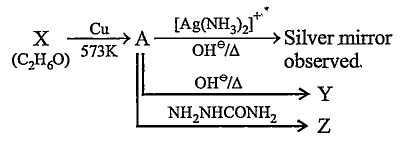
Consider: X (C₂H₆O) with Cu at 573 K gives A, which gives a silver mirror with Tollens' reagent, gives Y with OH⁻/Δ and gives Z with NH₂NHCONH₂. Identify A, X, Y and Z. [NEET 2017]
Figure for question 1
  1. A–Methoxymethane, X–Ethanol, Y–Ethanoic acid, Z–Semicarbazide
  2. A–Ethanal, X–Ethanol, Y–But-2-enal, Z–Semicarbazone
  3. A–Ethanol, X–Acetaldehyde, Y–Butanone, Z–Hydrazone
  4. A–Methoxymethane, X–Ethanoic acid, Y–Acetate ion, Z–Hydrazine
Show answer
Answer: (B) A–Ethanal, X–Ethanol, Y–But-2-enal, Z–Semicarbazone
Explanation: Ethanol dehydrogenated over hot copper gives ethanal, which answers Tollens' test. Base-catalysed aldol condensation of ethanal followed by loss of water gives but-2-enal, while semicarbazide condenses with the –CHO to give the semicarbazone.

Question 2

Previous-year question
The reaction between benzaldehyde and acetophenone in the presence of dilute NaOH is known as [NEET 2020]
  1. Cannizzaro's reaction
  2. Cross Cannizzaro's reaction
  3. Cross aldol condensation
  4. Aldol condensation
Show answer
Answer: (C) Cross aldol condensation
Explanation: Two different carbonyl compounds are involved, only one of which (acetophenone) has α-hydrogens. The enolate of acetophenone adds to benzaldehyde and the aldol loses water, so this is a cross (claisen–Schmidt type) aldol condensation.

Question 3

Previous-year question
The product formed when an aldehyde reacts with a primary amine is [NEET 2016]
  1. A Schiff base
  2. A ketone
  3. A carboxylic acid
  4. An aromatic acid
Show answer
Answer: (A) A Schiff base
Explanation: RCHO + R′NH₂ gives the carbinolamine, which dehydrates to the imine RCH=NR′, generally called a Schiff base.

Question 4

Previous-year question
The correct statement about a carbonyl compound bearing a hydrogen on its α-carbon is [NEET 2016]
  1. it never equilibrates with its corresponding enol
  2. it rapidly equilibrates with its enol, a process called aldehyde–ketone equilibration
  3. it rapidly equilibrates with its enol, a process called carbonylation
  4. it rapidly equilibrates with its corresponding enol, a process known as keto–enol tautomerism
Show answer
Answer: (D) it rapidly equilibrates with its corresponding enol, a process known as keto–enol tautomerism
Explanation: An α-hydrogen can migrate to the carbonyl oxygen with shift of the double bond, setting up a dynamic equilibrium between the keto and enol forms. This constitutional-isomer equilibrium is called keto–enol tautomerism.

Question 5

Previous-year question
A carbonyl compound reacts with a reagent by nucleophilic addition followed by elimination of water. The reagent is [AIPMT 2015]
  1. A Grignard reagent
  2. Hydrazine in a feebly acidic medium
  3. Hydrocyanic acid
  4. Sodium hydrogen sulphite
Show answer
Answer: (B) Hydrazine in a feebly acidic medium
Explanation: Ammonia derivatives such as hydrazine give an unstable carbinolamine that loses water to form the C=N compound. Grignard reagents, HCN and NaHSO₃ all stop at the simple addition stage without dehydration.

Question 6

Previous-year question
Which one is most reactive towards nucleophilic addition? [AIPMT 2014]
Figure for question 6
  1. Benzaldehyde
  2. Acetophenone
  3. p-Tolualdehyde
  4. p-Nitrobenzaldehyde
Show answer
Answer: (D) p-Nitrobenzaldehyde
Explanation: The strongly electron-withdrawing –NO₂ group intensifies the positive charge on the carbonyl carbon, making p-nitrobenzaldehyde the most electrophilic; the +I/+H methyl group in p-tolualdehyde has the opposite effect, and the extra methyl of acetophenone adds steric hindrance too.

Question 7

Toluene is oxidised with chromium(VI) oxide in acetic anhydride to give a compound X, and X is then hydrolysed with dilute aqueous acid. The final organic product is
  1. benzaldehyde
  2. benzyl alcohol
  3. benzyl acetate
  4. benzoic acid
Show answer
Answer: (A) benzaldehyde
Explanation: Chromic oxide in acetic anhydride oxidises the methyl group of toluene, and the aldehyde formed is trapped at once as benzylidene diacetate, C₆H₅CH(OCOCH₃)₂ (X). Trapping the aldehyde this way protects it from further oxidation to benzoic acid. Hydrolysis of the diacetate then releases the free aldehyde, so benzaldehyde is obtained.
Doing well? Create a free account to take timed tests on this topic and see your weak areas.

Question 8

Propanone does NOT form a crystalline derivative with
  1. 2,4-dinitrophenylhydrazine
  2. hydroxylamine
  3. sodium nitrate
  4. sodium hydrogensulphite
Show answer
Answer: (C) sodium nitrate
Explanation: 2,4-Dinitrophenylhydrazine gives a coloured crystalline hydrazone, hydroxylamine gives an oxime, and sodium hydrogensulphite adds across the C=O group of a methyl ketone to give a crystalline addition compound. All of these act as nucleophiles towards the carbonyl carbon. Sodium nitrate supplies no nucleophile that adds to the carbonyl group, so it forms no derivative.

Question 9

In which of the following compounds is a C–H hydrogen removed most easily by a base such as hydroxide ion?
  1. Ethene
  2. Benzene
  3. Propanone
  4. Propane
Show answer
Answer: (C) Propanone
Explanation: The hydrogens on the carbon next to the carbonyl group of propanone are acidic because the carbanion formed is stabilised by resonance, with the negative charge spread onto the electronegative oxygen as an enolate. The C–H bonds of an alkane, an alkene or benzene give anions with no such stabilisation. This is why aldol and haloform reactions start with removal of an α-hydrogen.

Question 10

Arrange the following in decreasing order of reactivity towards CH₃MgBr: (I) HCHO, (II) CH₃COCH₃, (III) CH₃CHO.
  1. II > III > I
  2. III > I > II
  3. I > III > II
  4. I > II > III
Show answer
Answer: (C) I > III > II
Explanation: A Grignard reagent attacks the carbonyl carbon, so reactivity falls as alkyl groups are added around it. Each alkyl group releases electrons and adds steric crowding. Methanal has no alkyl group, ethanal has one and propanone has two, so the order is HCHO > CH₃CHO > CH₃COCH₃.

Question 11

Cyclopentanone is treated with HCN to give B, and B is then heated with concentrated H₂SO₄ to give C. What is C?
  1. 1-hydroxycyclopentane-1-carboxylic acid
  2. cyclopentanecarboxylic acid
  3. cyclopent-1-ene-1-carbonitrile
  4. cyclopent-1-ene-1-carboxylic acid
Show answer
Answer: (D) cyclopent-1-ene-1-carboxylic acid
Explanation: HCN adds across the C=O group to give the cyanohydrin B, 1-hydroxycyclopentane-1-carbonitrile. Hot concentrated sulphuric acid hydrolyses the –CN group to –COOH and also dehydrates the tertiary –OH. The new C=C bond forms in conjugation with the carboxyl group, so C is cyclopent-1-ene-1-carboxylic acid.

Question 12

An aqueous solution containing about 40% methanal, used to preserve biological specimens, is commonly called
  1. glacial acetic acid
  2. carbolic acid
  3. formalin
  4. rectified spirit
Show answer
Answer: (C) formalin
Explanation: A solution of about 40% formaldehyde (methanal) in water is sold as formalin and is used to preserve biological specimens. Carbolic acid is phenol, rectified spirit is about 95% ethanol, and glacial acetic acid is nearly pure ethanoic acid.

Question 13

Which statement best describes the species that propanal can react with?
  1. Both nucleophiles and electrophiles
  2. Only free radicals
  3. Only electrophiles
  4. Only nucleophiles
Show answer
Answer: (A) Both nucleophiles and electrophiles
Explanation: The carbonyl group is polarised, with a partial positive charge on carbon and a partial negative charge on oxygen. Nucleophiles such as HCN, Grignard reagents and ammonia derivatives attack the carbon. Electrophiles also react: H⁺ adds to the oxygen lone pair in acid-catalysed reactions, and halogens attack the α-carbon through the enol.

Question 14

Which statement correctly explains why trichloroethanal, Cl₃C–CHO, does not undergo aldol condensation with dilute alkali?
  1. Its –CHO group is too crowded for any nucleophile to reach
  2. Its three chlorine atoms make the carbonyl carbon too electron-rich
  3. The carbon next to its –CHO group carries no hydrogen
  4. It is a ketone and not an aldehyde
Show answer
Answer: (C) The carbon next to its –CHO group carries no hydrogen
Explanation: Aldol condensation begins when the base removes a hydrogen from the carbon next to the carbonyl group to form an enolate. In Cl₃C–CHO that carbon bears three chlorine atoms and no hydrogen, so no enolate can form. Chlorine actually withdraws electrons and makes the carbonyl carbon more electron-deficient, and the compound is an aldehyde.

Question 15

Benzaldehyde can be converted into benzyl alcohol, with no change in the number of carbon atoms, by treating it with
  1. acidified KMnO₄
  2. zinc amalgam and concentrated HCl
  3. CH₃MgBr followed by H₃O⁺
  4. NaBH₄ followed by water
Show answer
Answer: (D) NaBH₄ followed by water
Explanation: Sodium borohydride delivers a hydride ion to the carbonyl carbon, and work-up gives the primary alcohol C₆H₅CH₂OH. A Grignard reagent would add a methyl group and give 1-phenylethanol. Clemmensen conditions reduce the C=O right down to CH₂, giving toluene, and acidified permanganate oxidises benzaldehyde to benzoic acid.

Want more ALDEHYDE Aldehyde – Nature of carbonyl group questions?

E-GYAN NIDHI has 125 questions on this topic and 63,000+ in total, all free: timed CBT tests, NEET marking and instant analysis.

Register free Free Sunday Mock Test

More topics in ORGANIC COMPOUNDS CONTAINING OXYGEN

↑
